

Kirjojen hintavertailu – 12 859 829 kirjaa ja 27 kauppaa

Kirjailija

Haris M. Khalid

Kirjat ja teokset yhdessä paikassa: 3 kirjaa, julkaisuja vuosilta 2021–2026, suosituimpiin kuuluu Cyberphysical Infrastructures in Power Systems. Vertaile teosten hintoja ja tarkista saatavuus suomalaisista kirjakaupoista.

3 kirjaa

Kirjojen julkaisuvuodet: 2021–2026.

Advanced Grid Technologies, Volume 2

Advanced Grid Technologies, Volume 2

Haris M. Khalid; Abdalla Ismail Alzarooni; S.M. Muyeen; Zhao Yang Dong

Elsevier - Health Sciences Division
2026
nidottu
Advanced Grid Technologies, Volume 2: Communication Networks, Internet-of-Things, Security Layers, Economics, and Policies provides a coherent, practical introduction to the innovative modern techniques required to integrate renewable energy into power grids. This book focuses on essential intelligence technologies for markets, security, and demand response, as well as policy and the solutions each presents to the challenges set by renewable integration. This second volume begins by outlining the major challenges renewable-integrated grids present for communication and security, and provides a clear, coherent comparison between the fundamentals of two potential approaches. An introduction to resilience and stability in the face of unexpected events is provided, including event-triggered control. Finally, the essential aspects of economics and policy are outlined, and the use of Data Centers for mitigating energy management challenges are explained. Including a variety of numerical examples and working from early principles for each topic, Advanced Grid Technologies, Volume 2: Communication Networks, Internet-of-Things, Security Layers, Economics, and Policies provides late-stage undergraduate and graduate students in energy systems and power engineering, as well as engineers working to modernize the power grid, with a fundamental resource for renewable energy integration.
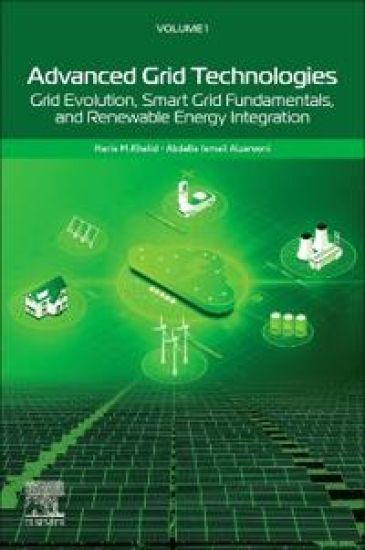
Advanced Grid Technologies, Volume 1

Advanced Grid Technologies, Volume 1

Haris M. Khalid; Abdalla Ismail Alzarooni; S.M. Muyeen; Zhao Yang Dong

Elsevier - Health Sciences Division
2025
nidottu
Advanced Grid Technologies: Grid Evolution, Smart Grid Fundamentals, and Renewable Energy Integration, Volume One provides a coherent, practical introduction to the innovative, modern techniques required to integrate renewable energy into power grids. The book focuses on the basic history of the grid, fundamental aspects of grid management, and the challenges set by renewable integration. It begins by outlining the history of the modern energy grid before providing a comprehensive overview of renewable energy sources, the challenges their use present for typical energy grids, and the fundamentals of modern smart adaptations. Specific major challenges are broken down into fundamentals, including electric vehicles and vehicle-to-grid, energy storage, intelligent electronic device-based substations, and demand forecasting for energy stability. Including a variety of numerical examples and working from early principles for each topic, this book provides late-stage undergraduate and graduate students in energy systems and power engineering, as well as engineers working to modernize the power grid, with a fundamental resource for renewable energy integration.
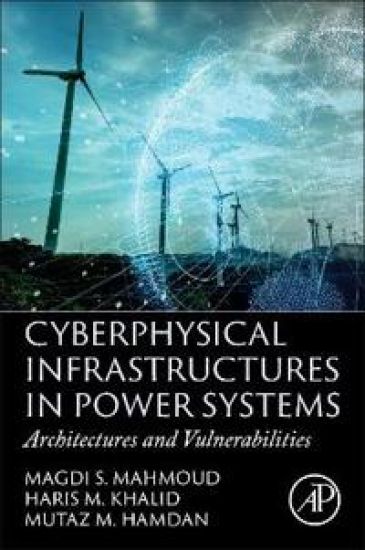
Cyberphysical Infrastructures in Power Systems

Cyberphysical Infrastructures in Power Systems

Magdi S. Mahmoud; Haris M. Khalid; Mutaz M. Hamdan

Academic Press Inc
2021
nidottu
In an uncertain and complex environment, to ensure secure and stable operations of large-scale power systems is one of the biggest challenges that power engineers have to address today. Traditionally, power system operations and decision-making in controls are based on power system computations of physical models describing the behavior of power systems. Largely, physical models are constructed according to some assumptions and simplifications, and such is the case with power system models. However, the complexity of power system stability problems, along with the system's inherent uncertainties and nonlinearities, can result in models that are impractical or inaccurate. This calls for adaptive or deep-learning algorithms to significantly improve current control schemes that solve decision and control problems. Cyberphysical Infrastructures in Power Systems: Architectures and Vulnerabilities provides an extensive overview of CPS concepts and infrastructures in power systems with a focus on the current state-of-the-art research in this field. Detailed classifications are pursued highlighting existing solutions, problems, and developments in this area.