Kirjojen hintavertailu – 12 903 725 kirjaa ja 27 kauppaa

Kirjailija

Harold D. Lasswell

Kirjat ja teokset yhdessä paikassa: 31 kirjaa, julkaisuja vuosilta 1971–2026, suosituimpiin kuuluu Psychopathology and Politics. Vertaile teosten hintoja ja tarkista saatavuus suomalaisista kirjakaupoista.

Nimi esiintyy myös muodoissa: Harold D Lasswell

31 kirjaa

Kirjojen julkaisuvuodet: 1971–2026.

Language of Politics: Studies in Quantitative Semantics

Language of Politics: Studies in Quantitative Semantics

Harold D. Lasswell; Nathan Leites

Literary Licensing, LLC
2011
sidottu
The Language Of Politics: Studies In Quantitative Semantics is a book written by Harold D. Lasswell that delves into the language used in political discourse. The book focuses on the use of quantitative semantics to analyze the language used in political communication. Lasswell argues that the language used in political discourse is often ambiguous and can be interpreted in different ways, which can lead to misunderstandings and miscommunications. The book provides a framework for analyzing the language used in political discourse and offers insights into how politicians use language to manipulate public opinion. The book is a valuable resource for anyone interested in the study of political language and communication. This scarce antiquarian book is a facsimile reprint of the old original and may contain some imperfections such as library marks and notations. Because we believe this work is culturally important, we have made it available as part of our commitment for protecting, preserving, and promoting the world's literature in affordable, high quality, modern editions, that are true to their original work.
The Good Years

The Good Years

Harold D. Lasswell

AldineTransaction
2011
nidottu
The period between 1900 and the First World War could be called the Confident Years, the Buoyant Years, the Spirited Years, or named after some bright, hopeful color, like the Golden Years. It could be done, but such tags are the invention of pundits, social historians, and professional name coiners. To the many varied people who lived through the era - the men and women who wistfully recall marching for suffrage, rebuilding San Francisco, or cheering wildly for Woodrow Wilson - the age was remembered as the Good Years. It was a time of triumph (the Wright brothers) and of tragedy (the Titanic). Days of wealth (a $200,000 ball) and of poverty (a child in a cotton mill earning $3.54 a week). But through it all ran an exciting thread of boundless confidence and hope. No one ever accused the people of that period of national indifference. It is this spirit of uncontested optimism, along with the pageant of great events, that makes this book such rewarding reading. In gathering his material, Walter Lord pored over letters, diaries, unpublished reminiscences, even Pinkerton reports, filled with fascinating and, until now, unknown detail. He traveled thousands of miles and interviewed the people who lived through the period. He met with individuals who firmly believed they had been given the greatest experience anyone could ever have; they knew and enjoyed the years when there was no limit to what we could and would do. Lord's attention to first-hand sources makes this book vivid and timeless. And Leslie Lenkowsky's new introduction adds contemporary dimension to this classic work.

The Analysis of Political Behaviour

The Analysis of Political Behaviour

Harold D. Lasswell

Routledge
2010
nidottu
This is Volume III of eighteen in collection on Political Sociology. Originally published in 1948, this is an empirical approach to the analysis of political behaviour. The present volume contains a selection of Prof. Lasswell's articles and papers on politics— the science and the art of management —written from the point of view of a man deeply[1]intent on making Democracy a working institution. It covers international political experiments and experiences of person-to-person relationships, morals, religion and quasi-religious movements; techniques of public opinion are scrutinized as well as the workings of the mind and the subconscious.
Power and Personality

Power and Personality

Harold D. Lasswell

AldineTransaction
2009
nidottu
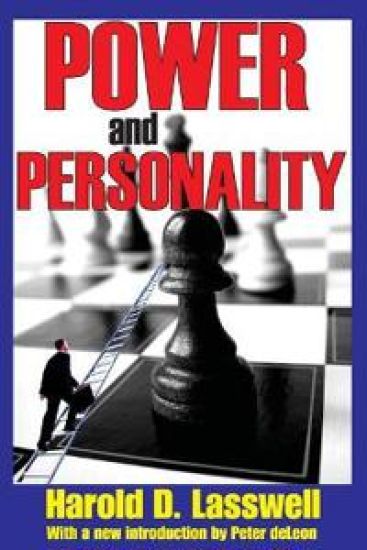
This book concerns the wanting, getting, and giving of power. Recent advances in medicine, sociology, and psychology have deepened our understanding of the motives, skills, and experience that operate between leaders and those who are led. Since power is about decision-making, it figures not only in offi cial institutions but in other organizations, including political parties, pressure groups, trade associations, business enterprises, trade unions, and many other types of organizations. A general theory of the political personality is set forth here. Lasswell describes the process by which power becomes a value of first importance and the way appropriate skills in exercising power are acquired. He shows that special political types such as agitators or administrators are related to basic types of character that contribute to how they lead. Finally, his analysis offers original perspectives to understand democratic leadership. Lasswell offers definite suggestions for perfecting "self-observatories" in national and world affairs and for forming democratic personalities, selecting and training democratic leaders, and reducing destructive conflicts in human relationships. Power and Personality followed the author's 1930 work Psychopathology and Politics, which was widely hailed for its pioneering approach. Power and Personality reevaluated the entire issue of the relationship between psychology and politics in the light of subsequent experience and scientific developments since publication of that earlier work. Lasswell's ideas continue to carry great weight and persuasiveness.
The Analysis of Political Behaviour

The Analysis of Political Behaviour

Harold D. Lasswell

Routledge
1998
sidottu
This is Volume III of eighteen in collection on Political Sociology. Originally published in 1948, this is an empirical approach to the analysis of political behaviour. The present volume contains a selection of Prof. Lasswell's articles and papers on politics— the science and the art of management —written from the point of view of a man deeply[1]intent on making Democracy a working institution. It covers international political experiments and experiences of person-to-person relationships, morals, religion and quasi-religious movements; techniques of public opinion are scrutinized as well as the workings of the mind and the subconscious.
In Defense of Public Order

In Defense of Public Order

R. Arens; Harold D. Lasswell

Praeger Publishers Inc
1985
sidottu
These studies are designed to clarify a field of legal study and professional practice that has begun to emerge only in recent times. The choice of sanction is frequently carried out in improvised, confused, and even contradictory fashion. The main questions that the authors try to answer are: Why bother to extend the meaning of the term sanction to include so much? What do we expect to see accomplished? Arens and Lasswell show that many sanctioning arrangements now current in the U. S. are on their face inconsistent with the articulated goals of the American system of public order, and that in actual operation the goals of our system suffer chronic and substantial defeat.
The Signature of Power

The Signature of Power

Harold D. Lasswell

Transaction Publishers
1978
sidottu
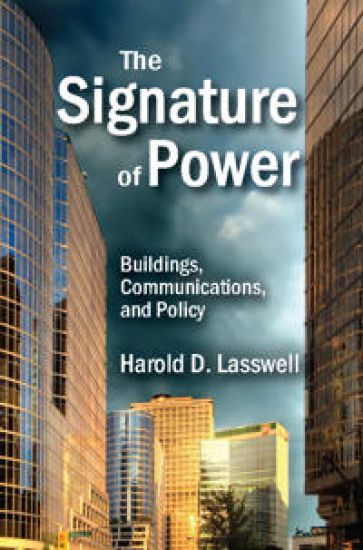
Advanced industrial societies are becoming aware of the impact of what they do to the physical and biological environment, and also what that environment does to individuals. In The Signature of Power, Harold D. Lasswell examines the symbolic use people make of their surroundings and the complexity of the way they interpret an altered environment. Transformed habitats can change experiences and behaviors. All people seek to maximize their preferred events, such as power and wealth, when they use the environment—be it through glass skyscrapers or Gothic estates. In all cases, physical structures give expression to the perspectives of influential individuals and groups. This volume considers the complex interplay between the material and the symbolic. Physical changes introduced for political purposes by architects, planners, and engineers are guided by the perspectives of designers. These and other interactions in human society are simultaneous acts of communication and collaboration. Regardless of whether physical resources are used to transmit messages, such interactions nevertheless have a degree of communicative impact. Physical structures may be profoundly affected by the purposes, assumptions, and identities of those people who plan or change them. Environmental design, says Lasswell, is an instrument of political power.
Propaganda Technique In World War I

Propaganda Technique In World War I

Harold D. Lasswell

MIT Press
1971
pokkari
A classic book on propaganda technique proposes a general theory of the strategy and tactics of propaganda. This classic book on propaganda technique focuses on American, British, French, and German experience in World War I. The book sets forth a simple classification of various psychological materials used to produce certain specific results and proposes a general theory of strategy and tactics for the manipulation of these materials. In an introduction (coauthored by Jackson A. Giddens) written for this edition, Harold Lasswell notes that this study was partially an exercise in the discovery of appropriate theory. It raised the crucial questions of how to classify the content of propaganda-for instance, a distinction is made between "value demands" (war aims, war guilt, and casting the enemy as evil personified) and "expectations" (the illusion of victory)-and how to summarize the procedures employed in organizing and carrying out propaganda operations. Propaganda Technique in World War I deals primarily with problems of internal administration and lateral coordination rather than with the relationship between policymakers and propagandists. However, Jackson Giddens enumerates procedures in the book that illustrate an underlying assumption that decision makers were deeply involved in propaganda and influenced by considerations of public opinion. He takes the study of propaganda further by elaborating on the nature and meaning of the category of "war aims" and its relation to the propagandist, for this, more than any other category of content, "is the catalyst of transnational political action." Giddens's exploration of the development of a comprehensive theory of propaganda adds another dimension to Lasswell's study while confirming its value as outstanding groundwork for continuing research.