Kirjojen hintavertailu – 12 859 819 kirjaa ja 27 kauppaa

Kirjailija

Harold Nicolson

Kirjat ja teokset yhdessä paikassa: 32 kirjaa, julkaisuja vuosilta 1970–2026, suosituimpiin kuuluu Programme for Victory (Works of Harold J. Laski). Vertaile teosten hintoja ja tarkista saatavuus suomalaisista kirjakaupoista.

32 kirjaa

Kirjojen julkaisuvuodet: 1970–2026.

Curzon: The Last Phase, 1919-1925

Curzon: The Last Phase, 1919-1925

Harold Nicolson

Faber Faber
2010
pokkari
In Harold Nicolson's own words 'This study of Lord Curzon represents the third volume of a trilogy on British diplomacy covering the years from 1870 to 1924. The first volume of that trilogy was a biography entitled Lord Carnock: A Study in the Old Diplomacy. The second volume was a critical survey of the Paris conference called Peacemaking, 1919.' All three volumes are reissued in Faber Finds. Curzon himself, not a modest man it must be admitted, rated highly the work of his final years. In his 'Literary Testament' dictated only a few hours before his death he said, 'As to my work as Foreign Secretary from 1918 to 1924 - a period of unparalleled difficulty in international affairs and of great personal worry and sometimes tribulation . . . - I court the fullest publicity as to my conduct in those anxious years and can imagine no better justification than the publication of any or all the telegrams, despatches, minutes and records of interviews for which I was responsible.'Some of the chapter headings alone remind us of what an eventful period it was: Armistice, The Eastern Question, Smyrna, Persia, Egypt, Reparation, Chanak and Lausanne. It is perhaps a pity that Harold Nicolson didn't write the official biography of Lord Curzon (he was a candidate) but what we have here is a work that is, in the words of David Gilmour, another biographer of Curzon, 'acute, jaunty, readable and sympathetic.'
Peacemaking, 1919

Peacemaking, 1919

Harold Nicolson

Faber Faber
2009
nidottu
'Of all branches of human endeavour, diplomacy is the most protean.' That is how Harold Nicolson begins this book. It is an apt opening. The Paris Conference of 1919, attended by thirty-two nations, had the supremely challenging task of attempting to bring about a lasting peace after the global catastrophe of the Great War. Harold Nicolson was a member of the British delegation. His book is in two parts. In the first he provides an account of the conference, in the second his diary covering his six month stint. There is a piquant counterpoise between the two. Of his diary he writes, 'I should wish it to be read as people read the reminiscences of a subaltern in the trenches. There is the same distrust of headquarters; the same irritation against the staff-officer who interrupts; the same belief that one's own sector is the centre of the battle-front; the same conviction that one is, with great nobility of soul, winning the war quite single-handed.' The diary ends with prophetic disillusionment, 'To bed, sick of life.'As a first-hand account of one of the most important events shaping the modern world this book remains a classic.
The Congress of Vienna

The Congress of Vienna

Harold Nicolson

Faber Faber
2009
nidottu
Harold Nicolson was well qualified to write this book. His father, Sir Arthur Nicolson, was a diplomat as he himself was in early adulthood being a member of the British delegation to the Paris Peace Conference of 1919 as well as serving in other capacities. A later historian of the Congress, Adam Zamoyski, has described it in the following way: 'The reconstruction of Europe at the Congress of Vienna is probably the most seminal episode in modern history.' Harold Nicolson's classic account written piquantly just after the Second World War is memorable not just for its adroit grasp of the many complex issues but also for its numerous vivid character sketches of the principal peacemakers: Alexander I of Russia, Metternich, Talleyrand, Castlereagh and others are brought brilliantly to life.'Mr Nicolson has written a vivid, entertaining and penetrating book about an episode in nineteenth-century history with which has gifts and his own education most particularly qualified him to deal. Moreover he often makes valuable generalisations. . . In a short review it is impossible to convey by quotation those qualities which will make it eagerly sought after: its vivid portraits and scenes from the past: its clear analysis of political situations as they arise; its shrewd comments on the characters of the men who dealt with them.' Desmond MacCarthy, Sunday Times Faber Finds is reissuing all of Harold Nicolson's works of diplomatic history: The Congress of Vienna: A Study in Allied Unity, 1812 - 1822; Lord Carnock: A Study in Old Diplomacy: Peacemaking, 1919 and Curzon: The Last Phase, 1919 - 1925.
Diaries and Letters Vol. 3 (1945-1962)

Diaries and Letters Vol. 3 (1945-1962)

Harold Nicolson

Faber Faber
2009
nidottu
Harold Nicolson's Diaries and Letters, spanning the years 1930 to 1962, were first published in three volumes, and it is in this format Faber Finds is reissuing them. The one-volume abridgement available in paperback from Phoenix is practical, and in itself a superb piece of compression, but such a great work, one of the major diaries of the twentieth-century, deserves also to be available in its full original incarnation. In this third volume we see Harold Nicolson, though no longer a Member of Parliament, still deeply involved in public affairs. He joins the Labour Party: he attends the Nuremberg trials: he broadcasts from Paris on the three-months peace-conference of 1946, and he gives an illuminating account of the Suez crisis. But perhaps the most valuable political aspect of this volume, as with the others, is the portraits and private conversation of leading statesmen: Churchill in advancing age, Macmillan on his way up and as Prime Minister, Eden, Smuts, Bevin and many others. 'One of the best diaries in the language' Michael Foot'Nowhere are his style and cultivation more truly reflected than in his diaries and letters, edited with skill and candour by his son Nigel . . . Full of witty and intimate pictures of the famous and immediate comments on the great events of the time, they were very much more than a record of classy hobnobbings, for few excelled Nicolson in the art of self-revelation and no lesser diarist could have made so moving and fascinating a thing of the relationship between himself and his wife, Vita Sackville-West, and his sons.' The Times
Diaries and Letters Vol. 2 (1939-1945)

Diaries and Letters Vol. 2 (1939-1945)

Harold Nicolson

Faber Faber
2009
nidottu
Harold Nicolson's Diaries and Letters, spanning the years 1930 to 1962, were first published in three volumes, and it is in this format Faber Finds is reissuing them. The one-volume abridgement available in paperback from Phoenix is practical, and in itself a superb piece of compression, but such a great work, one of the major diaries of the twentieth-century, deserves also to be available in its full original incarnation. This is the war volume. From the first page to the last Britain was at war. From 1940 to 1941 Harold Nicolson was Parliamentary Secretary to the Ministry of Information; subsequently he was a Governor of the B. B. C. Throughout he was in the perfect position to observe and describe, knowing the chief actors, Churchill, de Gaulle, Eden and many others. He experienced with acute anxiety and mounting excitement the fluctuating fortunes of the war, and came to share a mood of unreasoning faith and simple patriotism with the rest of the country. In July of 1940 he wrote, 'I have always loved England. But now I am in love with England. What a people! What a chance! . . . The chance that by out stubbornness we shall give victory to the world.' 'One stops to marvel at the achievement. Honesty, decency, modesty magnanimity are stamped on every page, as evident as the wit. These are not the normal virtues of successful diarists or would-be politicians, but Harold Nicolson possesses them all.' Michael Foot, Evening Standard'He remains completely unaware that he is tapping out a masterpiece. Brilliant though he is as historian and man of letters, the diary will keep him best remembered. As lively as Creevey or the de Goncourts, Sir Harold is a peer of those classics. Mr Nigel Nicolson has again done a superb job of editing and annotating.' A. P. Ryan, The Times
Diaries and Letters Vol. 1 (1930-1939)

Diaries and Letters Vol. 1 (1930-1939)

Harold Nicolson

Faber Faber
2009
nidottu
Harold Nicolson's Diaries and Letters, spanning the years 1930 to 1962, were first published in three volumes, and it is in this format Faber Finds is reissuing them. The one-volume abridgement available in paperback from Phoenix is practical, and in itself a superb piece of compression, but such a great work, one of the major diaries of the twentieth-century, deserves also to be available in its full original incarnation.'Not only a brilliant picture of English society in the 1930's, but a touching self-portrait of a highly intelligent and civilized man driven by conscience and curiosity to enter politics' Sir Kenneth Clark'Enthralling reading. . . . A sharp, concise and highly intelligent account of his times is provided, at once amusing and serviceable to the historian.' Malcolm Muggeridge, Observer 'One is hardly able to put it down for meals. . . It is very artfully edited for, besides the diary proper, there are many letters to Sir Harold's wife, Vita Sackville-West, and not a few from her to him. But this remains solidly and brillinatly Sir Harold's own book.' Cyril Connolly, Sunday Times
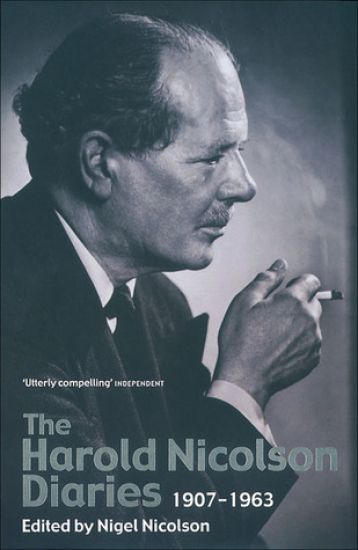
The Harold Nicolson Diaries

The Harold Nicolson Diaries

Harold Nicolson

Weidenfeld Nicolson
2005
pokkari

Halvin toimitettuna 26,90 €

One of the great 20th century political diaries'A tremendous read' SPECTATOR'One stops to marvel at the achievement. Honesty, decency, modesty, magnanimity, are stamped on every page, as evident as the wit' EVENING STANDARDHarold Nicolson was one of the three great political diarists of the 20th century (along with Chips Channon and Alan Clark). Nicolson was an MP (Conservative, 1935-45, who also flirted with Labour after WWII). He had previously been in the Foreign Office and attended the Paris Peace Conference in 1919, and material from his period is included in this new edition for the first time. Nicolson never achieved high office, but rarely a day went by when he didn't record what was going on at Westminster. He socialised widely, was married to the poet and author Vita Sackville-West, and together they created the famous garden at Sissinghurst. Both were bi-sexuals and had affairs outside their marriage. This new edition also draws on diary entries and letters previously considered too sensitive for inclusion. The diversity of Harold Nicolson's interests and the irony in his writing make his diary a highly entertaining record of his life and times, as well as a document of great historical value.