Kirjojen hintavertailu – 12 859 828 kirjaa ja 27 kauppaa

Kirjailija

Harold Rosenberg

Kirjat ja teokset yhdessä paikassa: 7 kirjaa, julkaisuja vuosilta 1983–2021, suosituimpiin kuuluu The Labyrinth. Vertaile teosten hintoja ja tarkista saatavuus suomalaisista kirjakaupoista.

7 kirjaa

Kirjojen julkaisuvuodet: 1983–2021.

Degree Theory of Immersed Hypersurfaces

Degree Theory of Immersed Hypersurfaces

Harold Rosenberg; Graham Smith

American Mathematical Society
2021
nidottu
The authors develop a degree theory for compact immersed hypersurfaces of prescribed $K$-curvature immersed in a compact, orientable Riemannian manifold, where $K$ is any elliptic curvature function. They apply this theory to count the (algebraic) number of immersed hyperspheres in various cases: where $K$ is mean curvature, extrinsic curvature and special Lagrangian curvature and show that in all these cases, this number is equal to $-\chi(M)$, where $\chi(M)$ is the Euler characteristic of the ambient manifold $M$.
Arshile Gorky: The Man, the Time, the Idea

Arshile Gorky: The Man, the Time, the Idea

Harold Rosenberg

Literary Licensing, LLC
2012
sidottu
Arshile Gorky: The Man, The Time, The Idea is a book written by Harold Rosenberg, which provides a comprehensive account of the life and work of Arshile Gorky, an Armenian-American abstract expressionist painter. The book delves into Gorky's personal life, including his childhood in Armenia and his struggles as an immigrant in the United States. It also explores his artistic evolution, from his early figurative paintings to his later abstract works, and his influence on the development of abstract expressionism. Rosenberg's book situates Gorky within the broader cultural and political context of the time, including the impact of the Armenian genocide and World War II on his work. The author also examines Gorky's relationship with other artists, such as Willem de Kooning and Jackson Pollock, and his place within the art world of the 1940s and 1950s. Arshile Gorky: The Man, The Time, The Idea is a valuable resource for anyone interested in the life and work of Arshile Gorky, as well as for those interested in the development of abstract expressionism as a movement in American art. This scarce antiquarian book is a facsimile reprint of the old original and may contain some imperfections such as library marks and notations. Because we believe this work is culturally important, we have made it available as part of our commitment for protecting, preserving, and promoting the world's literature in affordable, high quality, modern editions, that are true to their original work.
The Tradition Of The New

The Tradition Of The New

Harold Rosenberg

Da Capo Press Inc
1994
pokkari
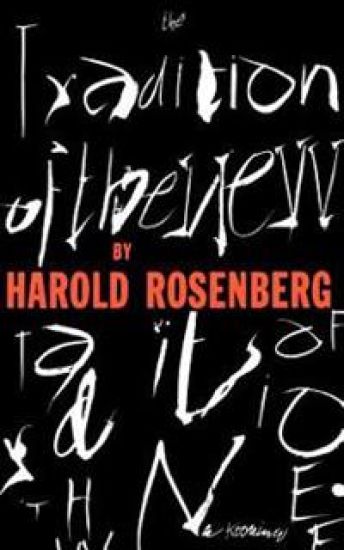
Harold Rosenberg was undoubtedly the most important American art critic of the twentieth century. It was he who first coined the term "Action Painters" to refer to the American Abstract Expressionists such as Pollock, Kline, and de Kooning. Rosenberg's seminal writings on this movement, as well as on other artists such as Newman and Rothko, appear in The Tradition of the New (1959), his first and most influential book its effects on subsequent art criticism, and the practice of art itself, are still felt today. The essays in this book are not limited to the art world, however: He also discusses poetry, political and cultural theory, and popular culture. As wide-ranging, independent, and deeply probing as the essays of Walter Benjamin, Harold Rosenberg's The Tradition of the New is a true classic of twentieth-century criticism.
The De-Definition of Art

The De-Definition of Art

Harold Rosenberg

University of Chicago Press
1983
nidottu
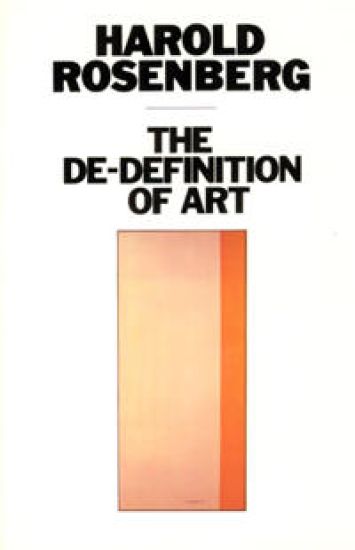
"Like the great German critic Walter Benjamin, Rosenberg is a master of dialectics whose sense of art is continuous with his sense of society, and (also like Benjamin) bears no taint of compromised, out-of-work radicalism. Instead, his radicalism is very much at work, enabling him to spot and skewer fallacies, false logic and the camouflaged nudity that is a large part of the art emperor's new wardrobe. [The De-definition of Art] detects with great sensitivity the forces that are deflecting and pressuring art in the direction of esthetic and moral nullity."—Jack Kroll, Newsweek
Art on the Edge

Art on the Edge

Harold Rosenberg

University of Chicago Press
1983
nidottu
Discusses the aesthetic orientations and creative directions of prominent contemporary artists as well as the nature and implications of the various modern movements