Kirjojen hintavertailu – 12 859 828 kirjaa ja 27 kauppaa

Kirjailija

Harold T. Shapiro

Kirjat ja teokset yhdessä paikassa: 4 kirjaa, julkaisuja vuosilta 2000–2016, suosituimpiin kuuluu A Larger Sense of Purpose. Vertaile teosten hintoja ja tarkista saatavuus suomalaisista kirjakaupoista.

4 kirjaa

Kirjojen julkaisuvuodet: 2000–2016.

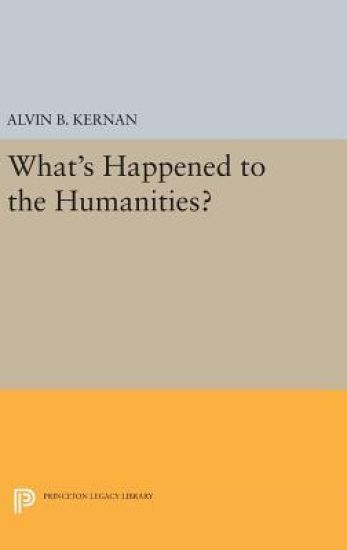
What's Happened to the Humanities?

What's Happened to the Humanities?

William G. Bowen; Harold T. Shapiro

Princeton University Press
2016
sidottu
This volume of specially commissioned original essays presents the thoughts of some of the most distinguished commentators within the American academy on the fundamental changes that have taken place in the humanities in the latter part of the twentieth century. In the transformation of American higher education from the university to the "demoversity," the humanities have become a less and less important part of education, a matter established by a statistical appendix and elaborated on in several of the essays. The individual essays offer close observations into how the humanities have been affected by declining academic status, by demographic shifts, by reductions in financial support, and by changing communication technology. They also explore the effect of these forces on books, libraries, and the phenomenology of reading in the age of images. When basic conditions change, theory follows, and several essays trace the appearance and effect of new relativistic epistemologies in the humanities. Social institutions change as well in such circumstances, and the volume concludes with studies of the new social arrangements that have developed in the humanities in recent years: the attack on professionalism and the effort to transform the humanities into the social conscience of academia and even of the nation as a whole. Cause and effect? Who can say? What the essays make clear, however, is that as the humanities have become less significant in American higher education, they have also been the scene of unusually energetic pedagogical, social, and intellectual changes. The contributors to the volume are David Bromwich, John D'Arms, Denis Donoghue, Carla Hesse, Gertrude Himmelfarb, Lynn Hunt, Frank Kermode, Louis Menand, Francis Oakley, Christopher Ricks, and Margery Sabin. Included is a substantial introduction by Alvin Kernan and an appendix of tables and figures showing baccalaureate and doctoral degrees over the years in various types of schools. Originally published in 1997. The Princeton Legacy Library uses the latest print-on-demand technology to again make available previously out-of-print books from the distinguished backlist of Princeton University Press. These editions preserve the original texts of these important books while presenting them in durable paperback and hardcover editions. The goal of the Princeton Legacy Library is to vastly increase access to the rich scholarly heritage found in the thousands of books published by Princeton University Press since its founding in 1905.
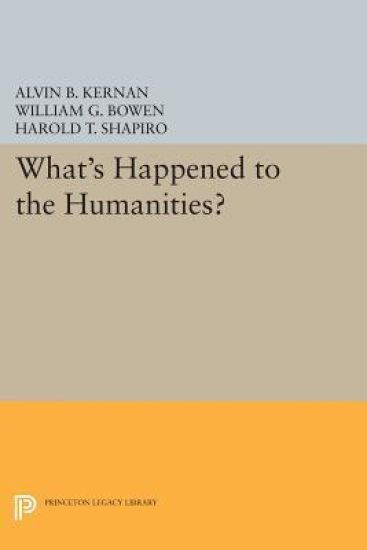
What's Happened to the Humanities?

What's Happened to the Humanities?

William G. Bowen; Harold T. Shapiro

Princeton University Press
2014
pokkari
This volume of specially commissioned original essays presents the thoughts of some of the most distinguished commentators within the American academy on the fundamental changes that have taken place in the humanities in the latter part of the twentieth century. In the transformation of American higher education from the university to the "demoversity," the humanities have become a less and less important part of education, a matter established by a statistical appendix and elaborated on in several of the essays. The individual essays offer close observations into how the humanities have been affected by declining academic status, by demographic shifts, by reductions in financial support, and by changing communication technology. They also explore the effect of these forces on books, libraries, and the phenomenology of reading in the age of images. When basic conditions change, theory follows, and several essays trace the appearance and effect of new relativistic epistemologies in the humanities. Social institutions change as well in such circumstances, and the volume concludes with studies of the new social arrangements that have developed in the humanities in recent years: the attack on professionalism and the effort to transform the humanities into the social conscience of academia and even of the nation as a whole. Cause and effect? Who can say? What the essays make clear, however, is that as the humanities have become less significant in American higher education, they have also been the scene of unusually energetic pedagogical, social, and intellectual changes. The contributors to the volume are David Bromwich, John D'Arms, Denis Donoghue, Carla Hesse, Gertrude Himmelfarb, Lynn Hunt, Frank Kermode, Louis Menand, Francis Oakley, Christopher Ricks, and Margery Sabin. Included is a substantial introduction by Alvin Kernan and an appendix of tables and figures showing baccalaureate and doctoral degrees over the years in various types of schools. Originally published in 1997. The Princeton Legacy Library uses the latest print-on-demand technology to again make available previously out-of-print books from the distinguished backlist of Princeton University Press. These editions preserve the original texts of these important books while presenting them in durable paperback and hardcover editions. The goal of the Princeton Legacy Library is to vastly increase access to the rich scholarly heritage found in the thousands of books published by Princeton University Press since its founding in 1905.
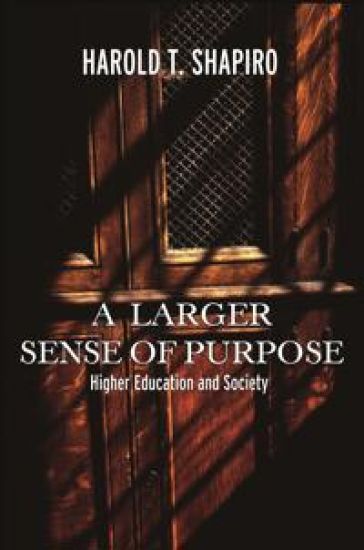
A Larger Sense of Purpose

A Larger Sense of Purpose

Harold T. Shapiro

Princeton University Press
2005
sidottu
Universities were once largely insular institutions whose purview extended no further than the campus gates. Not anymore. Today's universities have evolved into multifaceted organizations with complex connections to government, business, and the community. This thought-provoking book by Harold Shapiro, former president of both Princeton University and the University of Michigan, and Chairman of the National Bioethics Advisory Commission under President Bill Clinton, explores the role the modern university should play as an ethical force and societal steward. Based on the 2003 Clark Kerr lectures, A Larger Sense of Purpose draws from Shapiro's twenty-five years of experience leading major research universities and takes up key topics of debate in higher education. What are the nature and objectives of a liberal education? How should universities address the increasing commercialization not only of intercollegiate sports but of education and research? What are the university's responsibilities for the moral education of students? The book begins with an expanded history of the modern research institution followed by essays on ethics, the academic curriculum, the differences between private and public higher education, the future of intellectual property rights, and the changing relationship between the nation's universities and the for-profit sector. Shapiro calls for universities to be more accountable morally as well as academically. He urges scientists not only to educate others about the potential and limitations of science but also to acknowledge the public's distress over the challenges presented by the very success of the scientific enterprise. He advocates for a more intimate connection between professional training and the liberal arts--in the hope that future doctors, lawyers, and business executives will be educated in ethics and the social sciences as well as they are in anatomy, torts, and leveraged buyouts. Candid, timely, and provocative, A Larger Sense of Purpose demands the attention of not only those in academics but of anyone who shares an interest in the soul of education.
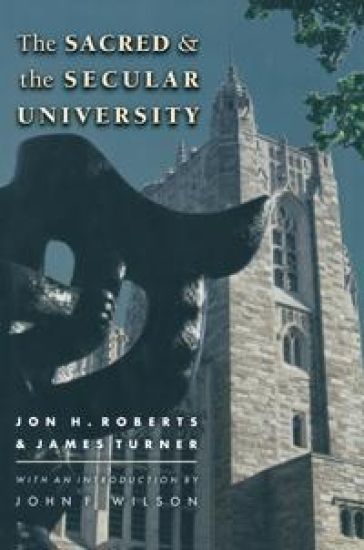
The Sacred and the Secular University

The Sacred and the Secular University

Jon H. Roberts; James Turner; William G. Bowen; Harold T. Shapiro

Princeton University Press
2000
sidottu
American higher education was transformed between the end of the Civil War and the beginning of World War I. During this period, U. S. colleges underwent fundamental changes--changes that helped to create the modern university we know today. Most significantly, the study of the sciences and the humanities effectively dissolved the Protestant framework of learning by introducing a new secularized curriculum. This secularization has long been recognized as a decisive turning point in the history of American education. Until now, however, there has been remarkably little attention paid to the details of how this transformation came about. Here, at last, Jon Roberts and James Turner identify the forces and explain the events that reformed the college curriculum during this era. The first section of the book examines how the study of science became detached from theological considerations. Previously, one of the primary pursuits of "natural scientists" was to achieve an understanding of the workings of the divine in earthly events. During the late nineteenth century, however, scientists reduced the scope of their inquiries to subjects that could be isolated, measured, and studied objectively. In pursuit of "scientific truth," they were drawn away from the larger "truths" that they had once sought. On a related path, social scientists began to pursue the study of human society more scientifically, attempting to generalize principles of behavior from empirically observed events. The second section describes the revolution that occurred in the humanities, beginning in the mid-nineteenth century, when the study of humanities was largely the study of Greek and Latin. By 1900, however, the humanities were much more broadly construed, including such previously unstudied subjects as literature, philosophy, history, and art history. The "triumph of the humanities" represented a significant change in attitudes about what constituted academic knowledge and, therefore, what should be a part of the college curriculum. The Sacred and the Secular University rewrites the history of higher education in the United States. It will interest all readers who are concerned about American universities and about how the content of a "college education" has changed over the course of the last century. "[Jon Roberts and James Turner's] thoroughly researched and carefully argued presentations invite readers to revisit stereotypical generalizations and to rethink the premises developed in the late nineteenth century that underlie the modern university. At the least, their arguments challenge crude versions of the secularization thesis as applied to higher education."--From the foreword by William G. Bowen and Harold T. Shapiro