Kirjojen hintavertailu – 12 903 732 kirjaa ja 27 kauppaa

Kirjailija

Harold Wolman

Kirjat ja teokset yhdessä paikassa: 5 kirjaa, julkaisuja vuosilta 2015–2023, suosituimpiin kuuluu Nation's Metropolis. Vertaile teosten hintoja ja tarkista saatavuus suomalaisista kirjakaupoista.

5 kirjaa

Kirjojen julkaisuvuodet: 2015–2023.

Nation's Metropolis

Nation's Metropolis

Royce Hanson; Harold Wolman

UNIVERSITY OF PENNSYLVANIA PRESS
2023
sidottu
Nation's Metropolis describes how the national capital region functions as a metropolitan political economy. Its authors distinguish aspects of the Washington region that reflect its characteristics as a national capital from those common to most other metropolitan regions and to other capitals. To do so, they employ an interdisciplinary approach that draws from economics, political science, sociology, geography, and history. Royce Hanson and Harold Wolman focus on four major themes: the federal government as the region's basic industry and its role in economic, physical, and political development; race as a core force in the development of the metropolis; the mismatch of the governance and economy of the national capital region; and the conundrum of achieving fully democratic governance for Washington, DC. Critical regional issues and policy problems are analyzed in the context of these themes, including poverty, inequality, education, housing, transportation, water supply, and governance. The authors conclude that the institutions and practices that accrued over the nineteenth and twentieth centuries are inadequate for dealing effectively with the issues confronting the city and the region in the twenty-first. The accumulation of problems arising from the unique role of the federal government and the persistent problem of racial inequality has been compounded by failure to resolve the conundrum of governance for the District of Columbia. They recommend rethinking the governance of the entire region. While many books are concerned with the city of Washington, DC, Nation's Metropolis is the only book focused on the development and political economy of the metropolitan region as a whole. It will engage readers interested in the national capital, metropolitan development more generally, and the growing comparative literature on national capitals.
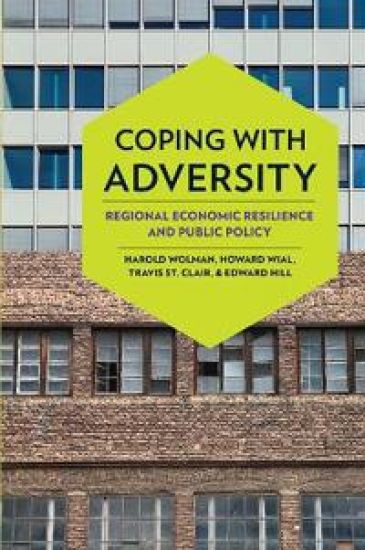
Coping with Adversity

Coping with Adversity

Harold Wolman; Howard Wial; Travis St. Clair; Edward Hill

Cornell University Press
2017
sidottu
Coping with Adversity addresses the question of why some metropolitan-area regional economies are resilient in the face of economic shocks and chronic distress while others are not. It is particularly concerned with what public policies make a difference in whether a region is resilient. The authors employ a wide range of techniques to examine the experience of all metropolitan area economies from 1978–2014. They then look closely at six American metropolitan areas to determine what strategies were employed, which of these contributed to regional economic resilience, and which did not. Charlotte, North Carolina, Seattle, Washington, and Grand Forks, North Dakota, are cases of economic resilience, while Cleveland, Ohio, Hartford, Connecticut, and Detroit, Michigan, are cases of economic nonresilience. The six case studies include hard data on employment, production, and demographics, as well as material on public policies and actions. The authors conclude that there is little that can done in the short term to counter economic shocks; most regions simply rebound naturally after a relatively short period of time. However, they do find that many regions have successfully emerged from periods of prolonged economic distress and that there are policies that can be applied to help them do so. Coping with Adversity will be important reading for all those concerned with local and regional economic development, including public officials, urban planners, and economic developers.
Coping with Adversity

Coping with Adversity

Harold Wolman; Howard Wial; Travis St. Clair; Edward Hill

Cornell University Press
2017
pokkari
Coping with Adversity addresses the question of why some metropolitan-area regional economies are resilient in the face of economic shocks and chronic distress while others are not. It is particularly concerned with what public policies make a difference in whether a region is resilient. The authors employ a wide range of techniques to examine the experience of all metropolitan area economies from 1978–2014. They then look closely at six American metropolitan areas to determine what strategies were employed, which of these contributed to regional economic resilience, and which did not. Charlotte, North Carolina, Seattle, Washington, and Grand Forks, North Dakota, are cases of economic resilience, while Cleveland, Ohio, Hartford, Connecticut, and Detroit, Michigan, are cases of economic nonresilience. The six case studies include hard data on employment, production, and demographics, as well as material on public policies and actions. The authors conclude that there is little that can done in the short term to counter economic shocks; most regions simply rebound naturally after a relatively short period of time. However, they do find that many regions have successfully emerged from periods of prolonged economic distress and that there are policies that can be applied to help them do so. Coping with Adversity will be important reading for all those concerned with local and regional economic development, including public officials, urban planners, and economic developers.
Urban Neighborhoods in a New Era

Urban Neighborhoods in a New Era

Clarence N. Stone; Robert P. Stoker; John Betancur; Susan E. Clarke; Marilyn Dantico; Martin Horak; Karen Mossberger; Juliet Musso; Jefferey M. Sellers; Ellen Shiau; Harold Wolman; Donn Worgs

University of Chicago Press
2015
nidottu
For decades, North American cities racked by deindustrialization and population loss have followed one primary path in their attempts at revitalization: a focus on economic growth in downtown and business areas. Neighborhoods, meanwhile, have often been left severely underserved. There are, however, signs of change. This collection of studies by a distinguished group of political scientists and urban planning scholars offers a rich analysis of the scope, potential, and ramifications of a shift still in progress. Focusing on neighborhoods in six cities-Baltimore, Chicago, Denver, Los Angeles, Phoenix, and Toronto-the authors show how key players, including politicians and philanthropic organizations, are beginning to see economic growth and neighborhood improvement as complementary goals. The heads of universities and hospitals in central locations also find themselves facing newly defined realities, adding to the fluidity of a new political landscape even as structural inequalities exert a continuing influence. While not denying the hurdles that community revitalization still faces, the contributors ultimately put forth a strong case that a more hospitable local milieu can be created for making neighborhood policy. In examining the course of experiences from an earlier period of redevelopment to the present postindustrial city, this book opens a window on a complex process of political change and possibility for reform.
Urban Neighborhoods in a New Era

Urban Neighborhoods in a New Era

Clarence N. Stone; Robert P. Stoker; John Betancur; Susan E. Clarke; Marilyn Dantico; Martin Horak; Karen Mossberger; Juliet Musso; Jefferey M. Sellers; Ellen Shiau; Harold Wolman; Donn Worgs

University of Chicago Press
2015
sidottu
For decades, North American cities racked by deindustrialization and population loss have followed one primary path in their attempts at revitalization: a focus on economic growth in downtown and business areas. Neighborhoods, meanwhile, have often been left severely underserved. There are, however, signs of change. This collection of studies by a distinguished group of political scientists and urban planning scholars offers a rich analysis of the scope, potential, and ramifications of a shift still in progress. Focusing on neighborhoods in six cities-Baltimore, Chicago, Denver, Los Angeles, Phoenix, and Toronto-the authors show how key players, including politicians and philanthropic organizations, are beginning to see economic growth and neighborhood improvement as complementary goals. The heads of universities and hospitals in central locations also find themselves facing newly defined realities, adding to the fluidity of a new political landscape even as structural inequalities exert a continuing influence. While not denying the hurdles that community revitalization still faces, the contributors ultimately put forth a strong case that a more hospitable local milieu can be created for making neighborhood policy. In examining the course of experiences from an earlier period of redevelopment to the present postindustrial city, this book opens a window on a complex process of political change and possibility for reform.