Kirjojen hintavertailu – 12 859 819 kirjaa ja 27 kauppaa

Kirjailija

Harriet Martineau

Kirjat ja teokset yhdessä paikassa: 420 kirjaa, julkaisuja vuosilta 1828–2026, suosituimpiin kuuluu Four Plays of Gil Vicente (Edition1). Vertaile teosten hintoja ja tarkista saatavuus suomalaisista kirjakaupoista.

420 kirjaa

Kirjojen julkaisuvuodet: 1828–2026.

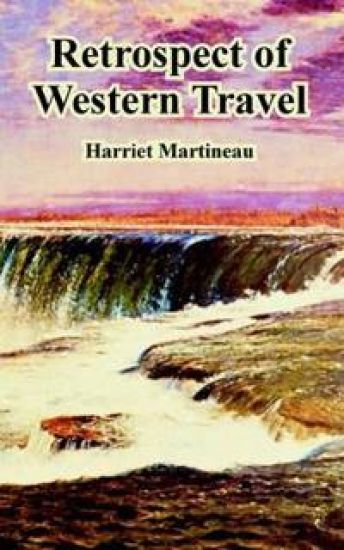
Retrospect of Western Travel

Retrospect of Western Travel

Harriet Martineau

University Press of the Pacific
2005
pokkari
A of the 1838 edition of Martineau's famed travel account of the United States in the Jacksonian era. Despite the hostile reception accorded some of Mrs. Martineau's comments on slavery, her perceptive observations on American life in the 1830's have particular relevance to today's student of history. This is the complete and unabridged edition. This title is cited and recommended by Books for College Libraries; Guide to the Study of the United States of America; Usiana; Literature of American History; and the Cambridge Bibliography of English Literature.
Illustrations of Political Economy

Illustrations of Political Economy

Harriet Martineau

Broadview Press Ltd
2004
pokkari
Published in 1832, Illustrations of Political Economy established Harriet Martineau as both a successful and controversial author and a pioneer of nineteenth-century "social problem" writing. This widely read series of didactic stories popularized political economy, making it accessible to audiences by vividly dramatizing issues such as overpopulation and labour strikes. Illustrations of Political Economy marks a pivotal moment in which literature and politics came together, laying the foundation for the realism and social commentary of later Victorian novels. This Broadview edition contains a critical introduction and a rich selection of historical documents, including contemporary reviews of Illustrations and writings on population growth, factory conditions, and working-class life.
Life in the Sick-Room

Life in the Sick-Room

Harriet Martineau

Broadview Press Ltd
2003
pokkari
Believing herself to be suffering from an incurable condition, Harriet Martineau wrote Life in the Sick-Room in 1844. In this work, which is both memoir and treatise, Martineau seeks to educate the healthy and ill alike on the spiritual and psychological dimensions of chronic suffering. Covering such topics as "Sympathy to the Invalid," "Temper," and "Becoming Inured," the work occupies a crucial place in the culture of invalidism that prospered in Victorian England. This Broadview edition also includes medical documents pertaining to Martineau's case; other writings on health by Martineau; excerpts from her other autobiographical writings; selected correspondence with Florence Nightingale; excerpts from contemporary works of sick-room literature; and reviews.
Writings on Slavery and the American Civil War

Writings on Slavery and the American Civil War

Harriet Martineau

Northern Illinois University Press
2002
sidottu
A leading social reformer and pioneering abolitionist, British journalist Harriet Martineau fueled the debate over the abolition of slavery that raged on both sides of the Atlantic before the American Civil War. Her impassioned writings about abolition-with more than fifty essays and articles collected in this premier annotated edition-provide piercing insights into American society, politics, and the issue of slavery. Determined to give a fair, objective hearing to both sides of the American slavery debate, Martineau crossed the ocean in 1834 and discovered a nation in turmoil. As a prominent writer, she was vigorously courted by both opponents and supporters of slavery who sought her endorsement for their political cause. From northern mansions to southern plantations, from Congress and President Jackson's White House to hospitals, factories, and slave quarters, people opened their doors to Martineau, providing her an unusually comprehensive view of American life. Shocked by the intensity of the controversy over slavery, and inspired by the bravery and defiance of abolitionists who campaigned in the face of social pressure and physical danger, Martineau publicly declared her support of abolition in 1835. Joining the ranks of the abolitionists made Martineau a prime target for persecution, and the remainder of her stay in America was fraught with death threats. She returned to England and promoted her cause by writing for the British periodical press, a career that would span the next thirty-five years. Martineau's friend and fellow abolitionist William Lloyd Garrison praised her as a "social heretic" whose compulsion to uphold the moral ground of human dignity and freedom outweighed any concern with popular opinions about her character or reputation. Twenty years after her dramatic American tour, Martineau wrote with pride that her name was "still reviled" in the South. One of the first women to earn a living by her pen, Martineau never faltered in the lifelong crusade that placed her in the forefront of political and social reform efforts. Writings on Slavery and the American Civil War conveys one woman's persistent call for absolute, immediate, and universal emancipation.
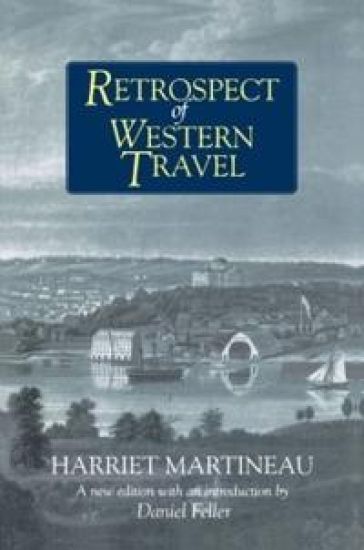
Retrospect of Western Travel

Retrospect of Western Travel

Harriet Martineau; Daniel Feller

Routledge
2000
nidottu
This abridged version of Harriet Martineau's narrative of her travels in Jacksonian America preserves her reporting on slavery and other current topics of the day, as well as her insights on women's place in society, and her observations and vignettes of famous people such as John Calhoun.
Retrospect of Western Travel

Retrospect of Western Travel

Harriet Martineau; Daniel Feller

Routledge
1998
sidottu
This abridged version of Harriet Martineau's narrative of her travels in Jacksonian America preserves her reporting on slavery and other current topics of the day, as well as her insights on women's place in society, and her observations and vignettes of famous people such as John Calhoun.
Selected Letters

Selected Letters

Harriet Martineau

Oxford University Press
1991
sidottu
Harriet Martineau, versatile woman of letters, philosopher, and economist, was at the heart of Victorian literary and social life. This is the first wide-ranging selection of her letters to a variety of correspondents, most of them major figures in Victorian political and literary history. Controversial because of Martineau's lifelong resistance to the future publication of her private correspondence, the letters reveal her outspoken views on contemporary writers, the working classes, women's role in society, political change, illness, mesmerism, and her own writing. Her opinions on literary realism and George Eliot, biography and Mrs Gaskell's Life of Charlotte Brontë, and Elizabeth Barrett's contribution to modern poetry are among the topics aired in these unashamedly forthright and often bigoted letters. Yet in her Autobiography, Harriet Martineau agrees with her friends `that it would be rather an advantage' to her than otherwise, to be known by her private letters. They allow the modern reader to enter fully into the spirit of Victorian social and literary controversy.
How to Observe Morals and Manners

How to Observe Morals and Manners

Harriet Martineau

Transaction Publishers
1988
nidottu
How to Observe Morals and Manners is the first systematic and substantive treatise on the methodology of sociological research. First published in 1838 and long out of print, this new edition presents for modern students research techniques used by those whose work has been the foundation for present-day social science. The book is based upon two years of intensive field research in the United States, and is a pioneering benchmark for all subsequent methodology texts in sociology. Martineau charts a comprehensive guide to sociological observation, exploring problems of bias, hasty generalization, samples, reactivity, interviews, participant observation, corroboration, and data recording techniques. Couching her observations as advice to travellers visiting foreign lands, she warns against preconceptions and urges strict reporting of observed patterns of cross-sections of social life. She also illustrates how to use interview data to corroborate observational data. Pragmatic tips and specific questions are suggested for exploring the major institutions of society, including religion, education, marriage, popular culture, markets, prisons, police, media, government, fine arts, and charities. Intended as a treatise on methodology, the book is also an insightful work of theory. Before Marx, and well before Durkheim and Weber, Martineau examined social class, forms of religion, types of suicide, national character, domestic relations and the status of women, delinquency and criminology, and the intricate interrelationships between social institutions and the individual. The book will be of interest to sociologists, geographers, anthropologists, historians, and researchers in women's studies. The introduction by Michael R. Hill locates the book within Martineau's overall epistemology of social analysis, revealing her to be a reflexive, critical, and scientific pioneer of sociological thought.

Society in America

Society in America

Harriet Martineau

Transaction Publishers
1981
nidottu
Harriet Martineau brought to her observations the convictions of a vehement English liberal and an astonishingly modern sociological approach. In 1834 she wrote the first draft of How to Observe Manners and Morals--perhaps the earliest book on the methodology of social research. In abridging the 800-page original for the modern reader, Lipset has concentrated on Martineau's brilliant discussion of religious practices, social status, and childrearing; political apathy and the position of women, blacks, and immigrants; and the American's casual approach to indebtedness and his speculative wealth-or-ruin schemes.
Household Education

Household Education

Harriet Martineau

Cosimo Classics
1828
pokkari
"Every member of the household-children, servants, apprentices-every inmate of the dwelling, must have a share in the family plan; or those who make it are despots, and those who are excluded are slaves." - Harriet Martineau, Household Education (1849)Household Education (1848), one of Harriet Martineau's most popular books, encouraged readers to believe that a woman's domestic and academic education be considered equally and criticized the lack of emphasis on formal education of young girls at that time. Further, she dismissed the time period's common ideas of command and obedience in favor of freedom and rationality. Acclaimed as one of the 100 best nonfiction books by "The Guardian" (2017), this book of empowerment of the time period is a must-read for those who wish to delve into Victorian history, sociology, and feminism.