Kirjojen hintavertailu – 12 903 725 kirjaa ja 27 kauppaa

Kirjailija

Harry G. Broadman

Kirjat ja teokset yhdessä paikassa: 4 kirjaa, julkaisuja vuosilta 2004–2017, suosituimpiin kuuluu Natural Gas Markets After Deregulation. Vertaile teosten hintoja ja tarkista saatavuus suomalaisista kirjakaupoista.

4 kirjaa

Kirjojen julkaisuvuodet: 2004–2017.

Natural Gas Markets After Deregulation

Natural Gas Markets After Deregulation

Harry G. Broadman; W. David Montgomery

Routledge
2017
nidottu
Originally published in 1983, Broadman and Montgomery present an agenda for further research into deregulated natural gas markets by relating natural gas production, transmission and distribution with the economic function of contracts and local distribution companies. This work raises fundamental issues that could arise with the deregulation of the natural gas industry and outlines analytical methods that could be used to predict any problems that might arise and possible changes to policy. This title is of interest to students of Environmental Studies and professionals.
Natural Gas Markets After Deregulation

Natural Gas Markets After Deregulation

Harry G. Broadman; W. David Montgomery

Routledge
2015
sidottu
Originally published in 1983, Broadman and Montgomery present an agenda for further research into deregulated natural gas markets by relating natural gas production, transmission and distribution with the economic function of contracts and local distribution companies. This work raises fundamental issues that could arise with the deregulation of the natural gas industry and outlines analytical methods that could be used to predict any problems that might arise and possible changes to policy. This title is of interest to students of Environmental Studies and professionals.
Africa's Silk Road

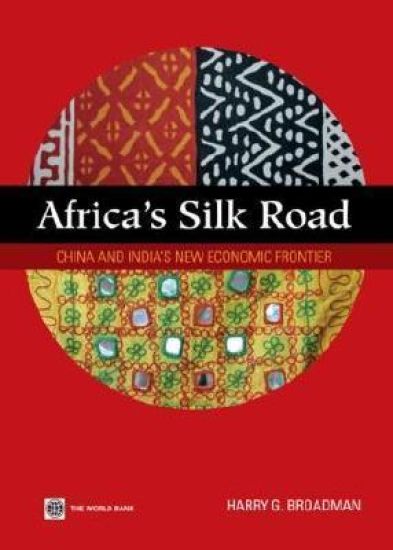
Africa's Silk Road

Harry G. Broadman

World Bank Publications
2006
nidottu
China and India's new-found interest in trade and investment with Africa - home to 300 million of the globe's poorest people and the world's most formidable development challenge - presents a significant opportunity for growth and integration of the Sub-Saharan continent into the global economy. ""Africa's Silk Road"" finds that China and India's South-South commerce with Africa is about far more than natural resources, opening the way for Africa to become a processor of commodities and a competitive supplier of goods and services to these countries - a major departure from its long established relations with the North. A growing number of Chinese and Indian businesses active in Africa operate on a global scale, work with world-class technologies, produce products and services according to the most demanding standards, and foster the integration of African businesses into advanced markets. There are significant imbalances, however, in these emerging commercial relationships. These can be addressed through a series of reforms in all countries: ""At-the-border"" reforms, such as elimination of China and India's escalating tariffs on Africa's leading exports, and elimination of Africa's tariffs on certain inputs that make exports uncompetitive; ""Behind-the-border"" reforms in Africa, to unleash competitive market forces and strengthen its basic market institutions; ""Between-the-border"" improvements in trade facilitation mechanisms to decrease transactions costs; and reforms that leverage linkages between investment and trade, to allow African businesses to participate in global production networks that investments by Chinese and Indian firms can generate.
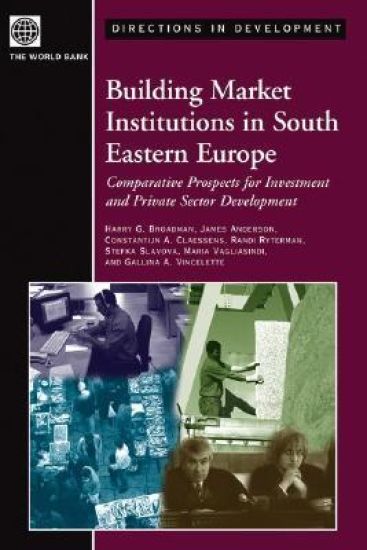
Building Market Institutions in South Eastern Europe

Building Market Institutions in South Eastern Europe

Harry G. Broadman; James Anderson; Stijn Claessens; Randi Ryterman; Stefka Slavova

World Bank Publications
2004
nidottu
Building Market Institutions in South Eastern Europe, a collaborative effort of the World Bank and the EBRD, analyses the institutional impediments to investment and growth in eight SEE countries - Albania, Bosnia and Herzegovina, Bulgaria, Croatia, FYR Macedonia, Moldova, Romania, and Serbia and Montenegro - and suggests policy reforms to ease these constraints. The analysis focuses on four core issues: (i) Business competition and economic barriers to entry/exit, (ii) Access to regulated utilities and services, (iii) Corporate ownership, financial transparency and access to finance, and (iv) Commercial dispute resolution. These issues are investigated empirically across the SEE countries to allow for cross-country comparisons and to develop a regional perspective on corresponding policy challenges. The study is innovative not only because of its use of a cross-country comparative analytical framework applied to a well-defined - and politically important - region, but also because of the novel way it marries data from several sources: (i) official data from the eight countries; (ii) two rounds of results (for 1999 and 2002) of a quantitative firm-level survey (EBRD-World Bank Business Environment and Enterprise Performance Survey) covering approximately 1600 SEE firms; and (iii) the results from a set of 40 original enterprise-level business case studies developed in the field in each of the eight countries. Building Market Institutions in South Eastern Europe provides new insights on improving the South East European business environment and suggests concrete policy recommendations.