Kirjojen hintavertailu – 12 903 732 kirjaa ja 27 kauppaa

Kirjailija

Harvey Lazar

Kirjat ja teokset yhdessä paikassa: 13 kirjaa, julkaisuja vuosilta 1998–2013, suosituimpiin kuuluu Paradigm Freeze. Vertaile teosten hintoja ja tarkista saatavuus suomalaisista kirjakaupoista.

13 kirjaa

Kirjojen julkaisuvuodet: 1998–2013.

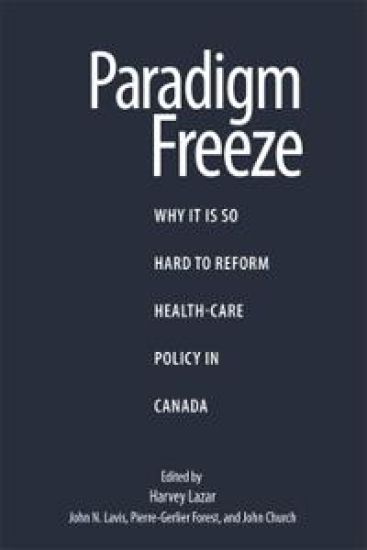
Paradigm Freeze

Paradigm Freeze

Harvey Lazar; Pierre-Gerlier Forest; John N. Lavis; John Church

Queen's University
2013
nidottu
Why has health care reform proved a stumbling block for provincial governments across Canada? What efforts have been made to improve a struggling system, and how have they succeeded or failed? In Paradigm Freeze, experts in the field answer these fundamental questions by examining and comparing six essential policy issues - regionalization, needs-based funding, alternative payment plans, privatization, waiting lists, and prescription drug coverage - in five provinces. Noting hundreds of recommendations from dozens of reports commissioned by provincial governments over the last quarter century - the great majority to little or no avail - the book focuses on careful diagnosis, rather than unplanned treatment, of the problem. Paradigm Freeze is based on thirty case studies of policy reform in Alberta, Saskatchewan, Ontario, Quebec, and Newfoundland and Labrador. The contributors assess the nature and extent of healthcare reform in Canada since the beginning of the 1990s. They account for the generally limited extent of reform that has occurred, and identify the factors associated with the relatively few cases of large reform. An insightful new perspective on a problem that has plagued Canadian governments for decades, Paradigm Freeze is an important addition to the field of health policy. Contributors include John Church (University of Alberta), Michael Ducie (Alberta Health and Wellness), Pierre-Gerlier Forest (Pierre Elliott Trudeau Foundation), Stephen Tomblin (Memorial University), Jeff Braun Jackson (Ontario Professional Firefighters Association, Burlington, ON), Marie-Pascale Pomey (Université de Montréal), John N. Lavis (McMaster University), Harvey Lazar (Queen's University), Elisabeth Martin (Université Laval),Tom McIntosh (University of Regina), Dianna Pasic (McMaster University), Neale Smith (University of British Columbia), and Michael G. Wilson (McMaster University).
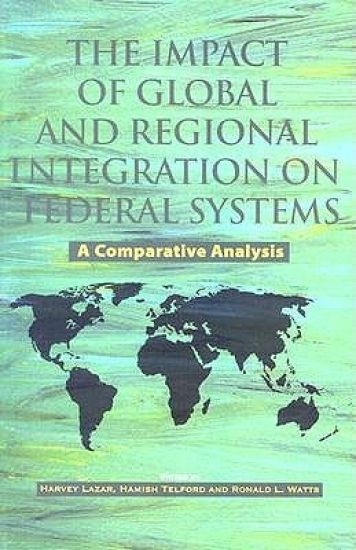
The Impact of Global and Regional Integration on Federal Systems

The Impact of Global and Regional Integration on Federal Systems

Harvey Lazar; Hamish Telford

Queen's University
2003
nidottu
Global and regional integration present special challenges to federal political systems around the world. The division of powers inherent in federal political systems complicates the impact of external pressures on the nation-state and confuses the possible responses to these pressures. In The Implications of Global and Regional Integration for the Future of Federal Political Systems each chapter analyzes the respective federation may look under a variety of future international scenarios. The broad conclusion of the study is that the specific impact of regional and global integration on each federation depends on the situational context and institutional structure of the federation. The study also concludes that global and regional integration has more impact on federal processes than institutional change. This reflects the fact that actors within institutions can respond to external pressures without necessarily reforming the institutions. The case studies consequently provide important lessons for students of comparative politics. The study makes clear that "globalization" is a multifaceted phenomenon, and it illustrates the wide range of institutional variations among federations. Policy makers in federal political systems will also appreciate the varied lessons to be learned from the differential impact of global and regional integration on federations around the world. The contributors to this volume are amongst the leading scholars of federalism in their respective countries. Contributors include Harvey Lazar, Hamish Telford, Richard Simeon (University of Toronto), John Kincaid (Lafayette College), Brian Galligan (University of Melbourne), Rudolf Hrbek (University of Tübingen), Liesbet Hooghe (University of North Carolina), Jürg Steiner (University of Bern and University of North Carolina), Nico Steytler (University of the Western Cape), and M. P. Singh (University of Delhi).
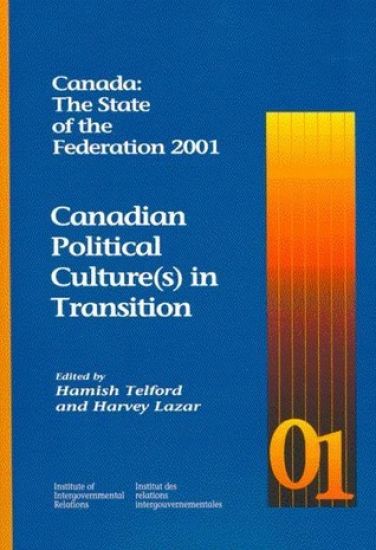
Canada: The State of the Federation 2001

Canada: The State of the Federation 2001

Hamish Telford; Harvey Lazar

Queen's University
2002
nidottu
Arguably, political changes in Canada have been greater in the 1990s than in any other decade since Confederation, but do these changes signify a shift in Canadian political culture? Can we even speak of a Canadian political culture? What are the consequences of these changes for the federation? Are Canadians more or less united? Are federal-provincial relations better or worse? What does the future hold? The authors attempt to answer these questions through analyses of the federal party system, politics in the provinces and regions, and political dynamics in a number of issue areas, including Aboriginal politics, the Charter, multiculturalism, the rural-urban cleavage, and social policy. Contributors include Gordon Gibson (Fraser Institute), Hugh Segal (Institute for Research on Public Policy), Samuel LaSelva (University of British Columbia), Jennifer Smith (Dalhousie University), Alain-G. Gagnon (McGill University), Nelson Wiseman (University of Toronto), and Ian Stewart (Acadia University).
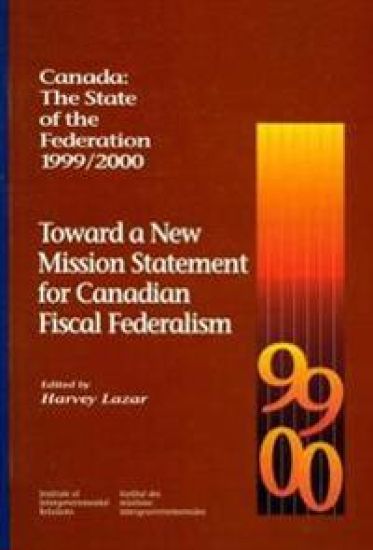
Canada: The State of the Federation, 1999-2000

Canada: The State of the Federation, 1999-2000

Harvey Lazar

Queen's University
2000
nidottu
The authors begin with an examination of recent developments in the theoretical literature surrounding fiscal federalism. They then examine some of the major issues facing the federation - Is there a vertical imbalance between federal and provincial governments? Does Ottawa collect more revenues than are needed relative to its spending responsibilities while the provinces are under-funded? How do federal-provincial struggles over money and jurisdictional power affect local government or the para-public sector, emerging aboriginal governments, and citizens? Federal government actions in 1999 suggest that Ottawa has not lost all of its interest in social outcomes. It is, however, seeking to influence the well-being of citizens by transferring money to them directly rather than through transfers to provinces. The authors suggest that if this trend continues the approach to the millennium will be seen as a watershed in public policy, given that current trends in Canadian fiscal federalism are as much about re-balancing the federation as they are about decentralization. Contributors include Frances Abele (Carleton), Richard Bird (Toronto), Robin Boadway (Queen's), Estee Garfin (Queen's), Paul Hobson (Queen's), Harry Kitchen (Trent), Harvey Lazar, Jack Mintz (C. D. Howe), Ken Norrie (Alberta), Lars Osberg (Dalhousie), Michael Prince (Victoria), France St-Hilaire (Institute for Research on Public Policy), Francois Vaillancourt (Montreal), Ronald Watts (Queen's), and Sam Wilson (Alberta).
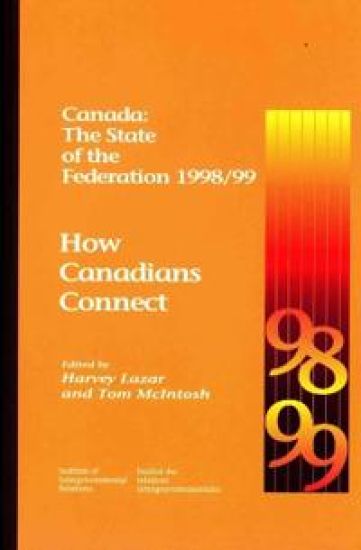
Canada: the State of the Federation 1998/99

Canada: the State of the Federation 1998/99

Harvey Lazar; Tom McIntosh

Queen's University
1999
nidottu
The last twenty or so years have seen a different kind of state emerge in Canada and elsewhere. The questioning of Keynesian macroeconomic policy in light of crises in Western economies coupled with the rise of neo-conservative and neo-liberal politics (and the attendant rethinking of the modern state's regulatory and redistributive roles) has resulted in significant restructuring and retrenchment of the state in Canada, both federal and provincial. Similarly, Canadians' sense of citizenship has undergone significant changes that need to be explored. Canada: The State of the Federation 1998 is a timely exploration of the current state of the ties that bind the federation together. Are they strong enough to survive in the context of a smaller (or at least different) state? Is Canadians' sense of citizenship sufficiently vibrant to maintain itself in an increasingly globalized world? How have Canada's civic and political institutions responded to these challenges? Is "Canadian culture," however defined, still a viable concept in the midst of the kinds of communications advances we have seen of late? How are global economic forces changing the east-west economic linkages that have been fostered since Confederation and how will Canada fit into a globalized political economy? These are but a few of the questions that the volume explores. Contributors include Reg Whitaker (York), Avigail Eisenberg (UBC), Ted Magder (NYU), Florian Sauvageau (Laval), Pierre Juneau (former chair of the CRTC), John Helliwell (UBC), François Vaillancourt and Marc Vachon (Montréal), Claire Turenne-Sjolander (Ottawa), Tom McIntosh (Queen's), Matthew James (UBC), Kathleen Day and Quentin Grafton (Ottawa), Brian Tanguay (Wilfred Laurier), Howard Leeson (Regina), Frank Graves (EKOS Research), and Melissa Kruger (Queen's).
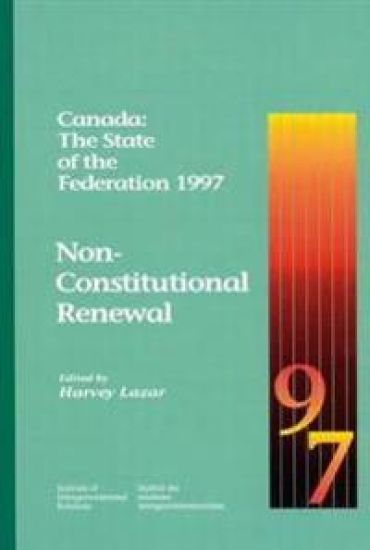
Canada: The State of the Federation 1997

Canada: The State of the Federation 1997

Harvey Lazar

Queen's University
1998
sidottu
The 1997 volume in the Canada: The State of the Federation series explores the theme of non-constitutional change. Contributors assess the progress of federal and provincial governments in renewing the federation through means other than constitutional change. Keith Banting (Queen's) deals with the lessons learned from the decline of the post-World War II social union, John Richards (Simon Fraser) lays out three propositions for a successful social union, and Harvey Lazar (Queen's) documents and analyses recent changes in the federal strategy toward the social union. Robert Knox (former executive director of the Internal Trade Secretariat) reviews progress on implementation of the Internal Trade Agreement. Patrick Fafard (Queen's) and Audrey Doerr (former official at Indian and Northern Affairs) focus on federal-provincial relations pertaining to environmental and Aboriginal issues respectively. Rejean Pelletier (Laval) analyses whether the change from Parizeau to Bouchard has affected Quebec's positions on non-constitutional files, Roger Gibbins (Calgary) explains factors that helped the government of Alberta become so influential in the intergovernmental arena in recent years, and Sid Noel (Western) looks at Ontario's radical refashioning of its approach to intergovernmental relations. Rob Howse (Toronto) analyses how the non-constitutional focuses fit well with the need to blend a community of association (Canada) with the different communities of identity that exist within Canadian borders. Harvey Lazar, in an introductory essay, provides an overall report card on the renewal process.
Canada: the State of the Federation 1997

Canada: the State of the Federation 1997

Harvey Lazar

Queen's University
1998
nidottu
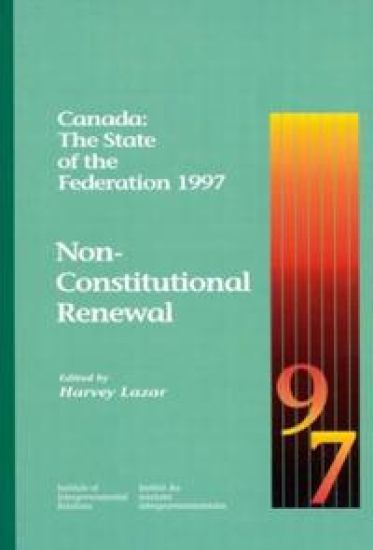
The 1997 volume in the Canada: The State of the Federation series explores the theme of non-constitutional change. Contributors assess the progress of federal and provincial governments in renewing the federation through means other than constitutional change. Keith Banting (Queen's) deals with the lessons learned from the decline of the post-World War II social union, John Richards (Simon Fraser) lays out three propositions for a successful social union, and Harvey Lazar (Queen's) documents and analyses recent changes in the federal strategy toward the social union. Robert Knox (former executive director of the Internal Trade Secretariat) reviews progress on implementation of the Internal Trade Agreement. Patrick Fafard (Queen's) and Audrey Doerr (former official at Indian and Northern Affairs) focus on federal-provincial relations pertaining to environmental and Aboriginal issues respectively. Rejean Pelletier (Laval) analyses whether the change from Parizeau to Bouchard has affected Quebec's positions on non-constitutional files, Roger Gibbins (Calgary) explains factors that helped the government of Alberta become so influential in the intergovernmental arena in recent years, and Sid Noel (Western) looks at Ontario's radical refashioning of its approach to intergovernmental relations. Rob Howse (Toronto) analyses how the non-constitutional focuses fit well with the need to blend a community of association (Canada) with the different communities of identity that exist within Canadian borders. Harvey Lazar, in an introductory essay, provides an overall report card on the renewal process.