Kirjojen hintavertailu – 12 903 725 kirjaa ja 27 kauppaa

Kirjailija

Harvey Mansfield

Kirjat ja teokset yhdessä paikassa: 4 kirjaa, julkaisuja vuosilta 1995–2026, suosituimpiin kuuluu Where Harvard Went Wrong. Vertaile teosten hintoja ja tarkista saatavuus suomalaisista kirjakaupoista.

4 kirjaa

Kirjojen julkaisuvuodet: 1995–2026.

Where Harvard Went Wrong

Where Harvard Went Wrong

Harvey Mansfield

ENCOUNTER BOOKS,USA
2026
sidottu
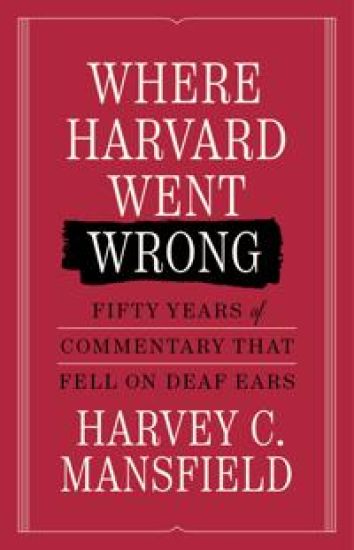
The book is a collection of the talks Harvey Mansfield gave to his colleagues at Harvard on major educational issues from 1974 to 2025. Six articles from the undergraduate newspaper, the Harvard Crimson in 2025 treat the issues in the clash between Harvard and the Trump Administration. This was an unprecedented invitation to a professor, widely read and discussed, covering the idea of an Ivory Tower, affirmative action for conservatives, free speech and protest speech, the origins of woke, science and the humanities, what conservatives offer to education. These are preceded by a talk that contrasts the new and the old Harvard, setting the stage for conflict today. Another item is a reform curriculum for a college with ambition. A study titled "the suicide of meritocracy" brings up the grade inflation everywhere today: everyone wants to choose students by merit, yet no one wants to test and grade it according to merits. Why do universities say they must keep up with change? Aren't there principles that do not change? Education needs tradition as well as progress. Science is always new; humanities are mostly old. How did Harvey Mansfield choose to address his colleagues? His faculty speeches, laced with humor, show one professor standing up to a whole faculty, not with taunts and insults, but with arguments. The author spent the life of his career defending lost causes, which now, after his retirement, have suddenly become winners--affirmative action and representation for conservatives. A university seems like a simple thing--students learn the knowledge professors teach. But professors disagree and students react--it's not so simple. Our universities have botched their job. They failed to see the need for the balance of opinion that permits faculty and students to disagree safely and reasonably.. They failed to appreciate the special character of institutions devoted to weighing the values that society takes for granted. The ivory tower sits in its society but rises above it. These are the topics and issues that teem in the talks of one professor to his university in our time.
Tocqueville

Tocqueville

Harvey Mansfield

Oxford University Press Inc
2010
nidottu
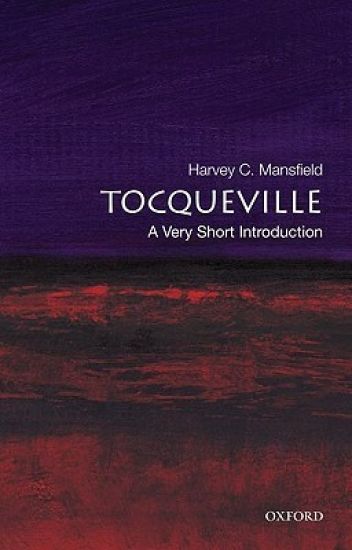
No one has ever described American democracy with more accurate insight or more profoundly than Alexis de Tocqueville. After meeting with Americans on extensive travels in the United States, and intense study of documents and authorities, he authored the landmark Democracy in America, publishing its two volumes in 1835 and 1840. Ever since, this book has been the best source for every serious attempt to understand America and democracy itself. Yet Tocqueville himself remains a mystery behind the elegance of his style. Now one of our leading authorities on Tocqueville explains him in this splendid new entry in Oxford's acclaimed Very Short Introductions series. Harvey Mansfield addresses his subject as a thinker, clearly and incisively exploring Tocqueville's writings-not only his masterpiece, but also his secret Recollections, intended for posterity alone, and his unfinished work on his native France, The Old Regime and the Revolution. Tocqueville was a liberal, Mansfield writes, but not of the usual sort. The many elements of his life found expression in his thought: his aristocratic ancestry, his ventures in politics, his voyages abroad, his hopes and fears for America, and his disappointment with France. All his writings show a passion for political liberty and insistence on human greatness. Perhaps most important, he saw liberty not in theories, but in the practice of self-government in America. Ever an opponent of abstraction, he offered an analysis that forces us to consider what we actually do in our politics--suggesting that theory itself may be an enemy of freedom. And that, Mansfield writes, makes him a vitally important thinker for today. Translator of an authoritative edition of Democracy in America, Harvey Mansfield here offers the fruit of decades of research and reflection in a clear, insightful, and marvelously compact introduction. ABOUT THE SERIES: The Very Short Introductions series from Oxford University Press contains hundreds of titles in almost every subject area. These pocket-sized books are the perfect way to get ahead in a new subject quickly. Our expert authors combine facts, analysis, perspective, new ideas, and enthusiasm to make interesting and challenging topics highly readable.
Tocqueville and the Nature of Democracy

Tocqueville and the Nature of Democracy

Pierre Manent; John Waggoner; Harvey Mansfield

Rowman Littlefield
1995
sidottu
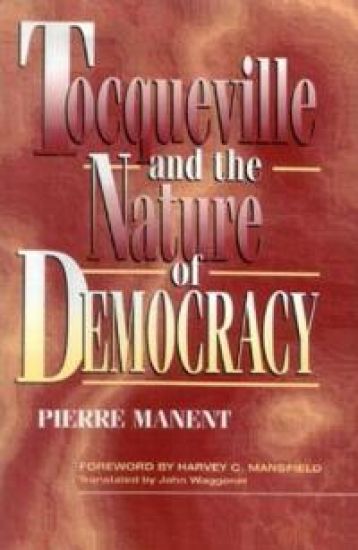
One of France's leading and most controversial political thinkers explores the central themes of Tocqueville's writings: the democratic revolution and the modern passion for equality. What becomes of people when they are overcome by this passion and how does it transform the contents of life? Pierre Manent's analysis concludes that the growth of state power and the homogenization of society are two primary consequences of equalizing conditions. The author shows the contemporary relevance of Tocqueville's teaching: to love democracy well, one must love it moderately. Manent examines the prophetic nature of Tocqueville's writings with breadth, clarity, and depth. His findings are both timely and highly relevant as people in Eastern Europe and around the world are grappling with the fragile, complicated, and frequently contradictory nature of democracy. This book is essential reading for students and scholars of political theory and political philosophy, as well as general readers interested in the nature of modern democracy.
Tocqueville and the Nature of Democracy

Tocqueville and the Nature of Democracy

Pierre Manent; John Waggoner; Harvey Mansfield

Rowman Littlefield
1995
nidottu
One of France's leading and most controversial political thinkers explores the central themes of Tocqueville's writings: the democratic revolution and the modern passion for equality. What becomes of people when they are overcome by this passion and how does it transform the contents of life? Pierre Manent's analysis concludes that the growth of state power and the homogenization of society are two primary consequences of equalizing conditions. The author shows the contemporary relevance of Tocqueville's teaching: to love democracy well, one must love it moderately. Manent examines the prophetic nature of Tocqueville's writings with breadth, clarity, and depth. His findings are both timely and highly relevant as people in Eastern Europe and around the world are grappling with the fragile, complicated, and frequently contradictory nature of democracy. This book is essential reading for students and scholars of political theory and political philosophy, as well as general readers interested in the nature of modern democracy.