Kirjojen hintavertailu – 12 903 724 kirjaa ja 27 kauppaa

Kirjailija

Hasia R. Diner

Kirjat ja teokset yhdessä paikassa: 17 kirjaa, julkaisuja vuosilta 1977–2024, suosituimpiin kuuluu Erin's Daughters in America. Vertaile teosten hintoja ja tarkista saatavuus suomalaisista kirjakaupoista.

Nimi esiintyy myös muodoissa: Hasia R Diner

17 kirjaa

Kirjojen julkaisuvuodet: 1977–2024.

Opening Doors

Opening Doors

Hasia R Diner

St Martin's Press
2024
sidottu
The extraordinary untold story of how Irish and Jewish immigrants worked together to secure legitimacy in America. Popular belief holds that the various ethnic groups that emigrated to the United States at the turn of the twentieth century regarded one another with open hostility, fiercely competing for limited resources and even coming to blows in the crowded neighborhoods of major cities. One of the most enduring stereotypes is that of rabidly anti-Semitic Irish Catholics, like Father Charles Coughlin of Boston and the sensationalized Gangs of New York trope of Irish street thugs attacking defenseless Jewish immigrants. In Opening Doors, Hasia R. Diner, one of the world's preeminent historians of immigration, tells a very different story; far from confrontational, the prevailing relationships between Jewish and Irish Americans were overwhelmingly cooperative, and the two groups were dependent upon one another to secure stable and upwardly mobile lives in their new home. The Irish had emigrated to American cities en masse a generation before the first major wave of Jewish immigrants arrived, and had already entrenched themselves in positions of influence in urban governments, public education, and the labor movement. Jewish newcomers recognized the value of aligning themselves with another group of religious outsiders who were able to stand up and demand rights and respect despite widespread discrimination from the Protestant establishment, and the Irish realized that they could protect their political influence by mentoring their new neighbors in the intricacies of American life. Opening Doors draws from a deep well of historical sources to show how Irish and Jewish Americans became steadfast allies in classrooms, picket lines, and political machines, and ultimately helped one another become key power players in shaping America's future. In the wake of rising anti-Semitism and xenophobia today, this informative and accessible work offers an inspiring look at a time when two very different groups were able to find common ground and work together to overcome bigotry, gain representation, and move the country in a more inclusive direction.
Immigration

Immigration

Carl J. Bon Tempo; Hasia R. Diner

YALE UNIVERSITY PRESS
2022
sidottu
A sweeping narrative history of American immigration from the colonial period to the present “A masterly historical synthesis, full of wonderful detail and beautifully written, that brings fresh insights to the story of how immigrants were drawn to and settled in America over the centuries.”—Nancy Foner, author of One Quarter of the Nation The history of the United States has been shaped by immigration. Historians Carl J. Bon Tempo and Hasia R. Diner provide a sweeping historical narrative told through the lives and words of the quite ordinary people who did nothing less than make the nation. Drawn from stories spanning the colonial period to the present, Bon Tempo and Diner detail the experiences of people from Europe, Asia, Africa, and the Americas. They explore the many themes of American immigration scholarship, including the contexts and motivations for migration, settlement patterns, work, family, racism, and nativism, against the background of immigration law and policy. Taking a global approach that considers economic and personal factors in both the sending and receiving societies, the authors pay close attention to how immigration has been shaped by the state response to its promises and challenges.
The Oxford Handbook of the Jewish Diaspora

The Oxford Handbook of the Jewish Diaspora

Hasia R. Diner

Oxford University Press Inc
2022
sidottu
For as long as historians have contemplated the Jewish past, they have engaged with the idea of diaspora. Dedicated to the study of transnational peoples and the linkages these people forged among themselves over the course of their wanderings and in the multiple places to which they went, the term “diaspora” reflects the increasing interest in migrations, trauma, globalism, and community formations. The Oxford Handbook of the Jewish Diaspora acts as a comprehensive collection of scholarship that reflects the multifaceted nature of diaspora studies. Persecuted and exiled throughout their history, the Jewish people have also left familiar places to find better opportunities in new ones. But their history has consistently been defined by their permanent lack of belonging. This Oxford Handbook explores the complicated nature of diasporic Jewish life as something both destructive and generative. Contributors explore subjects as diverse as biblical and medieval representations of diaspora, the various diaspora communities that emerged across the globe, the contradictory relationship the diaspora bears to Israel, and how the diaspora is celebrated and debated within modern Jewish thought. What these essays share is a commitment to untangling the legacy of the diaspora on Jewish life and culture. This volume portrays the Jewish diaspora not as a simple, unified front, but as a population characterized by conflicting impulses and ideas. The Oxford Handbook of the Jewish Diaspora captures the complexity of the Jewish diaspora by acknowledging the tensions inherent in a group of people defined by trauma and exile as well as by voluntary migrations to places with greater opportunity.
Feasting and Fasting

Feasting and Fasting

Hasia R. Diner; Jonathan Safran Foer

New York University Press
2020
pokkari
How Judaism and food are intertwined Judaism is a religion that is enthusiastic about food. Jewish holidays are inevitably celebrated through eating particular foods, or around fasting and then eating particular foods. Through fasting, feasting, dining, and noshing, food infuses the rich traditions of Judaism into daily life. What do the complicated laws of kosher food mean to Jews? How does food in Jewish bellies shape the hearts and minds of Jews? What does the Jewish relationship with food teach us about Christianity, Islam, and religion itself? Can food shape the future of Judaism? Feasting and Fasting explores questions like these to offer an expansive look at how Judaism and food have been intertwined, both historically and today. It also grapples with the charged ethical debates about how food choices reflect competing Jewish values about community, animals, the natural world and the very meaning of being human. Encompassing historical, ethnographic, and theoretical viewpoints, and including contributions dedicated to the religious dimensions of foods including garlic, Crisco, peanut oil, and wine, the volume advances the state of both Jewish studies and religious studies scholarship on food. Bookended with a foreword by the Jewish historian Hasia Diner and an epilogue by the novelist and food activist Jonathan Safran Foer, Feasting and Fasting provides a resource for anyone who hungers to understand how food and religion intersect.
Feasting and Fasting

Feasting and Fasting

Hasia R. Diner; Jonathan Safran Foer

New York University Press
2020
sidottu
How Judaism and food are intertwined Judaism is a religion that is enthusiastic about food. Jewish holidays are inevitably celebrated through eating particular foods, or around fasting and then eating particular foods. Through fasting, feasting, dining, and noshing, food infuses the rich traditions of Judaism into daily life. What do the complicated laws of kosher food mean to Jews? How does food in Jewish bellies shape the hearts and minds of Jews? What does the Jewish relationship with food teach us about Christianity, Islam, and religion itself? Can food shape the future of Judaism? Feasting and Fasting explores questions like these to offer an expansive look at how Judaism and food have been intertwined, both historically and today. It also grapples with the charged ethical debates about how food choices reflect competing Jewish values about community, animals, the natural world and the very meaning of being human. Encompassing historical, ethnographic, and theoretical viewpoints, and including contributions dedicated to the religious dimensions of foods including garlic, Crisco, peanut oil, and wine, the volume advances the state of both Jewish studies and religious studies scholarship on food. Bookended with a foreword by the Jewish historian Hasia Diner and an epilogue by the novelist and food activist Jonathan Safran Foer, Feasting and Fasting provides a resource for anyone who hungers to understand how food and religion intersect.
How America Met the Jews

How America Met the Jews

Hasia R Diner

Brown Judaic Studies
2017
pokkari
From the 1820s through the 1920s, nearly ninety percent of all Jews who left Europe moved to the United States. In this new book from Hasia Diner, she focuses on the realities of race, immigration, color, money, economic development, politics, and religion in America that shaped its history and made it such an attractive destination for Jews. Additionally, she approaches the question from the perspective of an America that sought out white immigrants to help stoke economic development and that valued religion as a force for morality. These tendencies converged and provided a situation where Jews could experience life in ways impossible elsewhere.
How America Met the Jews

How America Met the Jews

Hasia R Diner

Brown Judaic Studies
2017
sidottu
From the 1820s through the 1920s, nearly ninety percent of all Jews who left Europe moved to the United States. In this new book from Hasia Diner, she focuses on the realities of race, immigration, color, money, economic development, politics, and religion in America that shaped its history and made it such an attractive destination for Jews. Additionally, she approaches the question from the perspective of an America that sought out white immigrants to help stoke economic development and that valued religion as a force for morality. These tendencies converged and provided a situation where Jews could experience life in ways impossible elsewhere.
Gettot

Gettot

Louis Wirth; Hasia R. Diner

Égalité
2017
nidottu
I boken belyser sociologen Louis Wirth (1897–1952) det judiska gettots uppkomst i medeltidens Europa ur ett historiskt-sociologiskt perspekiv, med gettot i Frankfurt som specifikt exempel. Det rika inre liv som doldes bakom gettots gråa exteriör blottläggs, liksom dess fysiska, sociala och psykologiska inverkan på invånarna. Dessa erfarenheter återspeglas enligt Wirth sedan i det judiska gettot i Chicago vars befolkning kraftigt ökade i sluet av 1800-talet och början av 1900-talet då judar i Östeuropa tvingades emigrera på grund av antisemitism och pogromer. Författaren visar att det bland moderna judar i 1920-talets Chicago fortfarande fanns inslag av social isolering liknande dem som präglat europeiska judars tillvaro. Även om judarna i Chicago inte drabbades av påtvingad segregation så upprätthöll de, enligt Wirth, frivilliga och självpåtagna aspekter av gettolivet. ”Gettot” gavs ursprungligen ut 1928 av University of Chicago Press. Den amerikanska historikern Hasia R. Diner har skrivit introduktionen till 1998 års upplaga av Wirths bok, vilken finns i den svenska upplagan.
We Remember with Reverence and Love

We Remember with Reverence and Love

Hasia R. Diner

New York University Press
2010
pokkari
Winner of the 2009 National Jewish Book Award in American Jewish Studies Recipient of the 2010 Guggenheim Fellowship in Humanities-Intellectual & Cultural History It has become an accepted truth: after World War II, American Jews chose to be silent about the mass murder of millions of their European brothers and sisters at the hands of the Nazis. In this compelling work, Hasia R. Diner shows the assumption of silence to be categorically false. Uncovering a rich and incredibly varied trove of remembrances—in song, literature, liturgy, public display, political activism, and hundreds of other forms—We Remember with Reverence and Love shows that publicly memorializing those who died in the Holocaust arose from a deep and powerful element of Jewish life in postwar America. Not only does she marshal enough evidence to dismantle the idea of American Jewish "forgetfulness," she brings to life the moving and manifold ways that this widely diverse group paid tribute to the tragedy. Diner also offers a compelling new perspective on the 1960s and its potent legacy, by revealing how our typical understanding of the postwar years emerged from the cauldron of cultural divisions and campus battles a generation later. The student activists and "new Jews" of the 1960s who, in rebelling against the American Jewish world they had grown up in "a world of remarkable affluence and broadening cultural possibilities" created a flawed portrait of what their parents had, or rather, had not, done in the postwar years. This distorted legacy has been transformed by two generations of scholars, writers, rabbis, and Jewish community leaders into a taken-for-granted truth.
We Remember with Reverence and Love

We Remember with Reverence and Love

Hasia R. Diner

New York University Press
2009
sidottu
Winner of the 2009 National Jewish Book Award in American Jewish Studies Recipient of the 2010 Guggenheim Fellowship in Humanities-Intellectual & Cultural History It has become an accepted truth: after World War II, American Jews chose to be silent about the mass murder of millions of their European brothers and sisters at the hands of the Nazis. In this compelling work, Hasia R. Diner shows the assumption of silence to be categorically false. Uncovering a rich and incredibly varied trove of remembrances—in song, literature, liturgy, public display, political activism, and hundreds of other forms—We Remember with Reverence and Love shows that publicly memorializing those who died in the Holocaust arose from a deep and powerful element of Jewish life in postwar America. Not only does she marshal enough evidence to dismantle the idea of American Jewish "forgetfulness," she brings to life the moving and manifold ways that this widely diverse group paid tribute to the tragedy. Diner also offers a compelling new perspective on the 1960s and its potent legacy, by revealing how our typical understanding of the postwar years emerged from the cauldron of cultural divisions and campus battles a generation later. The student activists and "new Jews" of the 1960s who, in rebelling against the American Jewish world they had grown up in "a world of remarkable affluence and broadening cultural possibilities" created a flawed portrait of what their parents had, or rather, had not, done in the postwar years. This distorted legacy has been transformed by two generations of scholars, writers, rabbis, and Jewish community leaders into a taken-for-granted truth.
The Jews of the United States, 1654 to 2000

The Jews of the United States, 1654 to 2000

Hasia R. Diner

University of California Press
2006
pokkari
Since Peter Stuyvesant greeted with enmity the first group of Jews to arrive on the docks of New Amsterdam in 1654, Jews have entwined their fate and fortunes with that of the United States - a project marked by great struggle and great promise. What this interconnected destiny has meant for American Jews and how it has defined their experience among the world's Jews is fully chronicled in this work, a comprehensive and finely nuanced history of Jews in the United States from 1654 through the end of the past century. Hasia R. Diner traces Jewish participation in American history - from the communities that sent formal letters of greeting to George Washington; to the three thousand Jewish men who fought for the Confederacy and the ten thousand who fought in the Union army; and, to the Jewish activists who devoted themselves to the labor movement and the civil rights movement. Diner portrays this history as a constant process of negotiation, undertaken by ordinary Jews who wanted at one and the same time to be Jews and full Americans. Accordingly, Diner draws on both American and Jewish sources to explain the chronology of American Jewish history, the structure of its communal institutions, and the inner dynamism that propelled it. Her work documents the major developments of American Judaism - he economic, social, cultural, and political activities of the Jews who immigrated to and settled in America, as well as their descendants - and shows how these grew out of both a Jewish and an American context. She also demonstrates how the equally compelling urges to maintain Jewishness and to assimilate gave American Jewry the particular character that it retains to this day in all its subtlety and complexity.
A New Promised Land

A New Promised Land

Hasia R. Diner

Oxford University Press Inc
2003
nidottu
"An excellent Afikoman gift for the teen or young adult at the seder... Diner...writes in a clear style that pulls together that diverse entity known as the American Jewish community."--The Chicago Jewish Star An engaging chronicle of Jewish life in the United States, A New Promised Land reconstructs the multifaceted background and very American adaptations of this religious group, from the arrival of twenty-three Jews in the New World in 1654, through the development of the Orthodox, conservative, and Reform movements, to the ordination of Sally Priesand as the first woman rabbi in the United States. Hasia Diner supplies fascinating details about Jewish religious traditions, holidays, and sacred texts. In addition, she relates the history of the Jewish religious, political, and intellectual institutions in the United States, and addresses some of the biggest issues facing Jewish Americans today, including their increasingly complex relationship with Israel.
Hungering for America

Hungering for America

Hasia R. Diner

Harvard University Press
2003
nidottu
Millions of immigrants were drawn to American shores, not by the mythic streets paved with gold, but rather by its tables heaped with food. How they experienced the realities of America’s abundant food—its meat and white bread, its butter and cheese, fruits and vegetables, coffee and beer—reflected their earlier deprivations and shaped their ethnic practices in the new land. Hungering for America tells the stories of three distinctive groups and their unique culinary dramas. Italian immigrants transformed the food of their upper classes and of sacred days into a generic “Italian” food that inspired community pride and cohesion. Irish immigrants, in contrast, loath to mimic the foodways of the Protestant British elite, diminished food as a marker of ethnicity. And East European Jews, who venerated food as the vital center around which family and religious practice gathered, found that dietary restrictions jarred with America’s boundless choices. These tales, of immigrants in their old worlds and in the new, demonstrate the role of hunger in driving migration and the significance of food in cementing ethnic identity and community. Hasia Diner confirms the well-worn adage, “Tell me what you eat and I will tell you what you are.”
Lower East Side Memories

Lower East Side Memories

Hasia R. Diner

Princeton University Press
2002
pokkari
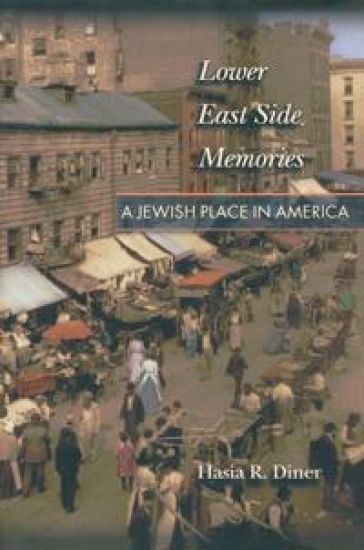
Manhattan's Lower East Side stands for Jewish experience in America. With the possible exception of African-Americans and Harlem, no ethnic group has been so thoroughly understood and imagined through a particular chunk of space. Despite the fact that most American Jews have never set foot there--and many come from families that did not immigrate through New York much less reside on Hester or Delancey Street--the Lower East Side is firm in their collective memory. Whether they have been there or not, people reminisce about the Lower East Side as the place where life pulsated, bread tasted better, relationships were richer, tradition thrived, and passions flared. This was not always so. During the years now fondly recalled (1880-1930), the neighborhood was only occasionally called the Lower East Side. Though largely populated by Jews from Eastern Europe, it was not ethnically or even religiously homogenous. The tenements, grinding poverty, sweatshops, and packs of roaming children were considered the stuff of social work, not nostalgia and romance. To learn when and why this dark warren of pushcart-lined streets became an icon, Hasia Diner follows a wide trail of high and popular culture. She examines children's stories, novels, movies, museum exhibits, television shows, summer-camp reenactments, walking tours, consumer catalogues, and photos hung on deli walls far from Manhattan. Diner finds that it was after World War II when the Lower East Side was enshrined as the place through which Jews passed from European oppression to the promised land of America. The space became sacred at a time when Jews were simultaneously absorbing the enormity of the Holocaust and finding acceptance and opportunity in an increasingly liberal United States. Particularly after 1960, the Lower East Side gave often secularized and suburban Jews a biblical, yet distinctly American story about who they were and how they got here. Displaying the author's own fondness for the Lower East Side of story books, combined with a commitment to historical truth, Lower East Side Memories is an insightful account of one of our most famous neighborhoods and its power to shape identity.

In the Almost Promised Land

In the Almost Promised Land

Hasia R. Diner

Johns Hopkins University Press
1995
pokkari
Seeking the reasons behind Jewish altruism toward African-Americans, Hasia Diner shows how - in the wake of the Leo Frank trial and lynching in Atlanta - Jews came to see that their relative prosperity was no protection against the same social forces that threatened blacks. It thus became in the Jewish American self-interest to support the black struggle for racial justice and to fight against American prejudice. Jewish leaders and organisations genuinely believed in the cause of black civil rights, Diner suggests, but they also used that cause as a way of advancing their own interests without seeming "pushy" or "too demanding" - launching a vicarious attack on the nation that they felt had not lived up to its own pronouncements of freedom and equality.