Kirjojen hintavertailu – 12 859 818 kirjaa ja 27 kauppaa

Kirjailija

Heinrich Kramer

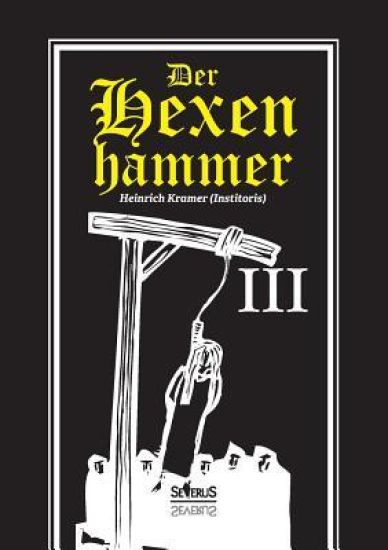
Kirjat ja teokset yhdessä paikassa: 33 kirjaa, julkaisuja vuosilta 2000–2025, suosituimpiin kuuluu Der Hexenhammer. Vertaile teosten hintoja ja tarkista saatavuus suomalaisista kirjakaupoista.

33 kirjaa

Kirjojen julkaisuvuodet: 2000–2025.

Hammer of the Witches: Malleus Maleficarum

Hammer of the Witches: Malleus Maleficarum

Henricus Institoris; Heinrich Kramer

Createspace Independent Publishing Platform
2017
nidottu
Hammer of the WitchesMalleus Maleficarum1486by Heinrich KramerTranslated by Montague Summers"It has been recognized even from the very earliest times, during the first gropings towards the essential conveniences of social decency and social order, that witchcraft is an evil thing, an enemy to light, an ally of the powers of darkness, disruption, and decay." "Sometimes, no doubt, primitive communities were obliged to tolerate the witch and her works owing to fear; in other words, witchcraft was a kind of blackmail; but directly Cities were able to to co-ordinate, and it became possible for Society to protect itself, precautions were taken and safeguards were instituted against this curse, this bane whose object seemed to blight all that was fair, all that was just and good, and that was well-appointed and honourable, in a word, whose aim proved to be set up on high the red standard of revolution; to overwhelm religion, existing order, and the comeliness of life in an abyss of anarchy, nihilism, and despair." The Malleus Maleficarum, usually translated as Hammer of Witches, is the best known and the most important treatise on witchcraft. It was written by the Catholic clergyman Heinrich Kramer (under his Latinized name Henricus Institoris) and first published in the German city of Speyer in 1487. It endorses extermination of witches and for this purpose develops a detailed legal and theological theory. It was a bestseller, second only to the Bible in terms of sales for almost 200 years. Magical acts and witchcraft had long been forbidden by the Church, whose attitude towards witchcraft was explained in the canon Episcopi written in about 900 AD. It stated that witchcraft and magic were just delusions and that those who believed in such things "had been seduced by the Devil in dreams and visions." However, in the same period supernatural intervention was accepted in the form of ordeals that were later also used during witch trials. Possessions by the Devil are considered real even in present times by some Christians and it is a part of doctrine that demons may be cast out by appropriate sacramental exorcisms. In Malleus, exorcism is, for example, one of the five ways to overcome the attacks of incubi. Prayer and transubstantiation are traditionally excluded by Christians from the category of magical rites. In 1484 clergyman Heinrich Kramer made one of the first attempts at prosecuting alleged witches in the Tyrol region. It was not a success: he was expelled from the city of Innsbruck and dismissed by the local bishop as "senile and crazy." According to Diarmaid MacCulloch, writing the book was Kramer's act of self-justification and revenge. Ankarloo and Clark claim that Kramer's purpose in writing the book was to explain his own views on witchcraft, systematically refute arguments claiming that witchcraft did not exist, discredit those who expressed skepticism about its reality, claim that those who practised witchcraft were more often women than men, and to convince magistrates to use Kramer's recommended procedures for finding and convicting witches.
Malleus Maleficarum: Hammer of the Witches

Malleus Maleficarum: Hammer of the Witches

Heinrich Kramer

Theophania Publishing
2011
nidottu

Halvin toimitettuna 31,40 €

Thank you for checking out this book by Theophania Publishing. We appreciate your business and look forward to serving you soon. We have thousands of titles available, and we invite you to search for us by name, contact us via our website, or download our most recent catalogues. The Malleus Maleficarum (Latin for "Hammer of the Witches", or "Der Hexenhammer" in German) is a famous treatise on witches, written in 1486 by Heinrich Kramer, an Inquisitor of the Catholic Church, and was first published in Germany in 1487. Jacob Sprenger is also often attributed as an author, but some scholars now believe that he became associated with the Malleus Maleficarum largely as a result of Kramer's wish to lend his book as much official authority as possible. In 1484 Kramer made one of the first attempts at a systematic persecution of witches in the region of Tyrol. It was not a success, Kramer was thrown out of the territory, and dismissed by the local bishop as a "senile old man". According to Diarmaid MacCulloch, writing the book was Kramer's act of self-justification and revenge. Some scholars have suggested that following the failed efforts in Tyrol, Kramer and Sprenger requested and received a papal bull Summis desiderantes affectibus in 1484. It allegedly gave full papal approval for the Inquisition to prosecute witchcraft in general and for Kramer and Sprenger specifically. Malleus Maleficarum was written in 1484 or 1485 and the papal bull was included as part of the preface. The main purpose of the Malleus was to attempt to systematically refute arguments claiming that witchcraft does not exist, discredit those who expressed skepticism about its reality, to claim that witches were more often women than men, and to educate magistrates on the procedures that could find them out and convict them. Kramer was denounced by the Inquisition in 1490.
The Man Who Was Thursday

The Man Who Was Thursday

G. K. Chesterton; Heinrich Kramer

Dover Publications Inc.
2003
nidottu
G. K. Chesterton's surreal masterpiece is a psychological thriller that centers on seven anarchists in turn-of-the-century London who call themselves by the names of the days of the week. Chesterton explores the meanings of their disguised identities in what is a fascinating mystery and, ultimately, a spellbinding allegory. As Jonathan Lethem remarks in his Introduction, The real characters are the ideas. Chesterton's nutty agenda is really quite simple: to expose moral relativism and parlor nihilism for the devils he believes them to be. This wouldn't be interesting at all, though, if he didn't also show such passion for giving the devil his due. He animates the forces of chaos and anarchy with every ounce of imaginative verve and rhetorical force in his body.
The Malleus Maleficarum

The Malleus Maleficarum

Heinrich Kramer; James Sprenger; Montague Summers

Dover Publications Inc.
2000
nidottu

Halvin toimitettuna 22,40 €

For nearly three centuries Malleus Maleficarum (The Witches' Hammer) was the professional manual for witch hunters. This work by two of the most famous Inquisitors of the age is still a document of the forces of that era's beliefs. Under a Bull of Pope Innocent VIII, Kramer and Sprenger exposed the heresy of those who did not believe in witches and set forth the proper order of the world with devils, witches, and the will of God. Even if you do not believe in witchcraft, the world of 1484 did. Contemporary cases illustrate methods by which witches attempt to control and subvert the world: How and why women roast their first-born male child; the confession of how to raise a tempest by a washwoman suspended "hardly clear of the ground" by her thumbs; methods of making a formal pact with the Devil; how witches deprive men of their vital member; and many others. Methods of destroying and curing witchcraft, such as remedies against incubus and succubus devils, are exemplified and weighed by the authors. Formal rules for initiating a process of justice are set down: how it should be conducted and the method of pronouncing sentence; when to use the trial by the red-hot-iron; how the prosecutor should protect himself; how the body is to be shaved and searched for tokens and amulets, including those sewn under the skin. As Summers says, it was the casebook on every magistrate's desk. Montague Summers has given a very sympathetic translation. His two introductions are filled with examples of witchcraft and the historical importance of Malleus Maleficarum. This famous document should interest the historian, the student of witchcraft and the occult, and the psychologist who is interested in the medieval mind as it was confronted with various forces which could be explained only by witchcraft. Reprint of the 1928 edition.