Kirjojen hintavertailu – 12 903 725 kirjaa ja 27 kauppaa

Kirjailija

Helen Vendler

Kirjat ja teokset yhdessä paikassa: 26 kirjaa, julkaisuja vuosilta 1969–2025, suosituimpiin kuuluu Liberties Journal of Culture and Politics. Vertaile teosten hintoja ja tarkista saatavuus suomalaisista kirjakaupoista.

26 kirjaa

Kirjojen julkaisuvuodet: 1969–2025.

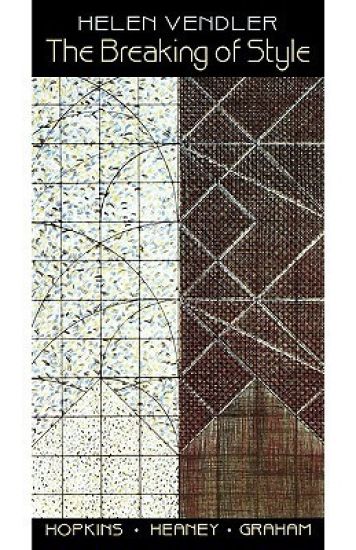
The Breaking of Style

The Breaking of Style

Helen Vendler

Harvard University Press
1995
nidottu
"Lucid and elegant...a tour de force."—A. O. Scott, The NationThree lectures on the fraught process of poetic development from a titan of contemporary criticism. Style is the material body of lyric poetry. To cast off an earlier style is to commit an act of violence against the creative self. Why do poets so often make these dramatic breaks? In her 1994 Richard Ellman Lectures, Helen Vendler investigates poets’ motives for inventing a new voice, along with their means of doing so. Exploring three archetypal ruptures, she yields a new view of the interplay of moral, emotional, and intellectual forces in each poet’s work. Gerard Manley Hopkins’s invention of sprung rhythm marks a radical break with his early style. Rhythm, Vendler shows us, is at the heart of Hopkins’s aesthetic, and sprung rhythm is his symbol for danger, difference, and the shock of the beautiful. In Seamus Heaney’s work, she identifies clear shifts in grammatical “atmosphere” from one poem to the next—from “nounness” to the “betweenness” of an adverbial style—shifts whose moral and political implications come under scrutiny here. And finally, Vendler looks at Jorie Graham’s departure from short lines to numbered lines to squared long lines of sentences, marking a move from “deliberation” to cinematic “freeze-framing” to “coverage,” each with its own meaning in this poet’s career. Throughout, Vendler reminds us that what distinguishes successful poetry is a mastery of language at all levels—including the rhythmic, the grammatical, and the graphic. A lucid reading of three poets and a superb exposition of the craft of poetry, The Breaking of Style revives our lapsed sense of what style means.
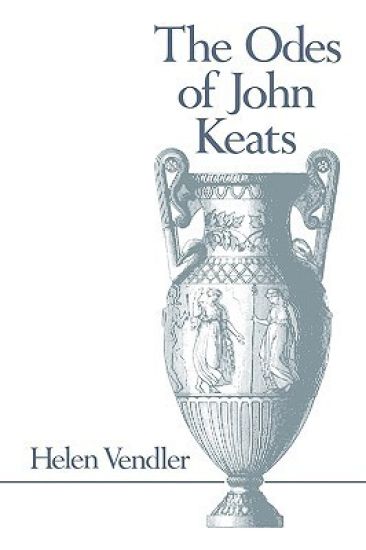
The Odes of John Keats

The Odes of John Keats

Helen Vendler

The Belknap Press
1985
nidottu
“Simply superb.”—The NationA landmark study reconstructs the magnificent architecture of Keats’s odes beam by beam. With the exception of Shakespeare, John Keats has garnered more critical attention than probably any other English poet, above all for his six great odes. Composed in the span of just a few months in 1819, the odes mark the high point of Keats’s all-too-short literary career, forming, as Helen Vendler puts it, “the group of works in which the English language finds an ultimate embodiment.” Even with the mountain of criticism that precedes it, The Odes of John Keats nonetheless accomplishes something bracingly new: it reveals that the odes, typically read separately, demand to be read as a unified whole. Only when we read them together, Vendler argues, do we see how each ode builds upon, and contradicts, the one that came before it—a progression that expresses Keats’s sustained and deliberate inquiry into nature of creativity itself. From fruitless revery in “Ode on Indolence,” to successive explorations of music and mimetic art in “Ode to a Nightingale” and “Ode on a Grecian Urn,” to the final triumph of lyric poetry in “To Autumn,” each ode advances tentative theses about the relationship between truth, beauty, and sensory experience, only to subsequently overturn them from a higher vantage point. Exquisitely attentive to the warp and weft of Keats’s “many languages,” from Greek mythology to eighteenth-century allegory, Vendler’s architectonic reading masterfully achieves criticism’s highest aim: keeping these classic poems, to borrow Keats’s own words, “forever warm and still to be enjoy’d.”
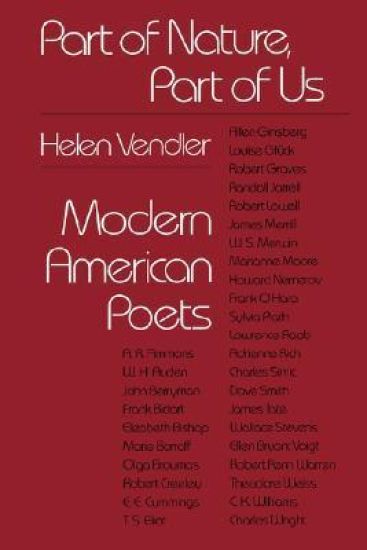
Part of Nature, Part of Us

Part of Nature, Part of Us

Helen Vendler

Harvard University Press
1980
nidottu
“Vendler sparkles.”—Irvin Ehrenpreis, New York Review of BooksAmerica’s foremost critic savors the poetry that made—and remade—our twentieth-century canon. The American poet Randall Jarrell once defined the ideal critic as “an extremely good reader—one who has learned to show to others what he saw in what he read.” By this measure, Helen Vendler is the best of her generation. Never doctrinaire or merely academic, she is an evangelist for poetic truth, guiding readers along the tracks of her own authoritative readings to disclose the interplay of form, feeling, and perception that defines each poet’s idiosyncratic vision of the world. A compilation of essays and reviews written for the New York Times Book Review and other outlets, Part of Nature, Part of Us is a dazzling retrospective of the authors who defined midcentury American poetry. The work collected here, originally published in the late 1960s and 1970s, marks the first time that canonical modern poets like T. S. Eliot, Marianne Moore, and Sylvia Plath could be judged from a critical distance. Reviewing more recent poets—including Robert Lowell, Elizabeth Bishop, and Adrienne Rich—Vendler also gives readers a chance to share in the “freshness of [her] first impressions.” Throughout, she is unforgiving but never unfair. She exults those who, like Lowell, show an essential fidelity to perception, who “say what happened” without stumbling into a mass of clichés. But she is unsparing with those who come to distrust their own emotions and retreat into clinical facticity, like the later Moore. Unflinching, engrossing, and frequently poetic in its own right, Part of Nature, Part of Us confirms Vendler’s unmatched ability to pinpoint great poets’ value as thinkers, as artists, and, finally, as humans.
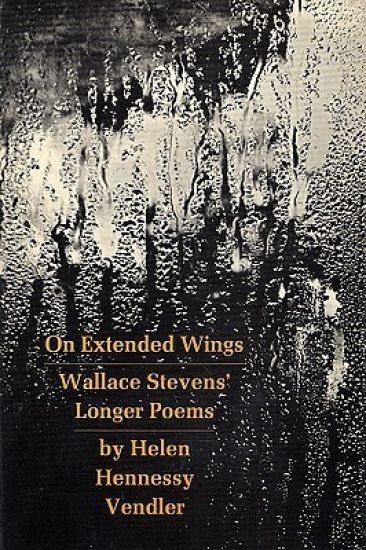
On Extended Wings

On Extended Wings

Helen Vendler

Harvard University Press
1969
nidottu
“Vendler is a commentator almost clairvoyant... Her book ought to be read, with care and gratitude, by every reader of Stevens, for no critic before her has understood so well his major poems.”—Harold Bloom, New York Times Book ReviewA virtuosic reading of Stevens’s most difficult poems brings their austere beauty and elaborately mannered movements to life. If “poetry is the subject of the poem,” as Wallace Stevens once declared, so too is the poet. A poet’s temperament, his attractions and repulsions, his sense of the world: all are integral to his style. And while Stevens’s short poems are perhaps his most anthologized, it is only in his longer works that we find his unique sensibilities on full display. Tracing the great modernist’s development through fourteen poems, from “Sunday Morning” (1915) to “An Ordinary Evening in New Haven” (1949), Helen Vendler reveals the longer poems as the proving grounds where Stevens tested formal innovations and discovered his own formidable strengths. Chief among these, she argues, is a gift for equivocation. Neither ascetic nor hedonist, neither solipsist aesthete nor engaged poet of the social, Stevens “trembles always at halfway points.” He departs from his romantic forbears, deprecating the pure imagination by letting flights of poetic fancy degenerate into intentional decadence and triviality. But he finds desperate clutching at “things as they are” equally fruitless: “endless struggle with fact” is the poet’s inevitable lot. From this ambivalence springs a whole world of grammatical and syntactic innovation, from his ambiguous use of tense to the welter of qualifications that seem to thwart every affirmative declaration. An unsurpassed classic in the canon of Stevens criticism, On Extended Wings gives us the full sweep his of his oeuvre—from the somber to the whimsical, from high stoic elegy to grotesque comedy—as no one but the brilliant Helen Vendler can.