Kirjojen hintavertailu – 12 859 827 kirjaa ja 27 kauppaa

Kirjailija

Helen Xanthaki

Kirjat ja teokset yhdessä paikassa: 6 kirjaa, julkaisuja vuosilta 2011–2024, suosituimpiin kuuluu Legislative Drafting for the EU. Vertaile teosten hintoja ja tarkista saatavuus suomalaisista kirjakaupoista.

6 kirjaa

Kirjojen julkaisuvuodet: 2011–2024.

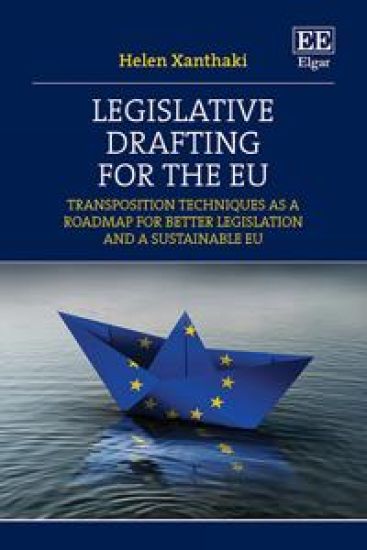
Legislative Drafting for the EU

Legislative Drafting for the EU

Helen Xanthaki

EDWARD ELGAR PUBLISHING LTD
2024
sidottu
Legislative Drafting for the EU calls for reform in the design of EU legislation to bolster its strength in political, social, and economic spheres. The book offers technical guidance on how to achieve such reform through drafting, and underlines the importance of accessible communication to create collective ownership of the regulatory aims. This innovative book reveals the weaknesses in the current drafting of EU law and recommends concrete changes for these regulations and directives in order to aid transposition. Highlighting the importance of drafting techniques, Helen Xanthaki offers an insightful analysis of EU legislation and emphasises the benefit of citizen-centred law-making in sustaining loyalty and trust in the EU. The author explores how reform is necessary to reflect the current usage of EU legislative expressions as the final legislative text for regulation, both at supranational and national levels. Considering the best ways to aid this reform, the book discusses legislative effectiveness and regulatory efficacy, Thornton’s methodology, and the use of easified and gender inclusive language to achieve clarity, precision, and unambiguity. Providing an incisive examination of EU legislative drafting and its implications for the member states, this thought-provoking book is a crucial read for scholars of European law, legislative drafting, regulation, and EU studies.

Thornton's Legislative Drafting

Thornton's Legislative Drafting

Helen Xanthaki

BLOOMSBURY PUBLISHING PLC
2022
sidottu
"...the uber-manual of all legislative drafting manuals" Statute Law Review, 2023, 44If you’re involved in drafting or amending legislation in the Commonwealth, the EU or beyond, you need a guide that will help you with both the traditional and modern techniques of drafting good quality statutory law. Thornton’s Legislative Drafting is recognised as the leading professional title in this area, used and referred to by legal officers and drafters internationally. Completely refreshed and updated, the new sixth edition includes full coverage of contemporary drafting developments and advances. Fully updated and alongside the detailed, learned and professional guidance and examples of best, and bad, practice, the new 6th edition includes new chapters on:- Legislation as a Tool for Regulation- Transposition of EU Legislation- Pre- and post-legislative scrutiny: the lifecycle of legislationThornton's Legislative Drafting helps the reader to:- Identify the aim of legislation as one of the regulatory tools- Align their concept of legislative quality with that of effectiveness of legislation- Use effectiveness as the criterion for resolving drafting dilemmas- Apply the effectiveness doctrine to all aspects of legislative drafting- Earn exposure to examples of best and bad practice drawn from a plethora of jurisdictions- Earn awareness of best practice in aspects of legislative drafting worldwide- Understand the “why” behind legislative conventions, thus becoming equipped with the tools for their application in practice.
A Legal and Political Interpretation of Articles 224 and 225 of the Treaty of Rome
First published in 1997. Article 224 is one of the most powerful Articles of the Treaty of Rome, allowing a member state to take unilateral measures and to suspend some or all its Treaty-based obligations in times of what can loosely be described as serious internal turmoil or external threat. It is for this reason that the very next Article of the Treaty, Article 225, allows the Commission or a member state to challenge invocation of Art.224, before the European Court of Justice (ECJ), on grounds of improper use. In practice, the use of Art.224, by a member state presents multiple problems. The obvious connection with defence and security issues has inhibited the ECJ which still has not given and authentic interpretation of this Article. As the recent former Yugoslav Republic of Macedonia (FYROM) cases (Greek referral for the embargo on FYROM) indicate, unless the use of Art.224 is blatantly flippant, the ECJ is not in a position to challenge a member state’s unilateral measures.
Drafting Legislation

Drafting Legislation

Helen Xanthaki

Hart Publishing
2014
sidottu
This book constitutes the first thorough academic analysis of legislative drafting. By placing the study of legislation and its principles within the paradigm of Flyvberg’s phronetic social sciences, it offers a novel approach which breaks the tradition of unimaginative past descriptive reiterations of drafting conventions. Instead of prescribing rules for legislation, it sets out to identify efficacy as the main aim of the actors in the policy, legislative and drafting processes, and effectiveness as the main goal in the drafting of legislation. Through the prism of effectiveness as synonymous with legislative quality, the book explores the stages of the drafting process; guides the reader through structure and sections in their logical sequence, and introduces rules for drafting preliminary, substantive and final provisions. Special provisions, comparative legislative drafting and training for drafters complete this thorough analysis of the drafting of legislation as a tool for regulation. Instead of teaching the reader which drafting rules prevail, the book explores the reasons why drafting rules have come about, thus encouraging readers to understand what goal is served by each rule and how each rule applies. The book is aimed at academics and practitioners who draft or use statutory law in the common or civil law traditions.
OLAF at the Crossroads

OLAF at the Crossroads

Constantin Stefanou; Helen Xanthaki; Simone White

Hart Publishing
2011
sidottu
The authors offer many insights into the regulatory, operational and institutional opportunities and challenges for OLAF, the European Commission's Anti-Fraud Office. Since OLAF was set up in 1999, significant changes in its functional environment have taken place including in EU criminal law and especially in mutual assistance and substantive criminal law; the reconstruction of Eurojust and Europol through recent Regulations and Memoranda of Cooperation; and the entry into force of the Lisbon Treaty. The authors advance the view that OLAF's current legal framework must address these issues adequately. The approach they take is multi-disciplinary. OLAF is examined here through the prisms of EU politics and national, European and (to some extent) comparative law, focusing not only on the identification of current problems in regulation and procedure but also on its positioning within the context of European integration. Operational issues are then extensively discussed, making this a book for practitioners as well as policy makers and academics. The book addresses the theoretical and practical aspects of anti-fraud actions within both criminal and civil aspects of public law. Although OLAF works within an incomplete EU legal framework and with varying cooperation by national authorities, its staff have devised mechanisms that address some of these issues. Nevertheless, rules covering procedural and operational issues will need to be safeguarded within future legislation.