Kirjojen hintavertailu – 12 903 735 kirjaa ja 27 kauppaa

Kirjailija

Helga Stoyan

Kirjat ja teokset yhdessä paikassa: 3 kirjaa, julkaisuja vuosilta 1994–2008, suosituimpiin kuuluu Umweltstatistik. Vertaile teosten hintoja ja tarkista saatavuus suomalaisista kirjakaupoista.

3 kirjaa

Kirjojen julkaisuvuodet: 1994–2008.

Statistical Analysis and Modelling of Spatial Point Patterns

Statistical Analysis and Modelling of Spatial Point Patterns

Janine Illian; Antti Penttinen; Helga Stoyan; Dietrich Stoyan

John Wiley Sons Inc
2008
sidottu
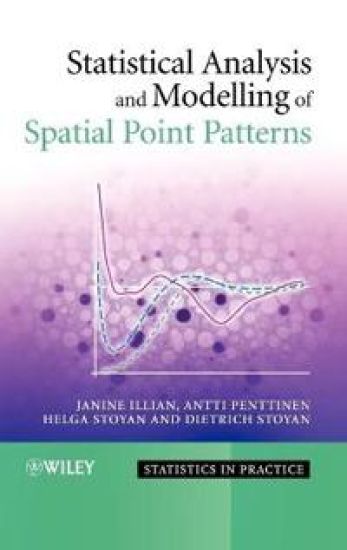
Spatial point processes are mathematical models used to describe and analyse the geometrical structure of patterns formed by objects that are irregularly or randomly distributed in one-, two- or three-dimensional space. Examples include locations of trees in a forest, blood particles on a glass plate, galaxies in the universe, and particle centres in samples of material. Numerous aspects of the nature of a specific spatial point pattern may be described using the appropriate statistical methods. Statistical Analysis and Modelling of Spatial Point Patterns provides a practical guide to the use of these specialised methods. The application-oriented approach helps demonstrate the benefits of this increasingly popular branch of statistics to a broad audience. The book: Provides an introduction to spatial point patterns for researchers across numerous areas of applicationAdopts an extremely accessible style, allowing the non-statistician complete understandingDescribes the process of extracting knowledge from the data, emphasising the marked point processDemonstrates the analysis of complex datasets, using applied examples from areas including biology, forestry, and materials scienceFeatures a supplementary website containing example datasets. Statistical Analysis and Modelling of Spatial Point Patterns is ideally suited for researchers in the many areas of application, including environmental statistics, ecology, physics, materials science, geostatistics, and biology. It is also suitable for students of statistics, mathematics, computer science, biology and geoinformatics.
Umweltstatistik

Umweltstatistik

Helga Stoyan; Uwe Jansen

VS Verlag fur Sozialwissenschaften
1997
nidottu
Die Statistik ist ein unentbehrliches Hilfsmittel der Umweltforschung. Sie wird benutzt, urn die massenhaft anfallenden, oft stark schwankenden, heterogenen und problembeladenen Daten aus der Umwelt zu analysieren und zu interpre- tieren. Viele wichtige Aussagen iiber die Umwelt wurden und werden auf sta- tistischem Wege erhalten. Das sind zum Beispiel diejenigen iiber eventuelle Kli- maveriinderungen, aber die Statistik ermoglicht auch zahlreiche weniger spekta- kuliire (und weniger umstrittene) Erkenntnisse. Das gilt besonders fUr Situatio- nen, in denen das Verhalten zahlreicher Menschen eine Rolle spielt oder wo den eigentlichen Zusammenhiingen erhebliche "zufiillige" Schwankungen iiberlagert sind, die auf vielen verschiedenen und uniibersichtlichen Einfliissen beruhen. Auch im Rahmen der Uberwachung der Umwelt (des "Umweltmonitoring") ist die Statistik ein wichtiges Element. SchlieBlich sind statistische Methoden fiir die Planung und Auswertung von Experimenten in der Umweltforschung erfor- derlich. Natiirlich gibt es keine eigentliche wissenschaftliche Disziplin "Umweltsta- tistik". Tatsache ist aber, dass fUr die U ntersuchung der U mwelt bestimmte statistische Verfahren besonders wichtig sind, und zwar wegen der dabei auf- tretenden speziellen Fragestellungen. Dabei miissen insbesondere riiumliche und zeitliche Aspekte beriicksichtigt werden, oder es sind die Einfliisse verschiedener, gleichzeitig wirkender Grofien simultan zu untersuchen. Verschiedene Verfahren, die das leisten, werden in diesem Buch behandelt, das natiirlich auch den Titel "Ausgewiihlte Kapitel der Statistik, dargestellt an Beispielen aus der Umwelt- forschung" hiitte haben konnen. Insbesondere geht es in dies em Buch urn multivariate Statistik, Zeitreihenanalyse, Geostatistik und zufiillige Punktfolgen.
Fractals, Random Shapes and Point Fields

Fractals, Random Shapes and Point Fields

Dietrich Stoyan; Helga Stoyan

John Wiley Sons Inc
1994
sidottu
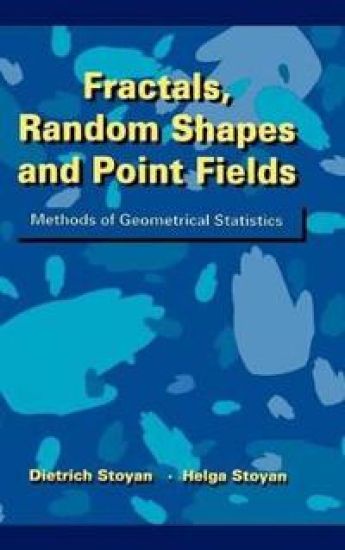
In Part I the reader is introduced to the methods of measuring the fractal dimension of irregular geometric structures. Part II demonstrates important modern methods for the statistical analysis of random shapes. The statistical theory of point fields, with and without marks, is introduced in Part III. Each of the three sections concentrates on the mathematical ideas, rather than detailed proofs, and can be read independently.