Kirjojen hintavertailu – 12 903 725 kirjaa ja 27 kauppaa

Kirjailija

Helge Ole Bergesen

Kirjat ja teokset yhdessä paikassa: 8 kirjaa, julkaisuja vuosilta 1997–2017, suosituimpiin kuuluu Year Book of International Co-operation on Environment and Development. Vertaile teosten hintoja ja tarkista saatavuus suomalaisista kirjakaupoista.

8 kirjaa

Kirjojen julkaisuvuodet: 1997–2017.

Dinosaurs or Dynamos

Dinosaurs or Dynamos

Helge Ole Bergesen; Leiv Lunde

Routledge
2017
sidottu
Explores how much and what the World Bank and the United Nations can really be expected to achieve. The text begins with a detailed account of the evolution of the two organizations as multilateral development institutions and then focuses on the functions that the World Bank and the UN carry out, and the governing structures that underlie their activities. The authors then go on to question what need there is for these two multilateral institutions in the next century and which tasks they can undertake in promoting world development. Both the United Nations (UN) and the World Bank have repeatedly proclaimed their solemn ambitions to improve the lot of humankind. Dinosaurs or Dynamos? explores how much, and what, they can really be expected to do. Both have extended their functions far beyond their original mandates, while their decision-making structures have remained basically unaltered despite recent adaptations on the part of the World Bank. Such expansions have created serious strains on both organizations. The UN has ambitions to perform tasks, such as the search for 'good governance' and 'sustainable development', for which it is ill equipped. The World Bank has taken on normative functions - 'the premier development institution' - that are incompatible with its traditional structures. The authors ask, what need is there for these two multilateral development institutions in the next century? Which tasks in promoting world development can they undertake that others cannot? To whom are these institutions politically accountable, who sets their agendas and are they credible given financial constraints? Dinosaurs or Dynamos? is an essential guide for those working within the international community, non-governmental organizations, governments and students of development, economics, politics and international relations.
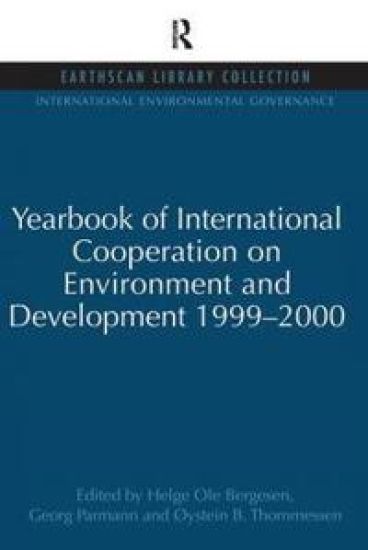
Yearbook of International Cooperation on Environment and Development 1999-2000

Yearbook of International Cooperation on Environment and Development 1999-2000

Helge Ole Bergesen; Georg Parmann; Oystein B. Thommessen

Routledge
2013
nidottu
This edition includes the new Convention on Access to Information, Public Participation in decision Making and Access to Justice in Environmental Matters and the Convention on the Prior Informed Consent Procedure for Certain Hazardous Chemicals and Pesticides in International Trade. ? Intergovernmental Organizations (IGOs), including UN specialized agencies objectives ,Country Profiles Summaries of the performance and main commitments of 15 OECD countries in addition to Brazil, Indonesia, Nigeria, South Africa, and Thailand. Originally published in 1999
Når livet banker på

Når livet banker på

Helge Ole Bergesen

Arneberg
2012
nidottu
"Legen er forbausende ung. Usikkert håndtrykk - er han litt nervøs? Han kremter og tar endelig ordet: 'Du har en livsvarig sykdom. Du må leve med denne diagnosen resten av livet.' Jeg er uhelbredelig. Fra nå av skal jeg leve med kreft, enten jeg vil det eller ei. Cancer prostata. Det hjelper å sette ordene på papiret. De er mindre farlige der enn i hodet. Det er ordene som gjør oss til mennesker, og derfor er de vår styrke når vi står overfor livets mest truende realitet. Ord er alvor. Nå mer enn noensinne." Slik begynner denne dagboken som handler om å skape en ny tilværelse og en ny identitet i et liv med kreft. Forfatteren leter etter en vei videre, ikke som pasient, men som "cancerianer". Han søker støtte i poesi og gastronomi, i hverdagslivets store og små gleder - nærhet og vennskap, jakt og fotball. Det er ikke meningen at vi skal finne meningen med livet, men at vi skal søke etter den, skriver han. Det er ikke døden som banker på sammen med kreftdiagnosen, men livet. Noen ganger så kraftig at det nesten gjør vondt.
Kraft, mod og haab

Kraft, mod og haab

Helge Ole Bergesen

Wigestrand
2011
sidottu
Sigval Bergesen - skipsreder, gründer, politiker og samfunnsbygger. I denne boken er det samfunnsbyggeren Sigval Bergesen som står i sentrum for oppmerksomheten, dvs. samspillet mellom ham, hans samtidige og hans samtid gjennom nesten hundre år. Formålet med biografien er å fortelle en historie om Sigval Bergesens generasjon og hans tid. Sigval Bergesens livsløp henger sammen med alle de sentrale fasene i vår moderne historie: avviklingen av embetsmannsstaten, gjennombruddet for folkestyret, industrialiseringen av landet og moderniseringen av økonomien. Forfatteren retter søkelyset mot de unge "entreprenørpolitikerne" som overtok lederskapet på slutten av 1800-tallet, som gjennomførte "gentlemansrevolusjonen" i 1905 og så tok fatt på "den nye arbeidsdagen" i det nye århundret. Uten dem ville vårt moderne samfunn sett annerledes ut. Et hovedformål med boken er å vise hvordan Sigval Bergesens livsløp kan illustrere den avgjørende rollen hans slektsledd av politikere og forretningsmenn kom til å spille; hvordan de bygde bro fra det forgangne til det moderne, og hvordan de satte standarden for samfunnsengasjement for en ung nasjon.
Yearbook of International Cooperation on Environment and Development 1999-2000

Yearbook of International Cooperation on Environment and Development 1999-2000

Helge Ole Bergesen; Georg Parmann; Oystein B. Thommessen

Earthscan Ltd
2009
sidottu
List of Contents * Current Issues and Key Themes * Agreements on Environment and Development Systematically listed key data and illustrations concerning the most important international agreements presented on the basis of information from the organizations in question and other sources, covering such matters as: objectives ? scope ? time and place of establishment ? status of participation ? affiliated instruments and organizations ? major activities ? secretariat ? finance ? rules and standards ? monitoring and implementation ? decision-making bodies ? key publications ? Internet sources. This edition includes the new Convention on Access to Information, Public Participation in decision Making and Access to Justice in Environmental Matters and the Convention on the Prior Informed Consent Procedure for Certain Hazardous Chemicals and Pesticides in International Trade. * Intergovernmental Organizations (IGOs), including UN specialized agencies objectives ? type of organization ? membership ? date of establishment ? secretariat ? activities ? decision-making bodies ? finance ? key publications ? Internet sources. * International Non-governmental Organizations (NGOs) * objectives ? type of organization ? membership ? date of establishment ? secretariat ? activities ? budget ? key publications ? Internet sources. * Country Profiles Summaries of the performance and main commitments of 15 OECD countries in addition to Brazil, Indonesia, Nigeria, South Africa, and Thailand. Originally published in 1999
Year Book of International Co-operation on Environment and Development

Year Book of International Co-operation on Environment and Development

Helge Ole Bergesen; Georg Parmann; Oystein B. Thommessen

Earthscan Ltd
1999
sidottu
This eighth annual edition analyzes the international community's position on specific environment and development problems, the main obstacles to effective international solutions, and how to overcome them. It assesses both the achievements and shortcomings of co-operation, distinguishing between the rhetoric and the reality of environmental world politics.
Dinosaurs or Dynamos

Dinosaurs or Dynamos

Helge Ole Bergesen; Leiv Lunde

Earthscan Ltd
1999
nidottu
Explores how much and what the World Bank and the United Nations can really be expected to achieve. The text begins with a detailed account of the evolution of the two organizations as multilateral development institutions and then focuses on the functions that the World Bank and the UN carry out, and the governing structures that underlie their activities. The authors then go on to question what need there is for these two multilateral institutions in the next century and which tasks they can undertake in promoting world development. Both the United Nations (UN) and the World Bank have repeatedly proclaimed their solemn ambitions to improve the lot of humankind. Dinosaurs or Dynamos? explores how much, and what, they can really be expected to do. Both have extended their functions far beyond their original mandates, while their decision-making structures have remained basically unaltered despite recent adaptations on the part of the World Bank. Such expansions have created serious strains on both organizations. The UN has ambitions to perform tasks, such as the search for 'good governance' and 'sustainable development', for which it is ill equipped. The World Bank has taken on normative functions - 'the premier development institution' - that are incompatible with its traditional structures. The authors ask, what need is there for these two multilateral development institutions in the next century? Which tasks in promoting world development can they undertake that others cannot? To whom are these institutions politically accountable, who sets their agendas and are they credible given financial constraints? Dinosaurs or Dynamos? is an essential guide for those working within the international community, non-governmental organizations, governments and students of development, economics, politics and international relations.

Environmental Challenges Confronting the Oil Industry

Environmental Challenges Confronting the Oil Industry

Javier Estrada; Kristian Tangen; Helge Ole Bergesen

John Wiley Sons Inc
1997
sidottu
Since the late 1980s, when the current tide of environmentalconcern began to rise, every improvement made by the oil industryhas been followed by new demands for further progress. New problemshave been placed on top of the old ones; first smog in the innercities and oil spills on the beaches, then acid rain and forest dieback followed by major tank disasters and renewed attention tourban air quality and finally, climatic change. The purpose of thisbook is to investigate whether the oil industry is able to extendand renew its social legitimacy as it faces its toughest agenda ina century the challenges stemming from its impact on theenvironment and the consequent public questioning of its role insociety. To find out whether and how the oil industry has respondedto environmental issues in general and climatic change inparticular, five indicators of change vision & image, R&D,investments, and government relations have been selected. Thesehave been assumed to be expressions of an environmental strategywhich can be identified as reactive, cautious or creative. Theempirical analysis begins with case studies of the environmentalresponse of five major oil companies: Shell, Exxon, BP, Amoco andStatoil. The next step is a case study of the refinery sector,which is the most environmentally sensitive part of the industry inmany ways. In addition, a brief description of how three industryassociations have tackled the same environmental issues isincluded. The main readership for this book will be policy makers,planners and researchers in the oil industry, and environmentalconsultants.