
Kirjailija
Helmut Maier
Kirjat ja teokset yhdessä paikassa: 8 kirjaa, julkaisuja vuosilta 2013–2025, suosituimpiin kuuluu Grundlagen der Robotik. Vertaile teosten hintoja ja tarkista saatavuus suomalaisista kirjakaupoista.
8 kirjaa
Kirjojen julkaisuvuodet: 2013–2025.
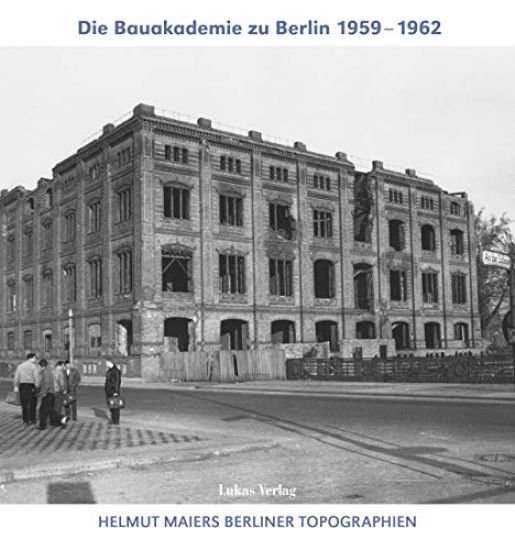
Helmut Maiers Berliner Topographien / Die Bauakademie zu Berlin 1959-1962
Helmut Maier
Lukas Verlag
2023
nidottu

Recent Progress On Topics Of Ramanujan Sums And Cotangent Sums Associated With The Riemann Hypothesis
Helmut Maier; Michael Th Rassias; Laszlo Toth
WORLD SCIENTIFIC PUBLISHING CO PTE LTD
2022
sidottu
In this monograph, we study recent results on some categories of trigonometric/exponential sums along with various of their applications in Mathematical Analysis and Analytic Number Theory. Through the two chapters of this monograph, we wish to highlight the applicability and breadth of techniques of trigonometric/exponential sums in various problems focusing on the interplay of Mathematical Analysis and Analytic Number Theory. We wish to stress the point that the goal is not only to prove the desired results, but also to present a plethora of intermediate Propositions and Corollaries investigating the behaviour of such sums, which can also be applied in completely different problems and settings than the ones treated within this monograph. In the present work we mainly focus on the applications of trigonometric/exponential sums in the study of Ramanujan sums — which constitute a very classical domain of research in Number Theory — as well as the study of certain cotangent sums with a wide range of applications, especially in the study of Dedekind sums and a facet of the research conducted on the Riemann Hypothesis. For example, in our study of the cotangent sums treated within the second chapter, the methods and techniques employed reveal unexpected connections with independent and very interesting problems investigated in the past by R de la Bretèche and G Tenenbaum on trigonometric series, as well as by S Marmi, P Moussa and J-C Yoccoz on Dynamical Systems. Overall, a reader who has mastered fundamentals of Mathematical Analysis, as well as having a working knowledge of Classical and Analytic Number Theory, will be able to gradually follow all the parts of the monograph. Therefore, the present monograph will be of interest to advanced undergraduate and graduate students as well as researchers who wish to be informed on the latest developments on the topics treated.

Edition Tirta: Kartenset - Die Blüten des Edward Bach
Helmut Maier
Reise Know-How Rump GmbH
2021
nidottu

Die Gesellschaft Deutscher Chemiker (GDCh) wurde 1949 gegründet und ist heute mit über 30.000 Mitgliedern, vorrangig aus Hochschulen und Industrie, die größte kontinentaleuropäische chemische Gesellschaft. Ihre im 19. Jahrhundert gegründeten Vorgängerorganisationen, die Deutsche Chemische Gesellschaft (DChG) und der Verein Deutscher Chemiker (VDCh), wirkten als die Motoren der so erfolgreichen Chemie in Deutschland und sind Teil des Erbes der GDCh. Dessen dunkle Seite begann man erst ab 2001 zuuntersuchen. Bis dahin sorgten auch in diesem Bereich unserer Gesellschaft existierende Kontinuitäten dafür, dass der Mantel des Schweigens über Leben und Wirken der männerbestimmten Verbände und ihrer Protagonisten gebreitet wurde. Viele Opfer des totalitären NS-Staates blieben gänzlich unbekannt. Der Wissenschaftshistoriker Helmut Maier legt nun eine eindrucksvolle, umfassende und unabhängige Studie über Funktionen und Strukturen der DChG und des VDCh von 1933 bis 1945 vor. Detailliert wird der Weg auch weniger bekannter Chemiker aus Forschung, Industrie und dem deutschen chemischenLiteraturwesen beschrieben, sowie Einzelschicksale systematisch aufgespürt und beleuchtet. Erstmals existiert ein Gesamtbild über die Berufsgruppe der Chemiker, ihre für das „Dritte Reich“ so bedeutende Rolle und damit vor allem eine mahnende Erinnerung für alle Nachfolgegenerationen.