Kirjojen hintavertailu – 12 903 725 kirjaa ja 27 kauppaa

Kirjailija

Helmut Rechenberg

Kirjat ja teokset yhdessä paikassa: 12 kirjaa, julkaisuja vuosilta 1982–2014, suosituimpiin kuuluu Original Scientific Papers / Wissenschaftliche Originalarbeiten. Vertaile teosten hintoja ja tarkista saatavuus suomalaisista kirjakaupoista.

12 kirjaa

Kirjojen julkaisuvuodet: 1982–2014.

Original Scientific Papers / Wissenschaftliche Originalarbeiten

Original Scientific Papers / Wissenschaftliche Originalarbeiten

Walter Blum; Hans-Peter Dürr; Helmut Rechenberg

Springer-Verlag Berlin and Heidelberg GmbH Co. K
2014
nidottu
This is the final volume of Heisenberg's Collected Works. It contains his papers on a (nonlinear) unified theory of elementary particles, as well as his contribution to superconductivity and multiparticle production. Especially interesting is the first group of papers, which is split intotwo sections dealing with, firstly, the formulation of the famous nonlinear spinor equation and, secondly,its applications. Among others the reader willfind a thorough discussion of Heisenberg's collaboration with W. Pauli on these matters. Illuminating annotations to the various sections in this volume have been provided by H. Koppe, R. Hagedorn and the editors.
Original Scientific Papers Wissenschaftliche Originalarbeiten

Original Scientific Papers Wissenschaftliche Originalarbeiten

Walter Blum; Helmut Rechenberg; Hans-Peter Dürr

Springer-Verlag Berlin and Heidelberg GmbH Co. K
2011
nidottu
Werner Heisenberg is one of the greatest scientists of our century. His work extends over a period of fifty years, ranging from turbulence theory, the establishment of quantum mechanics, its fundamental applications in atomic and solid state physics, to the theory of cosmic ray phenomena and of elementary particles. He recognized early the epistemological significance of the new discoveries. He was able to place the radical changes in the foundation of physics of this century in the historical context of natural philosophy. His thoughts on language as the medium to grasp scientific truth, artistic truth, religious truth, truth in general, reached many auditors and readers, scientists as well as non-scientists. In the 75 years of his life the political and social structure of his home country, of Europe and the world over underwent drastic changes. He grew up in Imperial Germany, made his great contributions to quantum mechanics during the period of the Weimar Republic and was engaged in nuclear physics when the potentates of the Third Reich tried to discredit relativity and quantum theory as "degenerate" science; in World War II he participated in the German effort to develop a nuclear reactor. After the war, he devoted himself mainly to the physics of elementary particles. In addition, he acted in many official capacities: for the promotion of research, the reconstruction of science in the Federal Republic of Germany, and the advancement of international collabora- tion.
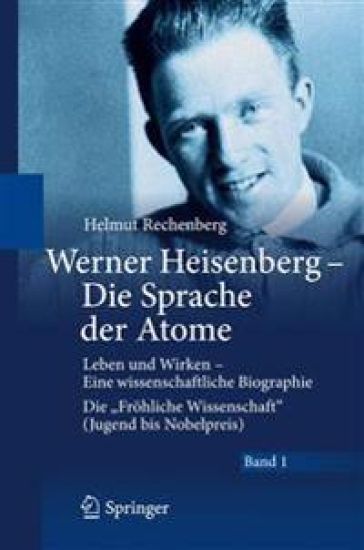
Werner Heisenberg - Die Sprache der Atome

Werner Heisenberg - Die Sprache der Atome

Helmut Rechenberg

Springer-Verlag Berlin and Heidelberg GmbH Co. KG
2010
sidottu
Mit seiner Entdeckung, dass sich Messwerte komplementärer Größen in der mikroskopischen Welt nicht beliebig genau bestimmen lassen, durchschnitt Werner Heisenberg den Gordischen Knoten zur Vollendung der von Planck, Einstein und anderen entwickelten Quantentheorie und eröffnete damit ein neues „goldenes Zeitalter" in der Physik des 20. Jahrhunderts. Auf der Grundlage der Dokumente aus seinem Leben und Wirken, d.h. der Urkunden, Briefe und Berichte von Zeitzeugen sowie der publizierten und unpublizierten Abhandlungen, Bücher und Artikel Heisenbergs – auch der später aufgefundenen, überwiegend aus dem Nachlass Heisenbergs stammenden Veröffentlichungen oder Manuskripten – entstand diese systematische Biographie Heisenbergs. Der Verfasser, der letzte Doktorand Heisenbergs, stützte sich weiterhin auf sachliche und persönliche Kenntnisse, vor allem eigene Erinnerungen an seinen Doktorvater und dessen Lehrer, Kollegen und Schüler. Im Interesse einer authentischen Biographie des theoretischen Physikers Heisenberg konnte auf die Darlegung der mathematischen Ansätze und der entsprechenden Ableitungen nicht ganz verzichtet werden. Diese Biographie richtet sich somit sowohl an ein wissenschaftlich gebildetes als auch an ein breiteres, an der Wissenschaft interessiertes Publikum und deckt die erste Phase Heisenberg Lebens bis zu seinem Nobelpreis 1933 ab.
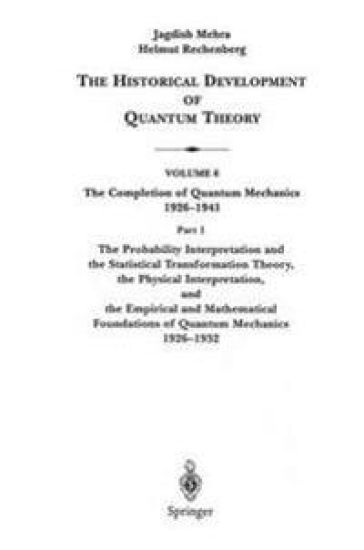
The Probability Interpretation and the Statistical Transformation Theory, the Physical Interpretation, and the Empirical and Mathematical Foundations of Quantum Mechanics 1926–1932
Quantum Theory, together with the principles of special and general relativity, constitute a scientific revolution that has profoundly influenced the way in which we think about the universe and the fundamental forces that govern it. The Historical Development of Quantum Theory is a definitive historical study of that scientific work and the human struggles that accompanied it from the beginning. Drawing upon such materials as the resources of the Archives for the History of Quantum Physics, the Niels Bohr Archives, and the archives and scientific correspondence of the principal quantum physicists, as well as Jagdish Mehra's personal discussions over many years with most of the architects of quantum theory, the authors have written a rigorous scientific history of quantum theory in a deeply human context. This multivolume work presents a rich account of an intellectual triumph: a unique analysis of the creative scientific process. The Historical Development of Quantum Theory is science, history, and biography, all wrapped in the story of a great human enterprise. Its lessons will be an aid to those working in the sciences and humanities alike.
Part 1 Schrödinger in Vienna and Zurich 1887–1925

Part 1 Schrödinger in Vienna and Zurich 1887–1925

Jagdish Mehra; Helmut Rechenberg

Springer-Verlag New York Inc.
2000
nidottu
Quantum Theory, together with the principles of special and general relativity, constitute a scientific revolution that has profoundly influenced the way in which we think about the universe and the fundamental forces that govern it. The Historical Development of Quantum Theory is a definitive historical study of that scientific work and the human struggles that accompanied it from the beginning. Drawing upon such materials as the resources of the Archives for the History of Quantum Physics, the Niels Bohr Archives, and the archives and scientific correspondence of the principal quantum physicists, as well as Jagdish Mehra's personal discussions over many years with most of the architects of quantum theory, the authors have written a rigorous scientific history of quantum theory in a deeply human context. This multivolume work presents a rich account of an intellectual triumph: a unique analysis of the creative scientific process. The Historical Development of Quantum Theory is science, history, and biography, all wrapped in the story of a great human enterprise. Its lessons will be an aid to those working in the sciences and humanities alike.
The Historical Development of Quantum Theory

The Historical Development of Quantum Theory

Jagdish Mehra; Helmut Rechenberg

Springer-Verlag New York Inc.
2000
nidottu
Quantum Theory, together with the principles of special and general relativity, constitute a scientific revolution that has profoundly influenced the way in which we think about the universe and the fundamental forces that govern it. The Historical Development of Quantum Theory is a definitive historical study of that scientific work and the human struggles that accompanied it from the beginning. Drawing upon such materials as the resources of the Archives for the History of Quantum Physics, the Niels Bohr Archives, and the archives and scientific correspondence of the principal quantum physicists, as well as Jagdish Mehra's personal discussions over many years with most of the architects of quantum theory, the authors have written a rigorous scientific history of quantum theory in a deeply human context. This multivolume work presents a rich account of an intellectual triumph: a unique analysis of the creative scientific process. The Historical Development of Quantum Theory is science, history, and biography, all wrapped in the story of a great human enterprise. Its lessons will be an aid to those working in the sciences and humanities alike.
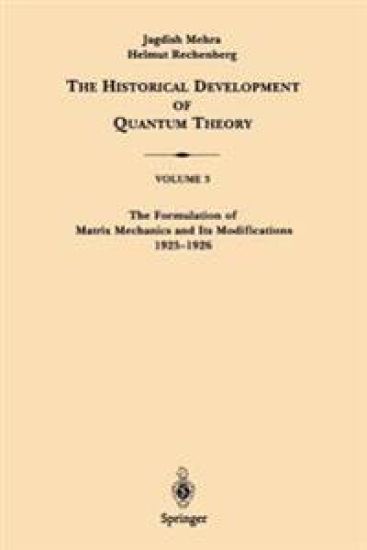
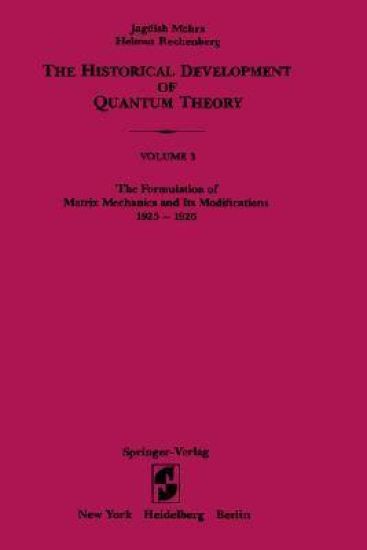
The Formulation of Matrix Mechanics and Its Modifications 1925–1926

The Formulation of Matrix Mechanics and Its Modifications 1925–1926

Jagdish Mehra; Helmut Rechenberg

Springer-Verlag New York Inc.
2000
nidottu
Quantum Theory, together with the principles of special and general relativity, constitute a scientific revolution that has profoundly influenced the way in which we think about the universe and the fundamental forces that govern it. The Historical Development of Quantum Theory is a definitive historical study of that scientific work and the human struggles that accompanied it from the beginning. Drawing upon such materials as the resources of the Archives for the History of Quantum Physics, the Niels Bohr Archives, and the archives and scientific correspondence of the principal quantum physicists, as well as Jagdish Mehra's personal discussions over many years with most of the architects of quantum theory, the authors have written a rigorous scientific history of quantum theory in a deeply human context. This multivolume work presents a rich account of an intellectual triumph: a unique analysis of the creative scientific process. The Historical Development of Quantum Theory is science, history, and biography, all wrapped in the story of a great human enterprise. Its lessons will be an aid to those working in the sciences and humanities alike.
The Historical Development of Quantum Theory

The Historical Development of Quantum Theory

Jagdish Mehra; Helmut Rechenberg

Springer-Verlag New York Inc.
2000
nidottu
Quantum Theory, together with the principles of special and general relativity, constitute a scientific revolution that has profoundly influenced the way in which we think about the universe and the fundamental forces that govern it. The Historical Development of Quantum Theory is a definitive historical study of that scientific work and the human struggles that accompanied it from the beginning. Drawing upon such materials as the resources of the Archives for the History of Quantum Physics, the Niels Bohr Archives, and the archives and scientific correspondence of the principal quantum physicists, as well as Jagdish Mehra's personal discussions over many years with most of the architects of quantum theory, the authors have written a rigorous scientific history of quantum theory in a deeply human context. This multivolume work presents a rich account of an intellectual triumph: a unique analysis of the creative scientific process. The Historical Development of Quantum Theory is science, history, and biography, all wrapped in the story of a great human enterprise. Its lessons will be an aid to those working in the sciences and humanities alike.
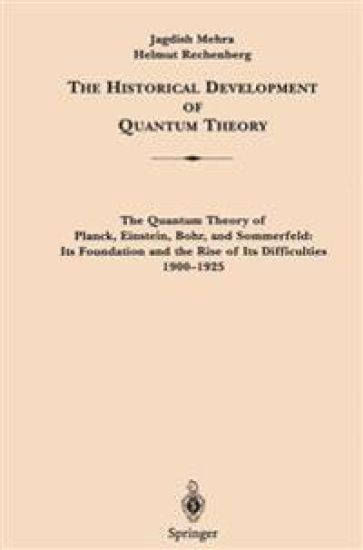
The Quantum Theory of Planck, Einstein, Bohr and Sommerfeld: Its Foundation and the Rise of Its Difficulties 1900–1925
Quantum Theory, together with the principles of special and general relativity, constitute a scientific revolution that has profoundly influenced the way in which we think about the universe and the fundamental forces that govern it. The Historical Development of Quantum Theory is a definitive historical study of that scientific work and the human struggles that accompanied it from the beginning. Drawing upon such materials as the resources of the Archives for the History of Quantum Physics, the Niels Bohr Archives, and the archives and scientific correspondence of the principal quantum physicists, as well as Jagdish Mehra's personal discussions over many years with most of the architects of quantum theory, the authors have written a rigorous scientific history of quantum theory in a deeply human context. This multivolume work presents a rich account of an intellectual triumph: a unique analysis of the creative scientific process. The Historical Development of Quantum Theory is science, history, and biography, all wrapped in the story of a great human enterprise. Its lessons will be an aid to those working in the sciences and humanities alike.
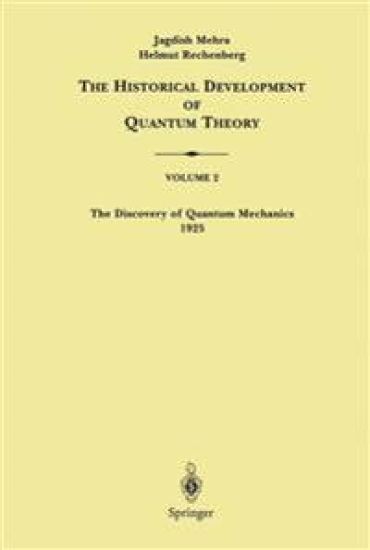
The Discovery of Quantum Mechanics 1925

The Discovery of Quantum Mechanics 1925

Jagdish Mehra; Helmut Rechenberg

Springer-Verlag New York Inc.
2000
nidottu
Quantum Theory, together with the principles of special and general relativity, constitute a scientific revolution that has profoundly influenced the way in which we think about the universe and the fundamental forces that govern it. The Historical Development of Quantum Theory is a definitive historical study of that scientific work and the human struggles that accompanied it from the beginning. Drawing upon such materials as the resources of the Archives for the History of Quantum Physics, the Niels Bohr Archives, and the archives and scientific correspondence of the principal quantum physicists, as well as Jagdish Mehra's personal discussions over many years with most of the architects of quantum theory, the authors have written a rigorous scientific history of quantum theory in a deeply human context. This multivolume work presents a rich account of an intellectual triumph: a unique analysis of the creative scientific process. The Historical Development of Quantum Theory is science, history, and biography, all wrapped in the story of a great human enterprise. Its lessons will be an aid to those working in the sciences and humanities alike.
The Probability Interpretation and the Statistical Transformation Theory, the Physical Interpretation, and the Empirical and Mathematical Foundations of Quantum Mechanics 1926–1932
Quantum Theory, together with the principles of special and general relativity, constitute a scientific revolution that has profoundly influenced the way in which we think about the universe and the fundamental forces that govern it. The Historical Development of Quantum Theory is a definitive historical study of that scientific work and the human struggles that accompanied it from the beginning. Drawing upon such materials as the resources of the Archives for the History of Quantum Physics, the Niels Bohr Archives, and the archives and scientific correspondence of the principal quantum physicists, as well as Jagdish Mehra's personal discussions over many years with most of the architects of quantum theory, the authors have written a rigorous scientific history of quantum theory in a deeply human context. This multivolume work presents a rich account of an intellectual triumph: a unique analysis of the creative scientific process. The Historical Development of Quantum Theory is science, history, and biography, all wrapped in the story of a great human enterprise. Its lessons will be an aid to those working in the sciences and humanities alike.
The Formulation of Matrix Mechanics and Its Modifications 1925–1926

The Formulation of Matrix Mechanics and Its Modifications 1925–1926

Jagdish Mehra; Helmut Rechenberg

Springer-Verlag New York Inc.
1982
sidottu
Quantum Theory, together with the principles of special and general relativity, constitute a scientific revolution that has profoundly influenced the way in which we think about the universe and the fundamental forces that govern it. The Historical Development of Quantum Theory is a definitive historical study of that scientific work and the human struggles that accompanied it from the beginning. Drawing upon such materials as the resources of the Archives for the History of Quantum Physics, the Niels Bohr Archives, and the archives and scientific correspondence of the principal quantum physicists, as well as Jagdish Mehra's personal discussions over many years with most of the architects of quantum theory, the authors have written a rigorous scientific history of quantum theory in a deeply human context. This multivolume work presents a rich account of an intellectual triumph: a unique analysis of the creative scientific process. The Historical Development of Quantum Theory is science, history, and biography, all wrapped in the story of a great human enterprise. Its lessons will be an aid to those working in the sciences and humanities alike.