Kirjojen hintavertailu – 12 903 735 kirjaa ja 27 kauppaa

Kirjailija

Henk J. de Vries

Kirjat ja teokset yhdessä paikassa: 4 kirjaa, julkaisuja vuosilta 1999–2019, suosituimpiin kuuluu Standardization: A Business Approach to the Role of National Standardization Organizations. Vertaile teosten hintoja ja tarkista saatavuus suomalaisista kirjakaupoista.

4 kirjaa

Kirjojen julkaisuvuodet: 1999–2019.

Restaurant Chains in China

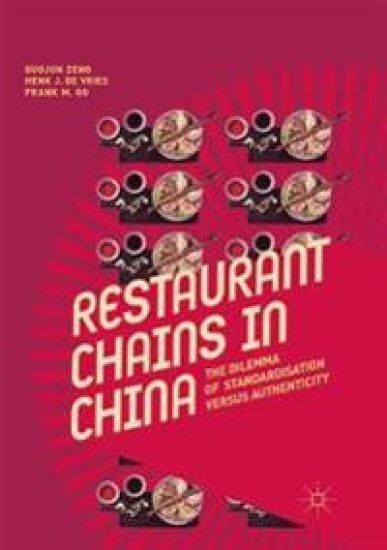
Restaurant Chains in China

Guojun Zeng; Henk J. de Vries; Frank M. Go

Springer Verlag, Singapore
2019
nidottu
This book explores the paradox of the hospitality industry: customers demand not only personal and innovative tourism products and services, but also cost-effective ones. Enterprises have the option to meet the former demand by offering authentic products and services while the latter could be achieved through standardization. Although it seems ideal to combine both concepts, they seemingly contradict each other leading to suppliers facing an authenticity-standardization paradox. The authors identify, analyze, and provide solutions for this authenticity-standardization paradox based on a series of case studies of restaurants in China. This book will be of interest to scholars, business owners, and consultants.

Restaurant Chains in China

Restaurant Chains in China

Guojun Zeng; Henk J. de Vries; Frank M. Go

Springer Verlag, Singapore
2018
sidottu
This book explores the paradox of the hospitality industry: customers demand not only personal and innovative tourism products and services, but also cost-effective ones. Enterprises have the option to meet the former demand by offering authentic products and services while the latter could be achieved through standardization. Although it seems ideal to combine both concepts, they seemingly contradict each other leading to suppliers facing an authenticity-standardization paradox. The authors identify, analyze, and provide solutions for this authenticity-standardization paradox based on a series of case studies of restaurants in China. This book will be of interest to scholars, business owners, and consultants.

Standardization: A Business Approach to the Role of National Standardization Organizations
This study fills a gap in standardization literature. It is the first academic analysis of national standardization organizations. These organizations exist in every country and may be private or governmental organizations. The first national standardization th organizations were founded in the early decades of the 20 century and were aimed at rationalizing industrial production. Their mode of operation reflects the sense of co­ operation at the national level and - in the telecommunications and electrotechnical field - at the intemationallevel as well. Now, however, the scene has changed, with companies operating internationally. Standards for products, processes, and services are crucial factors in determining success or failure on a fiercely competitive market, especially when functional compatibility is a prerequisite, as is the case in computer and telecommunications technologies. As a consequence, rather homogeneous needs of participants in standardization have given way to conflicting interests. This prompts a discussion about the traditional role of national standardization organizations. They increasingly depend on their exclusive links to the international standardization organizations ISO and IEC, and, in the case of Europe, the regional organizations CEN and CENELEC. In many cases, formal standardization organizations are not the obvious bodies for developing standards to meet business needs. Is this inevitable or could they improve performance and regain their market share? Henk de Vries answers this question against the background of current developments in standardization at the international, European, and national levels.
Standardization: A Business Approach to the Role of National Standardization Organizations
This study fills a gap in standardization literature. It is the first academic analysis of national standardization organizations. These organizations exist in every country and may be private or governmental organizations. The first national standardization th organizations were founded in the early decades of the 20 century and were aimed at rationalizing industrial production. Their mode of operation reflects the sense of co­ operation at the national level and - in the telecommunications and electrotechnical field - at the intemationallevel as well. Now, however, the scene has changed, with companies operating internationally. Standards for products, processes, and services are crucial factors in determining success or failure on a fiercely competitive market, especially when functional compatibility is a prerequisite, as is the case in computer and telecommunications technologies. As a consequence, rather homogeneous needs of participants in standardization have given way to conflicting interests. This prompts a discussion about the traditional role of national standardization organizations. They increasingly depend on their exclusive links to the international standardization organizations ISO and IEC, and, in the case of Europe, the regional organizations CEN and CENELEC. In many cases, formal standardization organizations are not the obvious bodies for developing standards to meet business needs. Is this inevitable or could they improve performance and regain their market share? Henk de Vries answers this question against the background of current developments in standardization at the international, European, and national levels.