Kirjojen hintavertailu – 12 859 828 kirjaa ja 27 kauppaa

Kirjailija

Henri Poincaré

Kirjat ja teokset yhdessä paikassa: 112 kirjaa, julkaisuja vuosilta 1894–2026, suosituimpiin kuuluu Mathematische Theorie des Lichtes. Vertaile teosten hintoja ja tarkista saatavuus suomalaisista kirjakaupoista.

Nimi esiintyy myös muodoissa: Henri Poincare

112 kirjaa

Kirjojen julkaisuvuodet: 1894–2026.

Science and Method

Science and Method

Henri Poincare

Cosimo Classics
2007
pokkari
"Henri Poincare s Science and Method is an examination of the process scientists go through when determining which of the countless facts before them will be most useful in advancing scientific knowledge. In this highly readable text first published in 1908 and here presented in a 1914 translation Poincare investigates mathematics, logic, physics, mechanics, and astronomy and discusses how the methods of selection differ with each field. Topics discussed include: the selection of facts the future of mathematics chance the relativity of space mathematics and logic mechanics and radium mechanics and optics the new mechanics and astronomy the Milky Way and the theory of gases and much more. French theoretical physicist, philosopher of science, and mathematician HENRI POINCARE (1854 1912) also wrote New Methods of Celestial Mechanics (1892 99) and Lessons of Celestial Mechanics. (1905 10)."
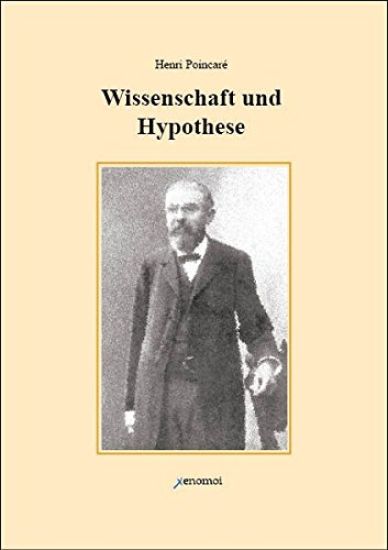
Wissenschaft und Hypothese

Wissenschaft und Hypothese

Henri Poincaré

Xenomoi Verlag
2003
nidottu
Der Text enthält neben den üblichen Teilen 1 - 4 auch die ausführlichen erläuternden Anmerkungen von F. Lindemann (ca. 70 Seiten). Diese 4. Auflage des 1928 zum letzten Mal auf deutsch erschienenen Werkes wurde vollkommen neu gesetzt, hält sich inhaltlich jedoch vollständig an die 3. Auflage 1928.
Scientific Opportunism L’Opportunisme scientifique

Scientific Opportunism L’Opportunisme scientifique

Henri Poincaré

BIRKHAUSER VERLAG AG
2002
sidottu
During his lifetime, Henri Poincare published three major philosophical books which achieved great success: "La science et l'hypothese" (1902), "La valeur de la science" (1905) and "Science et methode" (1908). After his death in 1913, a fourth volume of his philosophical works was published by his heirs as "Dernieres pensees" (1913). The four books constitute the core of Poincare's philosophic works and were given an ovation by scientific and general public. Around 1919, Gustave Le Bon wrote to Poincare's widow. As the director of the "Bibliotheque de Philosophie Scientifique at Flammarion", he asked her permission to publish a second posthumous volume. "L'Opportunisme scientifique" was intended to be the fifth and final volume of Poincare's philosophical writings. Louis Rougier had elaborated the project, with the collaboration of Gustave Le Bon, and the approval of the philosopher Emile Boutroux and his son Pierre. Because of the reservations of the mathematician's heirs, this book was never published and Dernieres pensees remained his last philosophical book. Nevertheless Poincare's correspondence - which is kept in the Poincare Archives at University Nancy 2 - contains a large amount of documents concerning the project, its justification and the discussions between Louis Rougier and the mathematician's heirs. The aim of this book is to restore this episode, which gives some crucial informations about editorial practices of Poincare and about the posterity of his philosophic thinking.
The Value of Science

The Value of Science

Henri Poincare

Modern Library Inc
2001
pokkari

Halvin toimitettuna 32,40 €

More than any other writer of the twentieth century, Henri Poincaré brought the elegant, but often complicated, ideas about science and mathematics to the general reader. A genius who throughout his life solved complex mathematical calculations in his head, and a writer gifted with an inimitable style, Poincaré rose to the challenge of interpreting the philosophy of science to scientists and nonscientists alike. His lucid and welcoming prose made him the Carl Sagan of his time. This volume collects his three most important books: Science and Hypothesis (1903); The Value of Science (1905); and Science and Method (1908).
Papers on Fuchsian Functions

Papers on Fuchsian Functions

Henri Poincare

Springer-Verlag New York Inc.
2000
sidottu
by John Stillwell I. General Reaarb , Poincare's papers on Fuchsian and Kleinian I1'OUps are of Il'eat interest from at least two points of view: history, of course, but also as an inspiration for further mathematical proll'ess. The papers are historic as the climax of the ceometric theory of functions initiated by Riemann, and ideal representatives of the unity between analysis, ceometry, topololY and alcebra which prevailed during the 1880's. The rapid mathematical prOll'ess of the 20th century has been made at the expense of unity and historical perspective, and if mathematics is not to disintell'ate altogether, an effort must sometime be made to find its , main threads and weave them tocether 81ain. Poincare's work is an excellent example of this process, and may yet prove to be at the core of a . new synthesis. Certainly, we are now able to gather up , some of the loose ends in Poincare, and a broader synthesis seems to be actually taking place in the work of Thurston. The papers I have selected include the three Il'eat memoirs in the first volumes of Acta Math. -tice, on* Fuchsian groups, Fuchsian , functions, and Kleinian groups (Poincare [1882 a,b,1883]). These are the papers which made his reputation and they include many results and proofs which are now standard. They are preceded by an , unedited memoir written by Poincare in May 1880 at the height of his , creative ferment.

New Methods of Celestial Mechanics

New Methods of Celestial Mechanics

Henri Poincare

American Institute of Physics
1992
sidottu
Edited by Daniel Goroff, Harvard University This English-language edition of Poincare's landmark work is of interest not only to historians of science, but also to mathematicians. Beginning from an investigation of the three-body problem of Newtonian mechanics, Poincare lays the foundations of the qualitative solutions of differential equations. To investigate the long-unsolved problem of the stability of the Solar System, Poincare invented a number of new techniques including canonical transformations, asymptotic series expansions, and integral invariants. These "new methods" are even now finding applications in chaos and other contemporary disciplines. Contents: Volume I: Periodic and asymptotic solutions: Introduction by Daniel Goroff. Generalities and the Jacobi method. Series integration. Periodic solutions. Characteristic exponents. Nonexistence of uniform integrals. Approximate development of the perturbative function. Asymptotic solutions. Volume II: Approximations by series: Formal calculus. Methods of Newcomb and Lindstedt. Application to the study of secular variations. Application to the three-body problem. Application to orbits. Divergence of the Lindstedt series. Direct calculation of the series. Other methods of direct calculation. Gylden methods. Case of linear equations. Bohlin methods. Bohlin series. Extension of the Bohlin method. Volume III: Integral invariants and asymptotic properties of certain solutions: Integral invariants. Formation of invariants. Use of integral invariants. Integral invariants and asymptotic solutions. Poisson stability. Theory of consequents. Periodic solutions of the second kind. Different forms of the principle of least action.
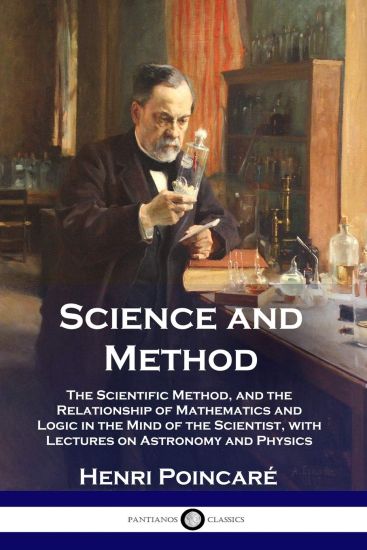
Science and Method

Science and Method

Henri Poincaré

Pantianos Classics
1914
pokkari
Poincare's explanation of the scientific method and the steps taken by scientists to discern the best experiments and results for the advancement of knowledge remains a classic on the subject. Straddling the line between rigorous scientific practice and philosophy of mind, Poincare explores what constitutes a good scientific mind. How can such a mind make the best use of mathematics and logic to arrive at results and discoveries in science? With mathematics evermore crucial in quantifying and interpreting results, can we conclude that an adept command of numbers and logical theory is vital for contemporary scientists? Writing at the start of the 20th century, Poincare lived at a time of exciting advancements. Great strides were made physics and chemistry, with new industrial processes following on from these. An ever-growing sophistication of telescopes and astronomy meant space could be comprehended. In all, science and technology were instrumental to modern society. Books such as this sought to help the public obtain clarity on how discoveries are made and reliable theories posited - the idea of popular science, whereby the methodology is explained for ordinary people, was catching on.