
Kirjailija
Henry D. Sokolski
Kirjat ja teokset yhdessä paikassa: 13 kirjaa, julkaisuja vuosilta 2001–2017, suosituimpiin kuuluu Should We Let The Bomb Spread. Vertaile teosten hintoja ja tarkista saatavuus suomalaisista kirjakaupoista.
Nimi esiintyy myös muodoissa: Henry D Sokolski
13 kirjaa
Kirjojen julkaisuvuodet: 2001–2017.
Nuclear deterrence and nonproliferation no longer enjoy the broad support they once did during the Cold War. Academics and security experts now question the ability of either to cope or check nuclear rogue states or terrorists. On the one hand, America's closest allies--e.g., Japan and South Korea--believe American nuclear security guarantees are critical to their survival. If the United States is unwilling to provide Tokyo or Seoul with the assurance they believe they need, would it then not make sense for them to acquire nuclear forces of their own? On the other hand, with more nuclear-armed states and an increased willingness to use them, how likely is it that nuclear deterrence will work? This volume investigates these questions. In it, six experts offer a variety of perspectives to catalyze debate. The result is a rich debate that goes well beyond current scholarship to challenge the very basis of prevailing nonproliferation and security policies.
Underestimated Second Edition: Our Not So Peaceful Nuclear Future
Henry D. Sokolski
Nonproliferation Policy Education Center
2016
nidottu
With the world focused on the nuclear crisis in Iran, it is tempting to think that addressing this case, North Korea, and the problem of nuclear terrorism is all that matters and is what matters most. Perhaps, but if states become more willing to use their nuclear weapons to achieve military advantage, the problem of proliferation will become much more unwieldy. In this case, U. S. security will be hostage not just to North Korea, Iran, or terrorists, but to nuclear proliferation more generally, diplomatic miscalculations, and wars between a much larger number of possible players. This, in a nutshell, is the premise of Underestimated: Our Not So Peaceful Nuclear Future, which explores what we may be up against and how we think about this future. Will nuclear weapons spread in the next 20 years to more nations than just North Korea and possibly Iran? Might they be used and, if so, what might we suffer? Finally, what can be done? Underestimated examines each of these questions. NPEC created the first version of Underestimated in November of 2014. The Strategic Studies Institute published an updated first edition in December of 2015 and a second edition in August of 2018. This second edition includes the very latest citations and research.
Underestimated: Our Not So Peaceful Nuclear Future
Henry D. Sokolski; Strategic Studies Institute; U.S. Army War College
Lulu.com
2015
nidottu
Henry Sokolski has written an excellent, short book about what he sees as our not so peaceful nuclear future. While short in length, it covers a lot of ground, and because it is extensively footnoted, it can lead readers to the broader literature. The book provides a good picture of the growing stockpiles of separated plutonium and the stockpiles of highly enriched uranium, as well as the likely expansion of nuclear power programs in additional countries. When reading the book, my thoughts turned to the Per Bak book, How Nature Works, and the concept of self-organized criticality and its descriptions of computer simulations and experiments leading to avalanches in sandpiles. This may be a useful way of thinking about the possible consequences for nuclear weapon proliferation as the stockpiles of fi ssile material grow.
Nuclear Weapons Materials Gone Missing: What Does History Teach?
Strategic Studies Institute; U.S. Army War College; Henry D. Sokolski
Lulu.com
2015
nidottu
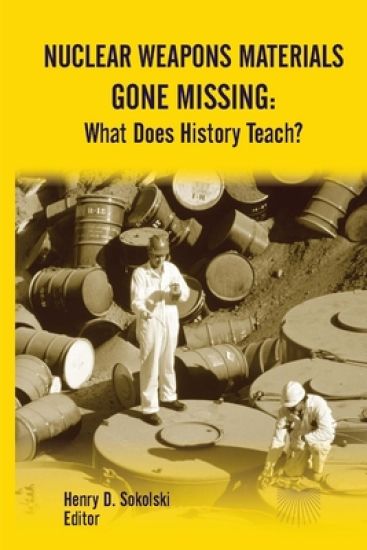
In 2009, the President of the United States spotlighted nuclear terrorism as one of the top threats to international security and launched an international effort to identify, secure, and dispose of global stocks of weapons-usable nuclear materials-namely highly enriched uranium and weapons-grade plutonium. Since that time, three nuclear security summits have been held, along with scores of studies and workshops (official and unofficial), drawing sustained high-level attention to the threat posed by these materials. However, little attention has been given to incidences where sensitive nuclear materials actually went missing. This volume seeks to correct this deficiency, examining incidences of material unaccounted for (MUF) arising from U. S. and South African nuclear weapons programs, plutonium gone missing from Japanese and British civilian production facilities, and a theft of highly enriched uranium from a U. S. military contractor in the 1960s that was used to help fuel Israel's nuclear weapons program.
The monographs in this book were all commissioned as part of a year-long project sponsored by the Nonproliferation Policy Education Center (NPEC), the U. S. Air Force's Institute for National Security Studies, and the U. S. Army War College's Strategic Studies Institute. They were written to help three working groups develop strategies to curb the threat posed by North Korea's strategic weapons programs. Central to these groups' efforts was competitive strategies analysis. As detailed in an earlier Strategic Studies Institute volume, Prevailing in a Well-Armed World, this approach requires analysts to examine four sets of questions. Stephen Bradner in his monograph, "North Korea's Strategy" (Chapter 2 of this volume), examines the first three sets of questions. These concern what one's strategic assumptions and goals are, who the likely key third actors are, and what strategies would make the most sense for each party to pursue.
Beyond Nunn-Lugar: Curbing the Next Wave of Weapons Proliferation Threats from Russia
Henry D. Sokolski; Thomas Riisager
Lulu.com
2014
nidottu
Although the present book never intended to be quite so timely, Beyond Nunn-Lugar: Curbing the Next Wave of Weapons Proliferation Threats from Russia is one book that, coming so soon after the events of September 11, 2001, and shortly before President Bush's Russian summit, should find a ready audience. The essays in the book were originally commissioned by the Nonproliferation Policy Education Center (NPEC) as part of a year-long study on the future of U. S.-Russian nonproliferation cooperation. What makes the book different from other studies of U. S.-Russian cooperation is its reliance on competitive strategies.1 Originally devised as a business management tool and subsequently used by the Pentagon to guide its military planning against the Soviet Union, the analytical approach based on competitive strategies requires analysts to evaluate long-term trends, 10 to 20 years out.
Getting Mad: Nuclear Mutual Assured Destruction, its Origins and Practice
Henry D. Sokolski; Nonproliferation Policy Education Center
Lulu.com
2014
nidottu
Nearly 40 years after the concept of finite deterrence was popularized by the Johnson administration, nuclear Mutual Assured Destruction (MAD) thinking appears to be in decline. The United States has rejected the notion that threatening population centers with nuclear attacks is a legitimate way to assure deterrence. Most recently, it withdrew from the Anti-Ballistic Missile Treaty, an agreement based on MAD. American opposition to MAD also is reflected in the Bush administration's desire to develop smaller, more accurate nuclear weapons that would reduce the number of innocent civilians killed in a nuclear strike. Still, MAD is influential in a number of ways. First, other countries, like China, have not abandoned the idea that holding their adversaries' cities at risk is necessary to assure their own strategic security. Nor have U. S. and allied security officials and experts fully abandoned the idea.
Pakistan's Nuclear Future: Worries Beyond War
Henry D. Sokolski; Strategic Studies Institute
Lulu.com
2014
nidottu
This volume was completed just before Pakistani President Musharraf imposed a state of emergency in November 2007. The political turmoil that followed raised concerns that Pakistan's nuclear assets might be vulnerable to diversion or misuse. This book, which consists of research that the Nonproliferation Policy Education Center (NPEC) commissioned and vetted in 2006 and 2007, details precisely what these worries might be. Dr. Ashley Tellis of the Carnegie Endowment for International Peace and Dr. Peter Lavoy, now the National Intelligence Officer for Southwest Asia at the National Intelligence Council, were instrumental in the selection of authors as well as producing original research. Thanks is also due to Ali Naqvi and Tamara Mitchell of NPEC's staff who helped organize the workshop at which the book's contents were discussed and who helped prepare the book manuscript. Finally, special thanks is due to Professor Douglas C. Lovelace, Jr., Ms. Marianne Cowling, and Ms. Rita Rummel...
The Next Arms Race (Enlarged Edition)
Henry D. Sokolski; U.S. Army War College; Strategic Studies Institute
Lulu.com
2013
nidottu
Nuclear Power's Global Expansion: Weighing Its Costs and Risks
Henry D. Sokolski
Createspace Independent Publishing Platform
2010
nidottu
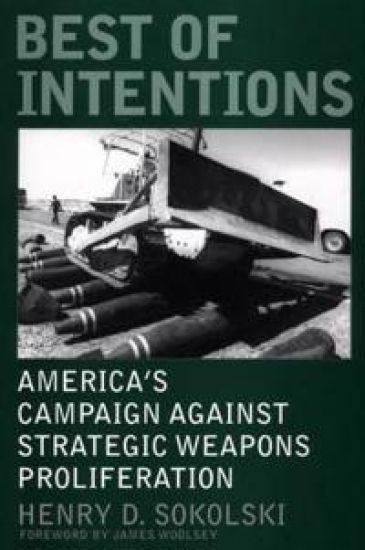
Although the United States efforts to prevent the spread of strategic weapons have varied significantly since 1945, they all presumed to be avoiding one or another type of strategic war. To the extent their military scenarios were sound, so too were the nonproliferation remedies these initiatives promoted. But, as Sokolski demonstrates, the obverse was also true--when these intiatives' military hopes and fears were mistaken, their nonproliferation recommendations also missed their mark. What is the best hope for breaking out of this box and securing a higher rate of nonproliferation success? The United States must base nonproliferation policies less on insights concerning strategic military trends and more on the progressive economic and political trends that have increased the number of relatively peaceful, prosperous, liberal democracies. For the proliferating nations that are exceptions to this trend, the U. S. and its allies need to devise ways of competing that will encourage these governments to expend more energies shoring up their weaknesses and eventually giving way to less militant regimes. A major resource for students and military professionals interested in arms control and international relations.