
Kirjailija
Henry Fielding
Kirjat ja teokset yhdessä paikassa: 574 kirjaa, julkaisuja vuosilta 1786–2026, suosituimpiin kuuluu Tom Jones. Vertaile teosten hintoja ja tarkista saatavuus suomalaisista kirjakaupoista.
Nimi esiintyy myös muodoissa: Henry. Fielding
574 kirjaa
Kirjojen julkaisuvuodet: 1786–2026.


Full Title Tumble Down Dick Or Phaeton In The Suds
Henry Fielding
KESSINGER PUBLISHING CO
2004
pokkari
History Of The Adventures Of Joseph Andrews And His Friend Mr. Abraham Adams
Henry Fielding
KESSINGER PUBLISHING CO
2004
pokkari

History Of The Life Of The Late Mr. Jonathan Wild The Great
Henry Fielding
KESSINGER PUBLISHING CO
2004
pokkari

The Tragedy Of Tragedies Or The Life And Death Of Tom Thumb The Great
Henry Fielding
Kessinger Pub
2004
pokkari
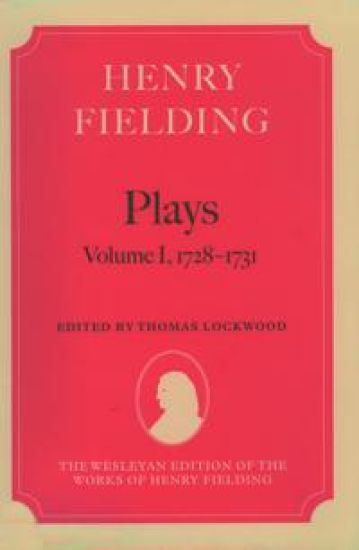
This is the first of three volumes representing the only modern edition of Fielding's dramatic works. Most of these plays have not appeared in print for a century, and never previously in edited form. Fielding came to the novel-writing for which he is best known after an important first career in professional theatre. He wrote twenty-eight plays, including comedies, satiric extravaganzas, and ballad operas. He was the leading playwright of his generation, an experimentalist and entrepreneur in a cheerfully mocking form of drama journalistically devoted to contemporary experience, culture, and politics. This volume presents the first seven of these plays in a critical unmodernized edition based on the original texts, with explanatory notes and commentary on sources, stage history, and critical reception, as well as appendices accounting for textual variation, bibliography, and musical sources.
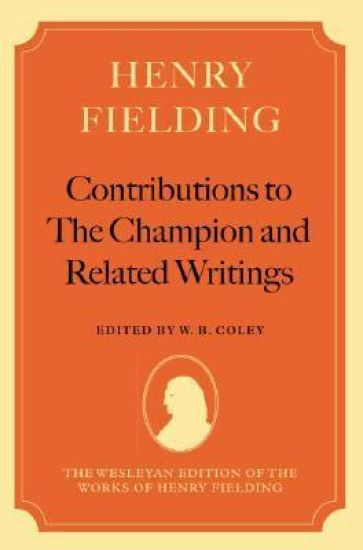
Henry Fielding: Contributions to The Champion, and Related Writings
Henry Fielding
Oxford University Press
2003
sidottu
This volume completes the edition's coverage of Henry Fielding's journalism, which occupied a far greater part of his time than has been traditionally acknowledged. His contributions to The Champion are not only among his most energetic and intriguing works in the genre; they also have a dense political background, of interest to historians studying the interface between journalism and politicians of the time, as well as the role of newspaper publishers. Walpole figures hugely, and the extent to which Fielding hints at the minister's life and activities is remarkable. Much of the volume's material has never been reprinted before. Explanatory annotations are full, as the characteristically allusive and topical nature of Fielding's writing requires. Appendices provide an analytical textual apparatus, and the editorial introductions emphasize matters such as genesis and composition, circumstances of publication, in addition to immediate biographical, literary, and historical backgrounds.
Jonathan Wild by Henry Fielding, Fiction, Classics, Literary
Henry Fielding
Borgo Press
2002
sidottu
HENRY FIELDING COMPARES JONATHAN WILD, HIGHWAY BANDIT WITH CAESAR -- AND FINDS CAESAR WANTING ." . . .when the mighty Caesar, with wonderful greatness of mind, had destroyed the liberties of his country, and with all the means of fraud and force had placed himself at the head of his equals, had corrupted and enslaved the greatest people whom the sun ever saw, we are reminded, as an evidence of his generosity, of his largesses to his followers and tools, by whose means he had accomplished his purpose, and by whose assistance he was to establish it. . . . Now, who doth not see that such sneaking qualities as these are rather to be bewailed as imperfections than admired as ornaments in these great men; rather obscuring their glory, and holding them back in their race to greatness, indeed unworthy the end for which they seem to have come into the world, viz. of perpetrating vast and mighty mischief?" -- from Henry Fielding's tongue-in-cheek classic, Jonathan Wild
SHAMELA is a brilliant parody of Samuel Richardson's PAMELA, in which a virtuous servant girl long resists her master's advances and is eventually 'rewarded' with marriage. Fielding's far more spirited and sexually honest heroine, by contrast, merely uses coyness and mock modesty as techniques to catch a rich husband. JOSEPH ANDREWS, Fielding's first full-length novel, can also be seen as a response to Richardson, as the lascivious Lady Booby sets out to seduce her comically chaste servant Joseph, (himself in love with the much-put-upon Fanny Goodwill). As in Tom Jones, Fielding takes a huge cast of characters out on the road and exposes them to many colourful and often hilarious adventures.
Fielding's satire on Richardsons's Pamela has survived its model in popularity for obvious reasons: the combination of breezy comedy, knockabout farce, lively narrative and vigorous satire is irresistible.
Volume Three of Henry Fielding's Miscellanies, first published as a three-volume set in 1743, consists in its entirety of a major work of fiction, The history of the Life of the Late Mr. Jonathan Wild the Great. Jonathan Wild takes its title from the `thief-taker' and gang-leader of that name who was hanged in 1725, but in Fielding's hands, the history of Wild is transformed into a mock-hostorical work of sustained irony aimed at all who would be `great men'. The general introduction to this edition sets the novel against its historical and biographical background and argues against the view, common since the mid-nineteenth century, that it is a personal satire directed at the figure of Sir Robert Walpole. In both the general and the textual introductions, the editors also offer a fresh view on questions about the date and history of the work's composition. Full explanatory notes and commentary place Fielding's allusions and details in their contemporary context. As in previous volumes of the Weslyan Edition, this provides critical, unmodernized text, based on the Greg-Bowers `Rationale of Copy-text'. The version is that of the first edition, with an appendix giving all variants in wording and presentation in the 1754 revision. In his introduction the textual editor lays out the rationale for his choice of version. This volume also includes, for the first time in modern edition, Fielding's list of subscribers to the Miscellanies, along with detailed biographical notes and an analysis of the subscription list by the textual editor.