Kirjojen hintavertailu – 12 903 724 kirjaa ja 27 kauppaa
Kirjailija
Henry Kissinger
Kirjat ja teokset yhdessä paikassa: 40 kirjaa, julkaisuja vuosilta 1969–2026, suosituimpiin kuuluu Diplomatija. Vertaile teosten hintoja ja tarkista saatavuus suomalaisista kirjakaupoista.
In a series of riveting interviews, America's senior statesman discusses the challenges of directing foreign policy during times of great global tension. As National Security Advisor to Richard Nixon, Henry Kissinger transformed America's approach to diplomacy with China, the USSR, Vietnam, and the Middle East, laying the foundations for geopolitics as we know them today. Nearly fifty years later, escalating tensions between the US, China, and Russia are threatening a swift return to the same diplomatic game of tug-of-war that Kissinger played so masterfully. Kissinger on Kissinger is a series of faithfully transcribed interviews conducted by the elder statesman's longtime associate, Winston Lord, which captures Kissinger's thoughts on the specific challenges that he faced during his tenure as NSA, his general advice on leadership and international relations, and stunning portraits of the larger-than-life world leaders of the era. The result is a frank and well-informed overview of US foreign policy in the first half of the 70s--essential reading for anyone hoping to understand tomorrow's global challenges.
"World population growth since World War II is quantitatively and qualitatively different from any previous epoch in human history... total growth rates are close to 2 percent a year, compared with about 1 percent before World War II, under 0.5 percent in 1750-1900, and far lower rates before 1750." -Executive Summary, The Kissinger ReportIn 1974, the United States National Security Council, led by Henry Kissinger, completed a classified report, National Security Study Memorandum 200 - Implications of Worldwide Population Growth for U. S. Security and Overseas Interests A. K. A. The Kissinger Report. Due to the sensitive nature of its content, it took another 15 years before this report was declassified in 1989. The Kissinger Report's purpose was to describe and analyze population growth, especially in the least developed countries ("LDCs"), and the implications for U. S. national security. This report forecasted world population to grow from 4 billion people in 1974 via 6.4 billion in 2000 to 12 billion in 2075. This kind of population growth was deemed unsustainable and would cause major problems: famines and ecological disasters; lack of economic development, civil unrest and mass foreign migration. This instability would be a threat to the countries involved, but also to the national interests of the U. S., since its import of minerals from those LDCs might be hampered. The report called for measures to limit the population to 6 billion by the mid-21st century and to an ultimate limit of 8 billion people, and for the promotion of contraception among 13 populous countries, including Pakistan, Nigeria, and Mexico. When this report was declassified in 1989, this proposed population control policy, including abortion and the targeting of LDCs, triggered controversy. However, today in 2017, with the world population at 7.4 billion, and daily news covering civil unrest and worse in the Middle East, record numbers of global refugees, heat waves and changing weather patterns, the bird flu and zika virus, it seems the The Kissinger Report had at least predictive value. Students of population studies, academics, journalists and anyone eager for a glimpse into the state of the world will find this essential reading.
How is critical thinking taught? How will the next generation cope with an ever-changing and increasingly complex world? These are questions that the Grand Strategy program at Yale seeks to address. The Brady-Johnson Program in Grand Strategy seeks to revive the study and practice of grand strategy by devising methods to teach that subject at the graduate and undergraduate levels, by training future leaders to think about and implement grand strategies in imaginative and effective ways, and by organizing public events that emphasize the importance of grand strategy. The program defines "grand strategy" as a comprehensive plan of action, based on the calculated relationship of means to large ends. Never an exact science, grand strategy requires constant reassessment and adjustment. Flexibility is key. Traditionally believed to belong to and best-developed in the politico-military and governmental realms, the concept of grand strategy applies--and ISS believes is essential--to a broad spectrum of human activities, not least those of international institutions, non-governmental organizations, and private businesses and corporations. For fifteen years, the Grand Strategy program has been cultivating leadership skills of undergraduates and graduate students of Yale University. In Linda Kulman's compelling book, we learn about this remarkable program from the inside, sharing the stress of the "murder boards," the revelation of applying the classics to current geopolitical situations, and the crucial importance of fast decision-making under duress. Teaching Common Sense weaves together on-site reporting, archival research, and original survey data into an intellectual history of the Grand Strategy program.
In World Order, Henry Kissinger - one of the leading practitioners of world diplomacy and author of On China - makes his monumental investigation into the 'tectonic plates' of global history and state relations. World Order is the summation of Henry Kissinger's thinking about history, strategy and statecraft. As if taking a perspective from far above the globe, it examines the great tectonic plates of history and the motivations of nations, explaining the attitudes that states and empires have taken to the rest of the world from the formation of Europe to our own times. Kissinger identifies four great 'world orders' in history - the European, Islamic, Chinese and American. Since the end of Charlemagne's empire, and especially since the Peace of Westphalia in 1648, Europeans have striven for balance in international affairs, first in their own continent and then globally. Islamic states have looked to their destined expansion over regions populated by unbelievers, a position exemplified today by Iran under the ayatollahs. For over 2000 years the Chinese have seen 'all under Heaven' as being tributary to the Chinese Emperor. America views itself as a 'city on a hill', a beacon to the world, whose values have universal validity. How have these attitudes evolved and how have they shaped the histories of their nations, regions, and the rest of the world? What has happened when they have come into contact with each other? How have they balanced legitimacy and power at different times? What is the condition of each in our contemporary world, and how are they shaping relations between states now? To answer these questions Henry Kissinger draws upon a lifetime's historical study and unmatched experience as a world statesman. His account is shot through with observations about how historical change takes place, how some leaders shape their times and others fail to do so, and how far states can stray from the ideas which define them. World Order is a masterpiece of narrative, analysis and portraits of great historical actors that only Henry Kissinger could have written.
"Dazzling and instructive . . . a] magisterial new book." --Walter Isaacson, TimeAn astute analysis that illuminates many of today's critical international issues. --Kirkus Reviews Henry Kissinger offers in World Order a deep meditation on the roots of international harmony and global disorder. Drawing on his experience as one of the foremost statesmen of the modern era--advising presidents, traveling the world, observing and shaping the central foreign policy events of recent decades--Kissinger now reveals his analysis of the ultimate challenge for the twenty-first century: how to build a shared international order in a world of divergent historical perspectives, violent conflict, proliferating technology, and ideological extremism. There has never been a true "world order," Kissinger observes. For most of history, civilizations defined their own concepts of order. Each considered itself the center of the world and envisioned its distinct principles as universally relevant. China conceived of a global cultural hierarchy with the emperor at its pinnacle. In Europe, Rome imagined itself surrounded by barbarians; when Rome fragmented, European peoples refined a concept of an equilibrium of sovereign states and sought to export it across the world. Islam, in its early centuries, considered itself the world's sole legitimate political unit, destined to expand indefinitely until the world was brought into harmony by religious principles. The United States was born of a conviction about the universal applicability of democracy--a conviction that has guided its policies ever since. Now international affairs take place on a global basis, and these historical concepts of world order are meeting. Every region participates in questions of high policy in every other, often instantaneously. Yet there is no consensus among the major actors about the rules and limits guiding this process or its ultimate destination. The result is mounting tension. Grounded in Kissinger's deep study of history and his experience as national security advisor and secretary of state, World Order guides readers through crucial episodes in recent world history. Kissinger offers a unique glimpse into the inner deliberations of the Nixon administration's negotiations with Hanoi over the end of the Vietnam War, as well as Ronald Reagan's tense debates with Soviet Premier Gorbachev in Reykjav k. He offers compelling insights into the future of U. S.-China relations and the evolution of the European Union, and he examines lessons of the conflicts in Iraq and Afghanistan. Taking readers from his analysis of nuclear negotiations with Iran through the West's response to the Arab Spring and tensions with Russia over Ukraine, World Order anchors Kissinger's historical analysis in the decisive events of our time. Provocative and articulate, blending historical insight with geopolitical prognostication, World Order is a unique work that could come only from a lifelong policy maker and diplomat. Kissinger is also the author of On China.
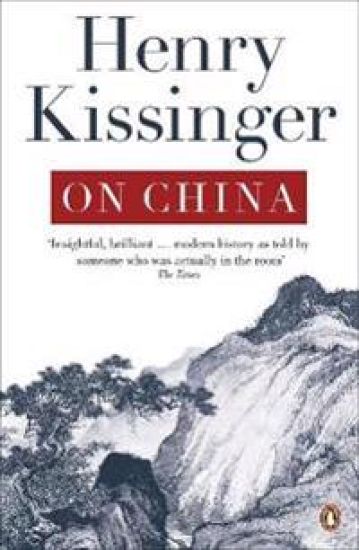
In 1971 Henry Kissinger took the historic step of reopening relations between China and the West, and since then has been more intimately connected with the country at the highest level than any other western figure. This book distils his unique experience, examining China's history from the classical era to the present day, describing the essence of its millennia-old approach to diplomacy, strategy and negotiation, and reflecting on these attitudes for our own uncertain future.
"Fascinating, shrewd . . . The book deftly traces the rhythms and patterns of Chinese history." --Michiko Kakutani, The New York Times "No one can lay claim to so much influence on the shaping of foreign policy over the past 50 years as Henry Kissinger." --The Financial Times In this sweeping and insightful history, Henry Kissinger turns for the first time at book length to a country he has known intimately for decades and whose modern relations with the West he helped shape. On China illuminates the inner workings of Chinese diplomacy during such pivotal events as the initial encounters between China and tight line modern European powers, the formation and breakdown of the Sino-Soviet alliance, the Korean War, and Richard Nixon's historic trip to Beijing. With a new final chapter on the emerging superpower's twenty-first-century role in global politics and economics, On China provides historical perspective on Chinese foreign affairs from one of the premier statesmen of our time.
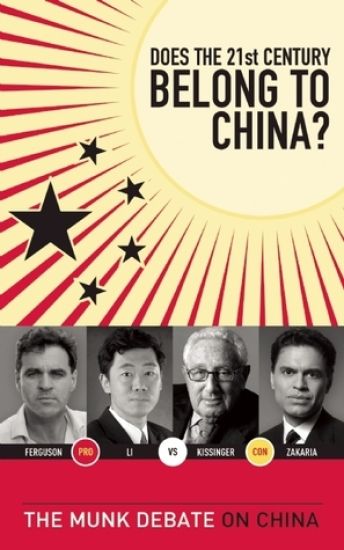
Is China's rise unstoppable? Powered by the human capital of 1.3 billion citizens, the latest technological advances, and a comparatively efficient system of state-directed capitalism, China seems poised to become the global superpower this century. But the Middle Kingdom also faces a series of challenges. From energy scarcity to environmental degradation to political unrest and growing global security burdens, a host of factors could derail China's global ascent. In this edition of The Munk Debates — Canada's premier international debate series — former U. S. Secretary of State Henry Kissinger and CNN's Fareed Zakaria square off against leading historian Niall Ferguson and world-renowned economist David Daokui Li to debate the biggest geopolitical issue of our time: Does the 21st century belong to China? Highly electrifying and thoroughly engrossing, the Munk Debate on China is the first formal public debate Dr. Kissinger has participated in on China's future, and includes exclusive interviews with Henry Kissinger and David Daokui Li.
One of the most important books to come out of the Nixon Administration, the New York Times bestselling White House Years covers Henry Kissinger's first four years (1969-1973) as Assistant to the President for National Security Affairs. Among the momentous events recounted in this first volume of Kissinger's timeless memoirs are his secret negotiations with the North Vietnamese in Paris to end the Vietnam War, the Jordan crisis of 1970, the India-Pakistan war of 1971, his back-channel and face-to-face negotiations with Soviet leaders to limit the nuclear arms race, his secret journey to China, and the historic summit meetings in Moscow and Beijing in 1972. He covers major controversies of the period, including events in Laos and Cambodia, his "peace is at hand" press conference and the breakdown of talks with the North Vietnamese that led to the Christmas bombing in 1972. Throughout, Kissinger presents candid portraits of world leaders, including Richard Nixon, Anwar Sadat, Golda Meir, Jordan's King Hussein, Leonid Brezhnev, Chairman Mao and Chou En-lai, Willy Brandt, Charles de Gaulle, and many others. White House Years is Henry Kissinger's invaluable and lasting contribution to the history of this crucial time.
Eloquent . . . immensely readable . . . the saga of the victory of capitalism over the brutal and irrational fraud that was state socialism. --The Baltimore Sun""Buckley's lucid account celebrates the tenacity of the human spirit and the will to achieve freedom."" --Publishers Weekly""This is a small masterpiece of the narrative tradition. The Fall of the Berlin Wall keep s] readers turning the page."" --National Review"" A] great narrative of democratic survival and democratic victory."" --The Washington TimesThe fall of the Berlin Wall in November 1989 was the turning point in the struggle against Communism in Eastern Europe. In The Fall of the Berlin Wall, renowned author and conservative pioneer William F. Buckley Jr. explains why the wall was built, reveals its devastating impact on the lives of people on both sides, and provides a riveting account of the events that led to the wall's destruction and the end of the Cold War.
The two major foreign policy crises in this book, one successful, one a tragic failure, were unique in that they moved so fast much of it had to be handled by telephone. The longer of the two sections deals in detail with the Yom Kippur War and is full of revelations, as well as great relevancy, for many of the main elements of the current problems in the Middle East. In the many conversations that Kissinger held with Israeli Prime Minister Golda Meir, the Israeli ambassador to the United States, the UN Secretary General, other foreign ambassadors and President Nixon, we can see the strategies being thrashed out that have played such a big part in contemporary diplomatic crises. In the second section Kissinger looks at the tragic end of the Vietnam War, to many one of the greatest diplomatic crises, and in astonishing detail we see his attempts to help his president and a divided nation through the final moments of a lost war. This is a book that presents perhaps the best record of the inner workings of diplomacy at the superheated pace and tension of real crisis.
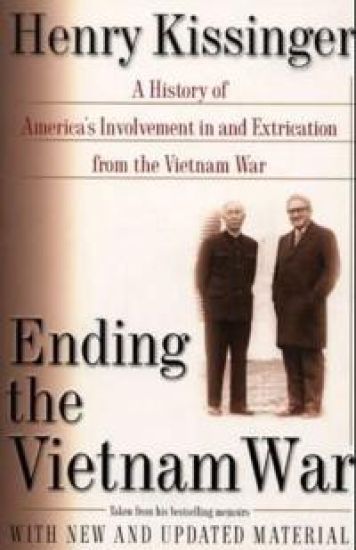
Henry Kissinger presents a seamless chronicle of the policies and personalities that thrust the US into war and explains in unprecedented detail the diplomatic efforts he employed both publicly and in private to extricate America from Vietnam. From his behind-the-scenes role to his key positions as President Nixon's foreign policy and national security adviser and later his Secretary of State, Henry Kissinger was at the centre of America's involvement in Vietnam. In ENDING THE VIETNAM WAR, he reveals what actually happened: what was said in high level meetings and in the conversations he had with President Nixon; how policy was made; the thinking behind major decisions and the negotiations that led to the Paris Peace table and much more. Supported by meticulous documentation and filled with sharply observed portraits of significant players, ENDING THE VIETNAM WAR is the story of the war from one of those who shaped its course.
Perhaps the best-known American diplomatist of this century, Henry Kissinger is a major figure in world history, winner of the Nobel Peace Prize, and arguably one of the most brilliant minds ever placed at the service of American foreign policy, as well as one of the shrewdest, best-informed, and most articulate figures ever to occupy a position of power in Washington. The third and final volume of his memoirs completes a major work of contemporary history. It is at once an historical document and a narrative of almost Shakespearean intensity, full of startling insights, unusual (and often unsparing) candor, and a sweeping sense of history. Above all, here are intimate, candid, and sharply intelligent portraits of world leaders, from Mao Zedong teasing Kissinger with a characteristic mixture of brutality and acerbic subtlety, to Leonid Brezhnev, confused, unwell, desperately trying to conceal the Soviet Union's growing difficulties with a facade of blustering bravado, as well as a galaxy of European, Middle Eastern, Asian, Latin American, and African leaders.
'Kissinger's absorbing book tackles head-on some of the toughest questions of our time ... Its pages sparkle with insight' Simon Schama in the NEW YORKER Spanning more than three centuries, from Cardinal Richelieu to the fragility of the 'New World Order', DIPLOMACY is the now-classic history of international relations by the former Secretary of State and winner of the Nobel Peace Prize. Kissinger's intimate portraits of world leaders, many from personal experience, provide the reader with a unique insight into what really goes on -- and why -- behind the closed doors of the corridors of power. 'Budding diplomats and politicians should read it as avidly as their predecessors read Machiavelli' Douglas Hurd in the DAILY TELEGRAPH 'If you want to pay someone a compliment, give them Henry Kissinger's DIPLOMACY ... It is certainly one of the best, and most enjoyable [books] on international relations past and present ... DIPLOMACY should be read for the sheer historical sweep, the characterisations, the story-telling, the ability to look at large parts of the world as a whole' Malcolm Rutherford in the FINANCIAL TIMES
The initial two essays, “Domestic Structure and Foreign Policy” and “Central Issues of American Foreign Policy,” appeared in the original edition of this volume and have been retained as backdrops for fifteen major addresses delivered by Mr. Kissinger over the past four years. The new selections include a statement to Congress that traces the main lines of détente policy; a review of the step-by-step process of negotiations in the Middle East; an analysis of efforts to achieve accords, with the Soviet Union on strategic arms limitation without imperiling American national security; a speech to the United Nations on the imperative of establishing a balanced global approach to economic development and resource conservation; several papers that candidly appraise prospects for new ties between the United States and the nations of Asia, Africa, and Latin America; and one that sets forth measures to strengthen the bonds among the industrial democracies. In their scope and detail, these documents constitute a remarkable set of designs, blueprints, and working drawings by a master architect of foreign policy.
"World population growth since World War II is quantitatively and qualitatively different from any previous epoch in human history... total growth rates are close to 2 percent a year, compared with about 1 percent before World War II, under 0.5 percent in 1750-1900, and far lower rates before 1750." -Executive Summary, The Kissinger ReportIn 1974, the United States National Security Council, led by Henry Kissinger, completed a classified report, National Security Study Memorandum 200 - Implications of Worldwide Population Growth for U. S. Security and Overseas Interests A. K. A. The Kissinger Report. Due to the sensitive nature of its content, it took another 15 years before this report was declassified in 1989. The Kissinger Report's purpose was to describe and analyze population growth, especially in the least developed countries ("LDCs"), and the implications for U. S. national security. This report forecasted world population to grow from 4 billion people in 1974 via 6.4 billion in 2000 to 12 billion in 2075. This kind of population growth was deemed unsustainable and would cause major problems: famines and ecological disasters; lack of economic development, civil unrest and mass foreign migration. This instability would be a threat to the countries involved, but also to the national interests of the U. S., since its import of minerals from those LDCs might be hampered. The report called for measures to limit the population to 6 billion by the mid-21st century and to an ultimate limit of 8 billion people, and for the promotion of contraception among 13 populous countries, including Pakistan, Nigeria, and Mexico. When this report was declassified in 1989, this proposed population control policy, including abortion and the targeting of LDCs, triggered controversy. However, today in 2017, with the world population at 7.4 billion, and daily news covering civil unrest and worse in the Middle East, record numbers of global refugees, heat waves and changing weather patterns, the bird flu and zika virus, it seems the The Kissinger Report had at least predictive value. Students of population studies, academics, journalists and anyone eager for a glimpse into the state of the world will find this essential reading.
In this book Professor Kissinger examines the framework of our foreign policy, the stresses to which that framework is being subjected, and the prospects for world order in an era of high international tension. The three essays were written before Professor Kissinger took leave from Harvard to serve as Assistant to President Nixon for National Security Affairs.