
Kirjailija
Henry Rider Haggard
Kirjat ja teokset yhdessä paikassa: 251 kirjaa, julkaisuja vuosilta 2007–2026, suosituimpiin kuuluu Jess. Vertaile teosten hintoja ja tarkista saatavuus suomalaisista kirjakaupoista.
Nimi esiintyy myös muodoissa: Henry-Rider Haggard
251 kirjaa
Kirjojen julkaisuvuodet: 2007–2026.

In giving to the world the record of what, looked at as an adventure only, is I suppose one of the most wonderful and mysterious experiences ever undergone by mortal men, I feel it incumbent on me to explain what my exact connection with it is. And so I may as well say at once that I am not the narrator but only the editor of this extraordinary history, and then go on to tell how it found its way into my hands. Some years ago I, the editor, was stopping with a friend, "vir doctissimus et amicus neus," at a certain University, which for the purposes of this history we will call Cambridge, and was one day much struck with the appearance of two persons whom I saw going arm-in-arm down the street. One of these gentlemen was I think, without exception, the handsomest young fellow I have ever seen. He was very tall, very broad, and had a look of power and a grace of bearing that seemed as native to him as it is to a wild stag. In addition his face was almost without flaw-a good face as well as a beautiful one, and when he lifted his hat, which he did just then to a passing lady, I saw that his head was covered with little golden curls growing close to the scalp.
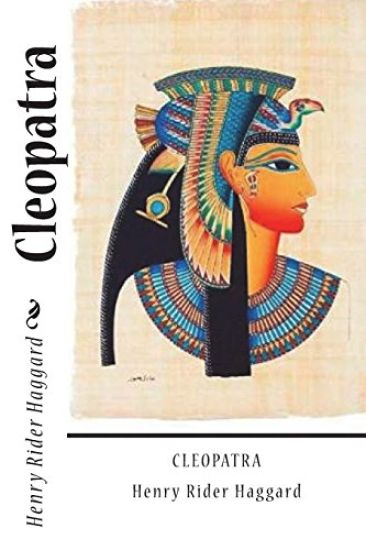
Cleopatra: Being an Account of the Fall and Vengeance of Harmachis is a novel written by the author H. Rider Haggard, the author of King Solomon's Mines and She. The book was first printed in 1889. The story is set in the Ptolemaic era of Ancient Egyptian history and revolves around the survival of a dynasty bloodline protected by the Priesthood of Isis. The main character Harmachis (the living descendant of the pharaoh's bloodline) is charged by the Priesthood to overthrow the supposed impostor Cleopatra, drive out the Greeks and Romans and restore Egypt to its golden era. As is the case with the majority of Haggard's works, the story draws heavily upon adventure and exotic concepts. The story, told from the point of view of the Egyptian priest Harmachis, is recounted in biblical language, being in the form of papyrus scrolls found in a tomb. Haggard's portrait of Cleopatra is quite stunning, revealing her wit, her treachery, and her overwhelming presence. All of the characters are mixtures of good and evil, and evoke both sympathy and loathing. While much of the material on ancient Egyptian ritual is overdone, the often brilliant dialogue and the fateful interactions between the principal characters make the book quite unforgettable in comparison to Haggard's better known but more conventional adventure novels. The character of Mark Antony, introduced in the later part of the book, is fleeting and lacks importance, though historically it seems that the book has some importance as the references made are based on facts about the romance between Cleopatra and Mark Antony and the fall of both from power. Cleopatra goes unrecognized in most discussions of Haggard

This sequel to King Solomon's Mines is based on Rider Haggard's own experiences in Africa. During their search for a white race reputed to live near Mount Kenya, Allan Quatermain and his companions undergo a series of dangerous and thrilling adventures. The dramatic and often poetic story reveals Victorian preoccupations with evolution, race, sexuality, and the "New Woman."

Child of Storm is a 1913 novel by H. Rider Haggard featuring Allan Quatermain. The plot is set in 1854-56 and concerns Quatermain hunting in Zululand and getting involved with Mameema, a beautiful African girl who causes great turmoil in the Zulu kingdom. The novel is the second in a trilogy by Haggard involving the collapse of the Zulu kingdom and featuring the dwarf Zikali. The first book is Marie, and the third, Finished. The story takes place against the real life struggle between Cetshwayo and Umbelazi, the two sons of the Zulu king Mpande (called "Panda" in the novel). The events culminate in the Battle of Ndondakusuka (here called the "Battle of the Tugela") in 1856. Real life people such as Panda, Cetshwayo, and John Robert Dunn appear as characters.

Who that has ever seen them can forget the ruins of Blossholme Abbey, set upon their mount between the great waters of the tidal estuary to the north, the rich lands and grazing marshes that, backed with woods, border it east and south, and to the west by the rolling uplands, merging at last into purple moor, and, far away, the sombre eternal hills Probably the scene has not changed very much since the days of Henry VIII, when those things happened of which we have to tell, for here no large town has arisen, nor have mines been dug or factories built to affront the earth and defile the air with their hideousness and smoke. The village of Blossholme we know has scarcely varied in its population, for the old records tell us this, and as there is no railway here its aspect must be much the same. Houses built of the local grey stone do not readily fall down. The folk of that generation walked in and out of the doorways of many of them, although the roofs for the most part are now covered with tiles or rough slates in place of reeds from the dike.
The People of the Mist is a classic lost race fantasy novel written by H. Rider Haggard. The People of the Mist is the tale of a British adventurer seeking wealth in the wilds of Africa, finding romance, and discovering a lost race and its monstrous god. The penniless Leonard Outram attempts to redress the undeserved loss of his family estates and his fiancee by seeking his fortune in Africa.
One day-it was about a week after Allan Quatermain told me his story of the "Three Lions," and of the moving death of Jim-Jim-he and I were walking home together on the termination of a day's shooting. He owned about two thousand acres of shooting round the place he had bought in Yorkshire, over a hundred of which were wood. It was the second year of his occupation of the estate, and already he had reared a very fair head of pheasants, for he was an all-round sportsman, and as fond of shooting with a shot-gun as with an eight-bore rifle. We were three guns that day, Sir Henry Curtis, Old Quatermain, and myself; but Sir Henry was obliged to leave in the middle of the afternoon in order to meet his agent, and inspect an outlying farm where a new shed was wanted. However, he was coming back to dinner, and going to bring Captain Good with him, for Brayley Hall was not more than two miles from the Grange. We had met with very fair sport, considering that we were only going through outlying cover for cocks. I think that we had killed twenty-seven, a woodcock and a leash of partridges which we secured out of a driven covey. On our way home there lay a long narrow spinney, which was a very favourite "lie" for woodcocks, and generally held a pheasant or two as well. "Well, what do you say?" said old Quatermain, "shall we beat through this for a finish?"

Finished is a 1917 novel by H. Rider Haggard featuring Allan Quatermain. It is the last in a trilogy about the Zulu kingdom, which also includes Marie and Child of Storm, and involved the dwarf Zikali. It is set against the background of the Anglo-Zulu War of 1879, covering events leading up to the war, and ending with the death of Cetewayo. Quatermain is depicted as being one of the few survivors of the Battle of Isandhlwana. Like others in the series, several real-life characters appear, such as Cetewayo and Anthony Durnford.
Allan's Wife: Allan Quatermain #13
Henry Rider Haggard
Createspace Independent Publishing Platform
2018
nidottu
Allan's Wife and Other Tales is a collection of Allan Quatermain stories by H. Rider Haggard, first published in London by Spencer Blackett in December 1889. The title story was new, with its first publication intended for the collection, but two unauthorized editions appeared earlier in New York, based on pirated galley proofs. The other three stories first appeared in an anthology and periodicals in 1885, 1887, and 1886.

The Yellow God: An Idol of Africa is a 1908 novel by H Rider Haggard.
She, subtitled A History of Adventure, is a novel by English writer H. Rider Haggard, first serialised in The Graphic magazine from October 1886 to January 1887. She was extraordinarily popular upon its release and has never been out of print. The story is a first-person narrative that follows the journey of Horace Holly and his ward Leo Vincey to a lost kingdom in the African interior.
Swallow: A Tale of the Great Trek is an 1899 novel by H. Rider Haggard set in South Africa during the Boer Trek of 1836.
The Mahatma and the Hare
Henry Rider Haggard
Createspace Independent Publishing Platform
2018
nidottu
"Ultimately a good hare was found which took the field at ... There the hounds pressed her, and on the hunt arriving at the edge of the cliff the hare could be seen crossing the beach and going right out to sea. A boat was procured, and the master and some others rowed out to her just as she drowned, and, bringing the body in, gave it to the hounds. A hare swimming out to sea is a sight not often witnessed."-Local paper, January 1911. "... A long check occurred in the latter part of this hunt, the hare having laid up in a hedgerow, from which she was at last evicted by a crack of the whip. Her next place of refuge was a horse-pond, which she tried to swim, but got stuck in the ice midway, and was sinking, when the huntsman went in after her. It was a novel sight to see huntsman and hare being lifted over a wall out of the pond, the eager pack waiting for their prey behind the wall."-Local paper, February 1911.
Cetywayo and his White Neighbours
Henry Rider Haggard
Createspace Independent Publishing Platform
2018
nidottu
Cetywayo and His White Neighbours, or Remarks on Recent Events in Zululand, Natal and the Transvaal is an 1882 non-fiction book by H. Rider Haggard, his first full-length published work. It was based on his time working in South Africa. The "Cetywayo" of the title is the Zulu king Cetshwayo kaMpande.