Kirjojen hintavertailu – 12 903 724 kirjaa ja 27 kauppaa

Kirjailija

Henry Rosemont

Kirjat ja teokset yhdessä paikassa: 6 kirjaa, julkaisuja vuosilta 1999–2016, suosituimpiin kuuluu The Chinese Classic of Family Reverence. Vertaile teosten hintoja ja tarkista saatavuus suomalaisista kirjakaupoista.

6 kirjaa

Kirjojen julkaisuvuodet: 1999–2016.

Against Individualism

Against Individualism

Henry Rosemont

Lexington Books
2016
nidottu
The first part of Against Individualism: A Confucian Rethinking of the Foundations of Morality, Politics, Family, and Religion is devoted to showing how and why the vision of human beings as free, independent and autonomous individuals is and always was a mirage that has served liberatory functions in the past, but has now become pernicious for even thinking clearly about, much less achieving social and economic justice, maintaining democracy, or addressing the manifold environmental and other problems facing the world today. In the second and larger part of the book Rosemont proffers a different vision of being human gleaned from the texts of classical Confucianism, namely, that we are first and foremost interrelated and thus interdependent persons whose uniqueness lies in the multiplicity of roles we each live throughout our lives. This leads to an ethics based on those mutual roles in sharp contrast to individualist moralities, but which nevertheless reflect the facts of our everyday lives very well. The book concludes by exploring briefly a number of implications of this vision for thinking differently about politics, family life, justice, and the development of a human-centered authentic religiousness. This book will be of value to all students and scholars of philosophy, political theory, and Religious, Chinese, and Family Studies, as well as everyone interested in the intersection of morality with their everyday and public lives.
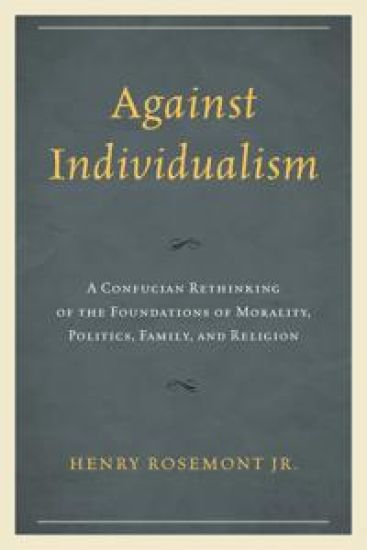
Against Individualism

Against Individualism

Henry Rosemont

Lexington Books
2015
sidottu
The first part of Against Individualism: A Confucian Rethinking of the Foundations of Morality, Politics, Family, and Religion is devoted to showing how and why the vision of human beings as free, independent and autonomous individuals is and always was a mirage that has served liberatory functions in the past, but has now become pernicious for even thinking clearly about, much less achieving social and economic justice, maintaining democracy, or addressing the manifold environmental and other problems facing the world today. In the second and larger part of the book Rosemont proffers a different vision of being human gleaned from the texts of classical Confucianism, namely, that we are first and foremost interrelated and thus interdependent persons whose uniqueness lies in the multiplicity of roles we each live throughout our lives. This leads to an ethics based on those mutual roles in sharp contrast to individualist moralities, but which nevertheless reflect the facts of our everyday lives very well. The book concludes by exploring briefly a number of implications of this vision for thinking differently about politics, family life, justice, and the development of a human-centered authentic religiousness. This book will be of value to all students and scholars of philosophy, political theory, and Religious, Chinese, and Family Studies, as well as everyone interested in the intersection of morality with their everyday and public lives.
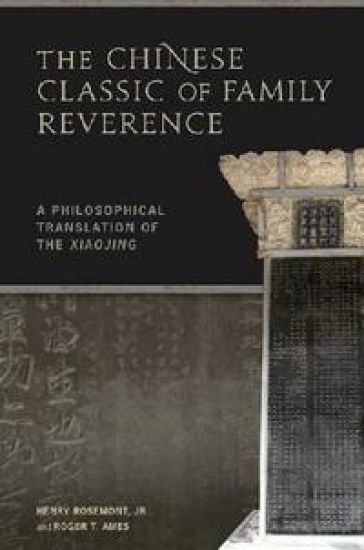
The Chinese Classic of Family Reverence

The Chinese Classic of Family Reverence

Henry Rosemont; Roger T. Ames

University of Hawai'i Press
2008
nidottu
For China, one may go so far as to say that family reverence was a necessary condition for developing any of the other human qualities of excellence. On the basis of the present translation of the ""Xiaojing"" (Classic of Family Reverence) and supplemental passages found in other early philosophical writings, Professors Rosemont and Ames articulate a specifically Confucian conception of 'role ethics' that, in its emphasis on a relational conception of the person, is markedly different from most early and contemporary dominant Western moral theories. This Confucian role ethics takes as its inspiration the perceived necessity of family feeling as the entry point in the development of moral competence and as a guide to the religious life as well. In the lengthy introduction, the two senior scholars offer their perspective on the historical, philosophical, and religious dimensions of the ""Xiaojing"". Together with this introduction, a lexicon of key terms presents a context for the ""Xiaojing"" and provides guidelines for interpreting the text historically in China as well as suggesting its contemporary significance for all societies. The inclusion of the Chinese text adds yet another dimension to this important study.
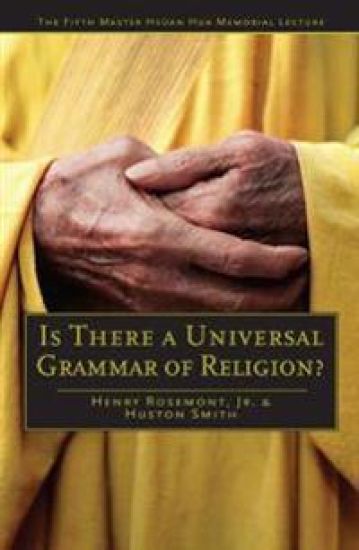
Is There a Universal Grammar of Religion?

Is There a Universal Grammar of Religion?

Henry Rosemont; Huston Smith

Cricket Books, a division of Carus Publishing Co
2008
pokkari
In this provocative volume two important scholars of religion, Huston Smith and Henry Rosemont, Jr., put forth their viewpoints and share a probing conversation. Though the two diverge considerably in their accounts of religious faith and practice, they also agree on fundamental points. Huston Smith, author of the important work The World’s Religions, has long argued for the fundamental equality of the world’s religions. Describing a ?universal grammar of religion,” he argues that fourteen points of similarity exist among all of the major religious traditions and that these similarities indicate an innate psychological affinity for religion within the human spirit. As Noam Chomsky has argued that humans are hardwired to use language, Smith similarly argues that humans are hardwired for religious experience. In response, Rosemont explicates his humanistic vision of the world, in which the ?homoversal” tendency to contemplate the infinite is part of our co-humanity that endures across time, space, language, and culture. Rosemont also elaborates upon Noam Chomsky’s theory of universal grammar and its relevance to Smith’s ideas about the similarities among religions. This insightful exploration of the most essential basis of religion provides a new direction for comparative-religion scholars everywhere.
Rationality and Religious Experience

Rationality and Religious Experience

Henry Rosemont

Open Court Publishing Co ,U.S.
2001
pokkari
Henry Rosemont puts forth two arguements in this volume: that Western science and education are products of an Abrahamic world view and would not have arisen in a non-Abrahamic religious environment such as India or China; and that all religions, regardless of tradition, enhance our non-material lives by providing direction towards a religious experience, a sense of "fully belonging".
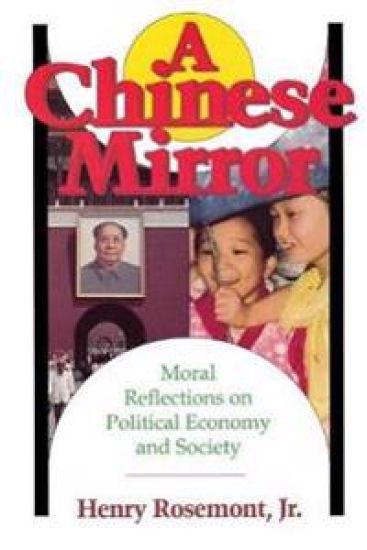
Chinese Mirror

Chinese Mirror

Henry Rosemont

Open Court Publishing Co ,U.S.
1999
pokkari
Ever since Chinese students began marching towards Tiananmen Square in mid-April 1989, they have been portrayed as idealistic young freedom fighters, struggling valiantly, but ultimately unsuccessfully, against a totalitarian regime made up of power-hungry octogenarians. "A Chinese Mirror" reflects a rather different picture, one that is more socially and politically complex, and morally troublesome. Against the specific background of the events of June 4th, the author (who was in Beijing at the time) proffers a more general analysis and evaluation of the economic "reforms" initiated by the Party leadership in 1978, concluding that a capitalist model of development has brought - and cannot but bring - the moral and other failures of capitalism, with few of its benefits, to China. Using China as a case study, "A Chinese Mirror" also introduces an ethical model of development for agrarian societies. Citizens of the capitalist industrial democracies must rethink the criteria by which they evaluate the foreign policies of their governments, especially policies purportedly aimed at assisting very poor countries, whose inhabitants still live in extremely primitive conditions - but comprise more than half of the human race.