Kirjojen hintavertailu – 12 903 725 kirjaa ja 27 kauppaa
Kirjailija
Henry Taylor
Kirjat ja teokset yhdessä paikassa: 85 kirjaa, julkaisuja vuosilta 1811–2026, suosituimpiin kuuluu Isaac Comnenus. Vertaile teosten hintoja ja tarkista saatavuus suomalaisista kirjakaupoista.
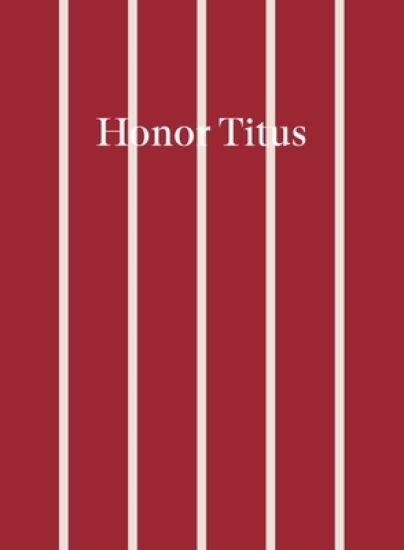
Honor Titus (born 1989) is an American artist who lives and works in Los Angeles. A self-taught painter, Titus is deeply influenced by his creative past as a musician and poet. Titus’s paintings, often suffused with a sense of romance, are embedded with nostalgic references to a simpler time and feature dark, luminous jewel tones. His works often depict faceless figures in minimal urban landscapes, reflecting the isolation that stems from metropolitan anonymity. Titus’s simplified compositions and striking patches of colour are inspired by Les Nabis while his flat, decorative surfaces echo the graphic hyperrealism of artists inspired by American advertising, such as Alex Katz. This, the artist’s first trade monograph, presents new and recent works, including a body of work presented in his 2022–3 solo exhibition at Timothy Taylor, London, Bourgeoisie in Bloom. Here Titus expands on the themes of ritual, class and nostalgia that have characterised previous work, incorporating debutante balls in which young adults are presented to society. Favouring bright panels of colour, Titus evokes traditions of cultural formality, using precise brushwork to delineate details of old-world glamour such as the tilt of a bow tie and the line of a ballgown. A foreword by artist Henry Taylor considers his first encounters with Titus’s work and their continuing friendship. Taylor describes the biographical factors that inform the subjects Titus paints, including music, referencing the first solo show of the artist’s work held at Henry Taylor Gallery in Chinatown, 2020. A text by Durga Chew-Bose brings the themes of nostalgia and memory into the field of discussion. Anecdotes relayed to Chew-Bose bring forward real experiences in relation with his work. The artist’s own words illuminate filmic, musical, photographic and romantic influences on the paintings, while dwelling, lastly, upon his studio space. Klaus Ottmann’s text reflects philosophically and sociologically on Titus’s oeuvre, bringing key art historical reference points into the discussion. Ottmann’s contribution draws connections to key works of literature and criticism that contextualise his work. Published following the exhibition Honor Titus: Bourgeoisie in Bloom at Timothy Taylor, London, 17 November 2022 – 14 January 2023, the publication has been edited by Chloe Waddington, designed by Joe Gilmore, and co-published in 2023 by Timothy Taylor and Anomie Publishing, London. Honor Titus (b. 1989, Brooklyn, NY) is a self-taught American artist who lives and works in Los Angeles, California. Recent solo exhibitions include Honor Titus: Bourgeoisie in Bloom, Timothy Taylor, London, United Kingdom (2022–3); Spotlight: Honor Titus, The FLAG Art Foundation, New York, NY (2022); Honor Titus: For Heaven’s Sake, Timothy Taylor, New York, NY (2021) and Honor Titus: Goodness Gracious, Studio Henry Taylor, Los Angeles, CA (2020). His work has been part of numerous group exhibitions, including IRL (In Real Life), Timothy Taylor, London, United Kingdom (2021); Parallel Worlds, Nassima Landau, Tel Aviv, Israel (2021); and I will wear you in my heart of heart, The FLAG Art Foundation, New York, NY (2021); and (Nothing but) Flowers, Karma, New York, NY (2020), among others. His work is represented in the collections of the Dallas Museum of Art, Dallas, Texas; Nasher Museum of Art, Durham, North Carolina; Rennie Collection, Vancouver, Canada; The Bunker Artspace, Palm Beach, Florida; and the Longlati Foundation, Shanghai, China. Titus has been featured in publications including Art in America, Artnet, Frieze, GQ, Interview Magazine, The New York Times, and Town & Country.
The book, The Bee-keeper's Manual; or Practical Hints on the Management and Complete Preservation of the Honey-bee., has been considered important throughout the human history, and so that this work is never forgotten we have made efforts in its preservation by republishing this book in a modern format for present and future generations. This whole book has been reformatted, retyped and designed. These books are not made of scanned copies of their original work and hence the text is clear and readable.
This Tilted World Is Where I Live gathers one hundred poems by Henry Taylor, drawing on over fifty years of published work by this witty, adept, and vital literary voice. Seventy-five poems appear from his previous books, spanning from The Horse Show at Midnight (1966) through The Flying Change (1985), which won the Pulitzer Prize in Poetry, to his latest volume, Crooked Run (2006). The book opens with twenty-five recent poems collected for the first time. From the beginning, Taylor has worked in both traditional and more open forms, avoiding rigid allegiance to either mode as he has responded to the world around him, from the horse farm in Virginia where he grew up, to the deserts around Santa Fe, New Mexico, where he and his wife Mooshe have lived for the past several years. In tones and moods ranging between grief and explosive hilarity, these poems confront a consistent set of themes. Taylor has long been drawn to considerations of what we mean by loving one another, how violence can intrude without warning into innocent lives, and how the things we have always seen can change with the passage of time. Gwendolyn Brooks once wrote that he ""is a truly important poet. Familiar and strange."" This Tilted World Is Where I Live offers an invaluable encapsulation of Taylor's knack for crafting poems that are not only fun but also instructive in the art of paying attention- of which he is a master.
This Tilted World Is Where I Live gathers one hundred poems by Henry Taylor, drawing on over fifty years of published work by this witty, adept, and vital literary voice. Seventy-five poems appear from his previous books, spanning from The Horse Show at Midnight (1966) through The Flying Change (1985), which won the Pulitzer Prize in Poetry, to his latest volume, Crooked Run (2006). The book opens with twenty-five recent poems collected for the first time. From the beginning, Taylor has worked in both traditional and more open forms, avoiding rigid allegiance to either mode as he has responded to the world around him, from the horse farm in Virginia where he grew up, to the deserts around Santa Fe, New Mexico, where he and his wife Mooshe have lived for the past several years. In tones and moods ranging between grief and explosive hilarity, these poems confront a consistent set of themes. Taylor has long been drawn to considerations of what we mean by loving one another, how violence can intrude without warning into innocent lives, and how the things we have always seen can change with the passage of time. Gwendolyn Brooks once wrote that he ""is a truly important poet. Familiar and strange."" This Tilted World Is Where I Live offers an invaluable encapsulation of Taylor's knack for crafting poems that are not only fun but also instructive in the art of paying attention- of which he is a master.
Philip van Artevelde - A Dramatic Romance is an unchanged, high-quality reprint of the original edition of 1862. Hansebooks is editor of the literature on different topic areas such as research and science, travel and expeditions, cooking and nutrition, medicine, and other genres. As a publisher we focus on the preservation of historical literature. Many works of historical writers and scientists are available today as antiques only. Hansebooks newly publishes these books and contributes to the preservation of literature which has become rare and historical knowledge for the future.
Apiculture (from Latin: apis "bee") is the maintenance of honey bee colonies, commonly in hives, by humans. A beekeeper (or apiarist) keeps bees in order to collect their honey and other products that the hive produces (including beeswax, propolis, pollen, and royal jelly), to pollinate crops, or to produce bees for sale to other beekeepers. A location where bees are kept is called an apiary or "bee yard". Depictions of humans collecting honey from wild bees date to 15,000 years ago. Beekeeping in pottery vessels began about 9,000 years ago in North Africa. Domestication is shown in Egyptian art from around 4,500 years ago. Simple hives and smoke were used and honey was stored in jars, some of which were found in the tombs of pharaohs such as Tutankhamun. It wasn't until the 18th century that European understanding of the colonies and biology of bees allowed the construction of the moveable comb hive so that honey could be harvested without destroying the entire colony. Collecting honey from wild bee colonies is one of the most ancient human activities and is still practiced by aboriginal societies in parts of Africa, Asia, Australia, and South America. In Africa, honeyguide birds have evolved a mutualist relationship with humans, leading them to hives and participating in the feast. This suggests honey harvesting by humans may be of great antiquity. Some of the earliest evidence of gathering honey from wild colonies is from rock paintings, dating to around Upper Paleolithic (13,000 BCE). Gathering honey from wild bee colonies is usually done by subduing the bees with smoke and breaking open the tree or rocks where the colony is located, often resulting in the physical destruction of the nest.