

Kirjailija
Herbert Marshall
Kirjat ja teokset yhdessä paikassa: 7 kirjaa, julkaisuja vuosilta 1976–2026, suosituimpiin kuuluu Mayakovsky and His Poetry. Vertaile teosten hintoja ja tarkista saatavuus suomalaisista kirjakaupoista.
7 kirjaa
Kirjojen julkaisuvuodet: 1976–2026.

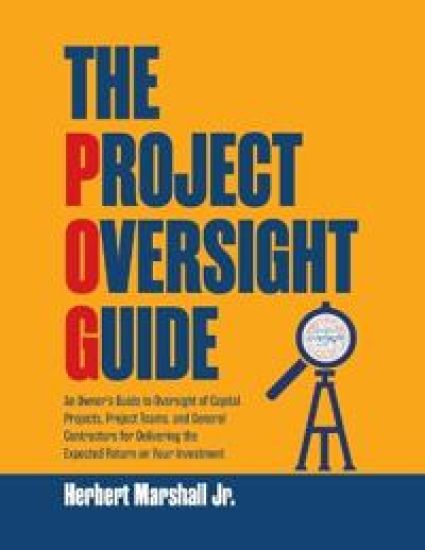
Whether you are a project manager tasked with overseeing an outsourced capital project or an owner investing in a major project critical to the future of your business, you are most likely starting at a disadvantage. A savvy contractor's project team is likely to be populated with project management professionals who have read an abundance of literature on how to maximize project value for themselves. Unfortunately, as any book search will show you, there is virtually no guidance out there for how to successfully oversee a capital project from an owner's perspective. In project management terms, the client or owner is just a "managed external stakeholder." The Project Oversight Guide (POG) is intended to bridge the gap between knowing how to run a project and knowing how to oversee one. Readers of the POG will learn that project oversight and project management are uniquely different disciplines. Bad project oversight can make an otherwise good project fail, whereas good oversight can lead a substandard project team or contractor to succeed in delivering the expected return on investment. Did you know that, when done right, project oversight more than pays for itself? By reading the POG, owners and project management students and professionals will gain insights into all facets of capital project oversight, including tools and techniques, organizational design, best practices, behaviors, and processes. The POG packages this information in an examples-based look-see at real situations and lessons learned from the field.

Eisenstein, Pudovkin, Dovzhenko, Vertov: these Soviet film directors are acknowledged to be among the greatest in the history of cinematography. To Eisenstein we owe such films as Battleship Potemkin and October; to Pudovkin Mother and The End of St Petersburg; to Dovzhenko Earth and Zvenigora; and to Vertov The Man With a Movie Camera and The Three Songs of Lenin. Herbert Marshall knew each of them personally, both as artists and as friends, and shared their cinema world when he was a student at the GIK (The Moscow State Institute of Cinematography) in the heady years following the Revolution into the period of the first Five Year Plan. His material is culled from personal recollections, diaries, notes, unpublished and published biographies, letters, press cuttings, articles and books in various languages, but mainly from Soviet sources and the Soviet cinema world. Taking the subjects one by one, this indispensible book discusses their major films including an account of their creation and reception in the USSR and abroad. It shows the tragedy of these four Soviet artists who were lucky enough not to be arrested or deprived of their limited freedom, yet who nevertheless ended up with ‘crippled creative biographies’. The author then examines the changed viewpoint in the climate of 1983 when the book was originally published.
Eisenstein, Pudovkin, Dovzhenko, Vertov: these Soviet film directors are acknowledged to be among the greatest in the history of cinematography. To Eisenstein we owe such films as Battleship Potemkin and October; to Pudovkin Mother and The End of St Petersburg; to Dovzhenko Earth and Zvenigora; and to Vertov The Man With a Movie Camera and The Three Songs of Lenin. Herbert Marshall knew each of them personally, both as artists and as friends, and shared their cinema world when he was a student at the GIK (The Moscow State Institute of Cinematography) in the heady years following the Revolution into the period of the first Five Year Plan. His material is culled from personal recollections, diaries, notes, unpublished and published biographies, letters, press cuttings, articles and books in various languages, but mainly from Soviet sources and the Soviet cinema world. Taking the subjects one by one, this indispensible book discusses their major films including an account of their creation and reception in the USSR and abroad. It shows the tragedy of these four Soviet artists who were lucky enough not to be arrested or deprived of their limited freedom, yet who nevertheless ended up with ‘crippled creative biographies’. The author then examines the changed viewpoint in the climate of 1983 when the book was originally published.

Canadian-American Industry
Herbert Marshall; Frank Southard; Kenneth W. Taylor
Carleton University Press,Canada
1976
nidottu
This volume is distinguished both for its detailed survey of the vast movement of industrial capital across the Canadian-American frontier, and for its multi-faceted analysis of the determinants and results of this movement. The authors have achieved a broad analysis covering the international movement of capital, labour skills, and technology, as well as the significant individual personalities. First published in 1936, Canadian-American Industry has retained its reputation for discerning and wise scholarship, and is republished at a crucial time in the debate over foreign ownership.