Kirjojen hintavertailu – 12 859 819 kirjaa ja 27 kauppaa
Kirjailija
Herman Melville
Kirjat ja teokset yhdessä paikassa: 1 182 kirjaa, julkaisuja vuosilta 1851–2026, suosituimpiin kuuluu Pierre. Vertaile teosten hintoja ja tarkista saatavuus suomalaisista kirjakaupoista.
"Bartleby, the Scrivener: A Story of Wall Street" is a short story by the American writer Herman Melville, first serialized anonymously in two parts in the November and December 1853 issues of Putnam's Magazine, and reprinted with minor textual alterations in his The Piazza Tales in 1856. A Wall Street lawyer hires a new clerk who, after an initial bout of hard work, refuses to make copy and any other task required of him, with the words "I would prefer not to". Numerous essays have been published on what, according to scholar Robert Milder, "is unquestionably the masterpiece of the short fiction" in the Melville canon. Melville's major source for the story was an advertisement for a new book, The Lawyer's Story, printed in both the Tribune and the Times for 18 February 1853. The book was published anonymously later that year but in fact was written by popular novelist James A. Maitland. This advertisement included the complete first chapter, which had the following opening sentence: "In the summer of 1843, having an extraordinary quantity of deeds to copy, I engaged, temporarily, an extra copying clerk, who interested me considerably, in consequence of his modest, quiet, gentlemanly demeanor, and his intense application to his duties". Melville biographer Hershel Parker points out that nothing else in the chapter besides this "remarkably evocative sentence" was "notable". 3] Critic Andrew Knighton notes the debt of the story to an obscure work from 1846, Robert Grant White's Law and Laziness: or, Students at Law of Leisure. This source contains one scene and many characters - including an idle scrivener - that appear to have influenced Melville's narrative. 4] Melville may have written the story as an emotional response to the bad reviews garnered by Pierre, his preceding novel. Christopher Sten suggests that Melville found inspiration in Ralph Waldo Emerson's essays, particularly "The Transcendentalist" which shows parallels to "Bartleby". Bartleby is a scrivener-a kind of clerk or a copyist-"who obstinately refuses to go on doing the sort of writing demanded of him". During the spring of 1851, Melville felt similarly about his work on Moby Dick. Thus, Bartleby may represent Melville's frustration with his own situation as a writer, and the story itself is "about a writer who forsakes conventional modes because of an irresistible preoccupation with the most baffling philosophical questions". 7] Bartleby may also be seen to represent Melville's relation to his commercial, democratic society. 8 Melville made an allusion to the John C. Colt case in this short story. The narrator restrains his anger toward Bartleby, his unrelentingly difficult employee, by reflecting upon "the tragedy of the unfortunate Adams and the still more unfortunate Colt and how poor Colt, being dreadfully incensed by Adams ...] was unawares hurled into his fatal act".
Herman Melville (1819 - 1891) was an American novelist, poet, and writer of short stories. His contributions to the Western canon are the whaling novel Moby-Dick (1851); the short work Bartleby, the Scrivener (1853) about a clerk in a Wall Street office; the slave ship narrative Benito Cereno (1855); and Billy Budd, Sailor (1924). When asked which of the great American writers he most admired, Vladimir Nabokov replied: "When I was young I liked Poe, and I still love Melville, whom I did not read as a boy." Around his twentieth year he was a schoolteacher for a short time, then became a seaman when his father met business reversals. On his first voyage he jumped ship in the Marquesas Islands, where he lived for a time. His first book, an account of that time, Typee, became a bestseller and Melville became known as the "man who lived among the cannibals". After Omoo, the sequel to his first book, Melville began to work philosophical issues in his third book, the elaborate Mardi (1849). The public indifference to Moby-Dick (1851), and Pierre (1852), put an end to his career as a popular author. From 1853 to 1856 he wrote short fiction for magazines, collected as The Piazza Tales (1856). In this book: Moby Dick; or The Whale Bartleby, The Scrivener A Story of Wall-Street The Piazza Tales Typee A Romance of the South Sea, A Romance of the South Sea Pierre; or The Ambiguities
"Ah, Bartleby Ah, humanity "Set in 19th century Wall Street, "Bartleby, the Scrivener" is now among the most noted of American short stories. It has been considered a precursor of absurdist literature, touching on several of Franz Kafka's themes.
"...for there is no folly of the beast of the earth which is not infinitely outdone by the madness of men."--Herman Melville, Moby-Dick"Call me Ishmael" is the iconic opening line of Herman Melville's classic American novel, Moby-Dick. Ishmael is a seaman aboard the whaling vessel, Pequod, under the vengeful captain, Ahab. Maniacally seeking retribution from the great white sperm whale called Moby-Dick--the whale responsible for the captain's missing leg--Ahab leads the crew on a quest to kill the infamous beast. A fictional work based on actual events, Moby-Dick is a classic that has been enjoyed for generations, and it's now available as part of the Word Cloud Classic series, making it a stylish and affordable addition to any library.
Great American Short Novels is a collection of some of the most celebrated works of Herman Melville, one of the most prominent American authors of the 19th century. The book includes five of Melville's most famous short novels, including Bartleby, The Scrivener, Benito Cereno, Billy Budd, Sailor, The Piazza Tales, and The Encantadas. Each of these works is a masterpiece in its own right, exploring themes of morality, justice, and the human condition. Bartleby, The Scrivener is a haunting tale of a copyist who refuses to work, while Benito Cereno is a gripping story of a slave revolt on a ship. Billy Budd, Sailor is a tragic tale of a young sailor who is falsely accused of mutiny, and The Piazza Tales is a collection of short stories that showcase Melville's skill as a storyteller. The Encantadas is a series of sketches that describe the Galapagos Islands in vivid detail, providing a glimpse into Melville's fascination with nature and the natural world. Overall, Great American Short Novels is a must-read for anyone interested in American literature and the works of one of its most important authors. Melville's prose is masterful, his characters are complex and compelling, and his stories are timeless classics that continue to resonate with readers today. This Is A New Release Of The Original 1922 Edition. This scarce antiquarian book is a facsimile reprint of the old original and may contain some imperfections such as library marks and notations. Because we believe this work is culturally important, we have made it available as part of our commitment for protecting, preserving, and promoting the world's literature in affordable, high quality, modern editions, that are true to their original work.
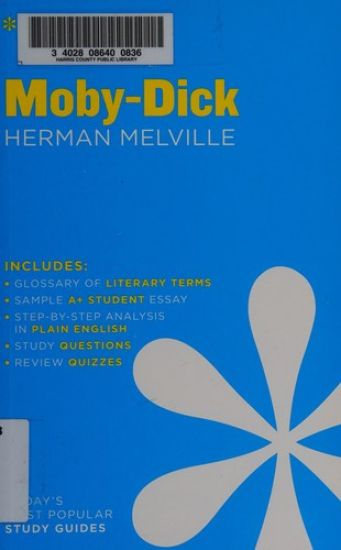
When an essay is due and dreaded exams loom, here's the lit-crit help students need to succeed! SparkNotes Literature Guides make studying smarter, better, and faster. They provide chapter-by-chapter analysis, explanations of key themes, motifs and symbols, a review quiz, and essay topics. Lively and accessible, SparkNotes is perfect for late-night studying and paper writing.