Kirjojen hintavertailu – 12 903 725 kirjaa ja 27 kauppaa

Kirjailija

Hermann Haken

Kirjat ja teokset yhdessä paikassa: 31 kirjaa, julkaisuja vuosilta 1975–2022, suosituimpiin kuuluu Synergetik in der Psychologie. Vertaile teosten hintoja ja tarkista saatavuus suomalaisista kirjakaupoista.

31 kirjaa

Kirjojen julkaisuvuodet: 1975–2022.

Information and Self-Organization

Information and Self-Organization

Hermann Haken

Springer-Verlag Berlin and Heidelberg GmbH Co. K
2006
sidottu
The widespread interest this book has found among professors, scientists and stu­ dents working in a variety of fields has made a new edition necessary. I have used this opportunity to add three new chapters on recent developments. One of the most fascinating fields of modern science is cognitive science which has become a meet­ ing place of many disciplines ranging from mathematics over physics and computer science to psychology. Here, one of the important links between these fields is the concept of information which, however, appears in various disguises, be it as Shan­ non information or as semantic information (or as something still different). So far, meaning seemed to be exorcised from Shannon information, whereas meaning plays a central role in semantic (or as it is sometimes called "pragmatic") information. In the new chapter 13 it will be shown, however, that there is an important interplay between Shannon and semantic information and that, in particular, the latter plays a decisive role in the fixation of Shannon information and, in cognitive processes, al­ lows a drastic reduction of that information. A second, equally fascinating and rapidly developing field for mathematicians, computer scientists and physicists is quantum information and quantum computa­ tion. The inclusion of these topics is a must for any modern treatise dealing with in­ formation. It becomes more and more evident that the abstract concept of informa­ tion is inseparably tied up with its realizations in the physical world.

Molekülphysik und Quantenchemie

Molekülphysik und Quantenchemie

Hermann Haken; Hans C. Wolf

Springer-Verlag Berlin and Heidelberg GmbH Co. K
2006
sidottu
Molekülphysik und Quantenchemie führt systematisch und leicht zugänglich in die Grundlagen der beiden Gebiete ein, wie es zum Verständnis der physikalischen Eigenschaften von Molekülen und der chemischen Bindung erforderlich ist. Aufbauend auf Grundkenntnissen aus der Atom- und Quantenphysik (von den gleichen Autoren) vermittelt es den Studenten der Physik, der Physikalischen Chemie und der Theoretischen Chemie die experimentellen und theoretischen Grundlagen und deren Wechselwirkung. Die vorliegende fünfte Auflage wurde um wesentliche aktuelle Entwicklungen experimenteller Methoden und theoretischer Ansätze erweitert. Neu: Abschnitte zu Molekularen Funktionseinheiten, zu Optischer Spektroskopie und Elektrolumineszenz. Durchgehende überarbeitete Neuauflage. 133 Aufgaben vervollständigen das Buch. Die dazugehörigen Lösungen können im Internet abgerufen werden.
The Physics of Atoms and Quanta

The Physics of Atoms and Quanta

Hermann Haken; Hans Christoph Wolf

Springer-Verlag Berlin and Heidelberg GmbH Co. K
2005
sidottu

Halvin toimitettuna 151,30 €

The highly positive affirmation and wide reception that this book continues to receive from professors and students ahke is the occasion for this 7th edition. Once again we have included a number of valuable suggestions for improvements, which we address as appropriate. In addition, we refer to a number of developments in atomic physics. Of these new developments in regard to exotic atoms, we mention antihydrogen in par­ ticular, because fundamental experiments in matter and antimatter can be expected in the future. Furthermore, we have inserted a chapter on the behaviour of atoms in strong elec­ trical fields. Experiments with corresponding lasers could only recently be realized. We thank our Jenaer colleague, R. Sauerbrey, for his contribution of this chapter. We have also included a new chapter on the behaviour of the hydrogen atom in strong magnetic fields. The results are of profound interest for two very different fields of physics: on the one hand, according to classical physics, one expects chaotic behaviour from Rydberg atoms in magnetic fields that can be created in the laborato­ ry; thus, an association can be drawn to aspects of chaos theory and the problems of quantum chaos. On the other hand, the very strong fields necessary for low quantum numbers are realized in the cosmos, in particular with white dwarfs and neutron stars.
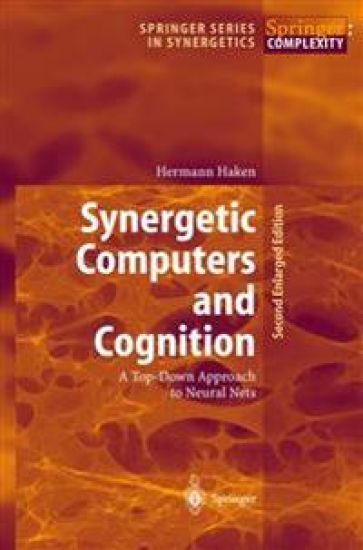
Synergetic Computers and Cognition

Synergetic Computers and Cognition

Hermann Haken

Springer-Verlag Berlin and Heidelberg GmbH Co. K
2004
sidottu
The first edition of this book has found great interest among scientists and en­ gineers dealing with pattern recognition and among psychologists working on psychophysics or Gestalt psychology. This book also proved highly useful for graduate students of informatics. The concept of the synergetic computer offers an important alternative to the by now more traditional neural nets. I just mention a few advantages: There are no ghost states so that time-consuming methods such as simulated annealing can be avoided; the synaptic strengths are explicitly determined by the prototype patterns to be stored, but they can equally well be learned, and the learning procedure allows a classification. Also a precise meaning and function can be attributed to "hidden variables". The synergetic computer has found a number of important practical applications in industry. I use the opportunity of this second edition to include a new section on transfor­ mation properties of the equations of the synergetic computer and on the invariance properties of its order parameter equations. A new section is devoted to the problem of stereopsis that is dealt with by the basic concept of the synergetic computer. Finally, attention is paid to a recent de­ velopment, namely to the use of pulse-coupled neural nets for pattern recognition.
Molecular Physics and Elements of Quantum Chemistry

Molecular Physics and Elements of Quantum Chemistry

Hermann Haken; Hans Christoph Wolf

Springer-Verlag Berlin and Heidelberg GmbH Co. K
2004
sidottu
Since the publication of the first edition of this book, there have been many im­ portant new developments in the field of molecular physics. The new methods and results which are most significant for students are treated extensively in this second edition. Among these are in particular single-molecule spectroscopy and the field of molecular electronics, which is in a stage of rapid development, including the areas of electroluminescence and organic light-emitting diodes. In addition, we have ex­ tended and corrected the earlier material in a number of places. We have also included exercises in this new edition; they will allow students to deepen their understanding and offer a basis for further individual study. The complete solutions to the exercises can be found on the Internet under www. springeronline. com/3-540-40792-S. We are grateful to Mr. C. -D. Bachem and Dr. Th. Schneider of the Springer­ Verlag for their continuous and very agreeable cooperation during the preparation of the book. We thank our colleague Prof. W. D. Brewer for his competent translation. Stuttgart, February 2004 H. Haken . H. C. Wolf Preface to the First Edition This textbook is intended for use by students of physics, physical chemistry, and theoretical chemistry. The reader is presumed to have a basic knowledge of atomic and quantum physics at the level provided, for example, by the first few chapters in our book The Physics of Atoms and Quanta.
Synergetics

Synergetics

Hermann Haken

Springer-Verlag Berlin and Heidelberg GmbH Co. K
2004
sidottu
This book is a reprint edition that comprises two titles, namely "Synergetics. An Introduction. Nonequilibrium Phase Transitions and Self-Organization in Physics, Chemistry and Biology" and ''Advanced Synergetics. Instability Hierarchies of Self­ Organizing Systems and Devices". The reason for this publication is two-fold: Since synergetics is a new type of interdisciplinary field, initiated by the author in 1969, the basic ideas developed in these volumes are of considerable theoretical interest. But much more than this, the methods and even the concrete examples presented in these books are still highly useful for graduate students, professors, and even for researchers in this fascinating field. The reason lies in the following facts: Synergetics deals with complex systems, i. e. systems that are composed of many individual parts that are able to spontaneously form spatial, temporal or functional structures by means of self-organization. Such phenomena occur in many fields ranging from physics, chemistry and biology to economy and sociology. More recent areas of application have been found in medicine and psychology, where the great potential of the basic principles of synergetics can be unearthed. Further applications have become possible in informatics, for instance the designing of new types of computers, and in other fields of engineering.
Atom- und Quantenphysik

Atom- und Quantenphysik

Hermann Haken; Hans Christoph Wolf

Springer-Verlag Berlin and Heidelberg GmbH Co. K
2003
sidottu
Atom- und Quantenphysik führt sorgfältig und leicht verständlich in die Ergebnisse und Methoden der empirischen Atomphysik ein, wobei auch das Rüstzeug der Quantentheorie vermittelt und besonders die Wechselwirkung zwischen Experiment und Theorie herausgearbeitet wird. Die vorliegende achte Auflage enthält neben umfangreichen Aktualisierungen neue Abschnitte zur quantenmechanischen Behandlung des Atoms im Magnetfeld und im elektrischen Feld. Weiter finden sich in dem Kapitel "Fortschritte der Quantenphysik: Tieferes Verständnis und neue Anwendungen" genaue Erläuterungen zur Verschränkung von Wellenfunktionen, dem Einstein-Podolsky-Rosen Paradoxon, den Bellschen Ungleichungen, dem Paradoxon der Schrödingerschen Katze und dem Konzept der Dekohärenz. Das letzte Kapitel führt in die Grundlagen der Quantentheorie der chemischen Bindung ein, welche im zweiten Band der Autoren "Molekülphysik und Quantenchemie" ihre Fortsetzung findet. 177 Übungen mit vollständigen Lösungen runden das Buch ab und dienen der Vertiefung.
Atom- und Quantenphysik

Atom- und Quantenphysik

Hermann Haken; Hans C. Wolf

Springer-Verlag Berlin and Heidelberg GmbH Co. K
1987
nidottu
Dieses Lehrbuch wendet sich an Studenten der Physik, der Naturwissenschaften oder der Elektrotechnik ab 3. Semester. Die Atomphysik und die dazugehörige Quantenphysik bilden die Grundlage für viele moderne Gebiete der Physik, der Chemie, Biologie wie auch der Elektrotechnik. Es führt sorgfältig und leicht verständlich in die Ergebnisse und Methoden der empirischen Atomphysik ein. Gleichzeitig wird dem Leser das Rüstzeug der Quantentheorie vermittelt, wobei die Wechselwirkung zwischen Experiment und Theorie besonders herausgearbeitet wird. Die Autoren haben die neuesten Resultate mit berücksichtigt und behandeln insbesondere auch die für Grundlagenforschung und Anwendung gleichermaßen wichtige Laserphysik und nichtlineare Spektroskopie. Verbesserungen und Ergänzungen in der vorliegenden 3. Auflage beziehen sich u.a. auf die Behandlung der relativistischen Klein-Gordon und Dirac-Gleichungen, eine theoretische Ableitung der Lamb-Verschiebung, neue Entwicklungen in der Spektroskopie innerer Schalen, neue Anwendungen der NMR-Spektroskopie, z. B. Tomographie. Außerdem enthält diese Auflage eine große Anzahl von Übungsaufgaben einschließlich der Lösungen zur Vertiefung und zum Selbststudium.
Atomic and Quantum Physics

Atomic and Quantum Physics

Hermann Haken; Hans C. Wolf

Springer-Verlag Berlin and Heidelberg GmbH Co. K
1987
nidottu
Atomic physics and its underlying quantum theory are the point of departure for many modern areas of physics, astrophysics, chemistry, biology, and even electrical engineering. This textbook provides a careful and eminently readable introduction to the results and methods of empirical atomic physics. The student will acquire the tools of quantum physics and at the same time learn about the interplay between experiment and theory. A chapter on the quantum theory of the chemical bond provides the reader with an introduction to molecular physics. Plenty of problems are given to elucidate the material. The authors also discuss laser physics and nonlinear spectroscopy, incorporating latest experimental results and showing their relevance to basic research. Extra items in the second edition include solutions to the exercises, derivations of the relativistic Klein-Gordon and Dirac equations, a detailed theoretical derivation of the Lamb shift, a discussion of new developments in the spectroscopy of inner shells, and new applications of NMR spectroscopy, for instance tomography.
Laser Theory

Laser Theory

Hermann Haken

Springer-Verlag Berlin and Heidelberg GmbH Co. K
1983
nidottu
This book, written by one of the pioneers of laser theory, is now considered a classic by many laser physicists. Originally published in the prestigious Encyclopedia of Physics series, it is now being republished in paperback to make it available not only to professors and scientists, but also to students. It presents a thorough treatment of the theory of laser resonators, the quantum theory of coherence, and the quantization of electromagnetic fields. Especial emphasis is placed on the quantum-mechanical treatment of laser light by means of quantum-mechanical Langevin equations, the density matrix equation, and the Fokker-Planck equation. The semiclassical approach and the rate equa­ tion approach are also presented. The principles underlying these approaches are used to derive the relevant equations, from which, in turn, the various properties of laser light are derived. Preface. The concept of the laser came into existence more than a decade ago when SCHAWLOW and TOWNES showed that the maser principle could be extended to the optical region. Since then this field has developed at an incredible pace which hardly anybody could have foreseen. The laser turned out to be a meeting place for such different disciplines as optics (e. g. spectroscopy). optical pumping, radio engineering, solid state physics, gas discharge physics and many other fields. The underlying structure of the laser theory is rather simple.