Kirjojen hintavertailu – 12 903 725 kirjaa ja 27 kauppaa

Kirjailija

Hermann Weyl

Kirjat ja teokset yhdessä paikassa: 44 kirjaa, julkaisuja vuosilta 1919–2026, suosituimpiin kuuluu The Theory of Groups and Quantum Mechanics. Vertaile teosten hintoja ja tarkista saatavuus suomalaisista kirjakaupoista.

44 kirjaa

Kirjojen julkaisuvuodet: 1919–2026.

Riemanns geometrische Ideen, ihre Auswirkung und ihre Verknüpfung mit der Gruppentheorie

Riemanns geometrische Ideen, ihre Auswirkung und ihre Verknüpfung mit der Gruppentheorie

Hermann Weyl

Springer-Verlag Berlin and Heidelberg GmbH Co. K
2011
nidottu
Ganz in Hermann Weyls bekannt klarer Darstellung geschrieben, gibt dieser Beitrag einen Bericht uber die Entstehung der grundlegenden Ideen, die der modernen Geometrie zugrunde liegen. Diese Schrift spiegelt in einzigartiger Weise Weyls mathematische Personlichkeit wider. Sie richtet sich an alle, die sich mit Fragen der Topologiegruppentheorie, Differentialgeometrie und mathematischer Physik beschaftigen. From the foreword of the editor K. Chandrasekharan: "Written in Weyl's finest style, while he was rising forty, the article is an authentic report on the genesis and evolution of those fundamental ideas that underlie the modern conception of geometry. Part I is on the continuum, and deals with analysis situs, imbeddings, and coverings. Part II is on structure, and deals with infinitesimal geometry in its many aspects, metric, conformal, affine, and projective; with the question of homogeneity, homogeneous spaces from the group-theoretical standpoint, the role of the metric field theories in physics, and the related problems of group theory. It is hoped that this article will be of interest to all those concerned with the growth and development of topology, group theory, differential geometry, geometric function theory, and mathematical physics. It bears the unmistakable imprint of Weyl's mathematical personality, and of his remarkable capacity to capture and delineate the transmutation of some of the nascent into the dominant ideas of the mathematics of our time".
Space, Time, Matter

Space, Time, Matter

Hermann Weyl

Cosimo Classics
2010
sidottu
In this classic text first published in German in 1918-this is a translation by HENRY L. BROSE (1890-1965) of the 1921 fourth edition-Weyl considers the role of Euclidean space in physics and the mathematics of Einstein's general theory of relativity, exploring: - foundations of affine and metrical geometry - conception of n-dimensional geometry - tensor algebra - the stationary electromagnetic field - Riemann's geometry - affinely connected manifolds - space metrics from the point of view of the Theory of Groups - relativistic geometry, kinematics, and optics - electrodynamics of moving bodies - mechanics of the principle of relativity - mass and energy - gravitational waves - concerning the interconnection of the world as a whole - and more. HERMANN KLAUS HUGO WEYL (1885-1955)was a German mathematician who spent most of his life working in Zurich, Switzerland. When the Nazi party began to gain power he fled to a job at the Institute of Advanced Study in Princeton, New Jersey where he continued to develop his representation theory. He was one of the most influential mathematicians of the 20th century. He greatly impacted theoretical physics and number theory and was the first to combine general relativity and electromagnetism
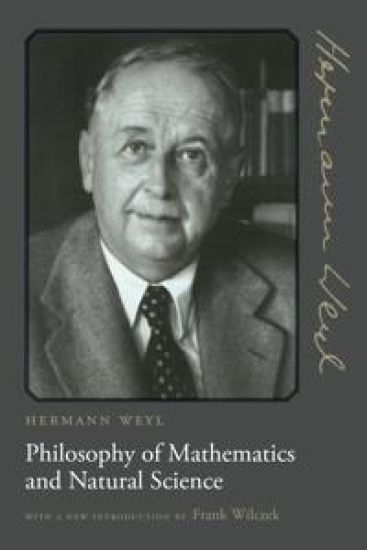
Philosophy of Mathematics and Natural Science

Philosophy of Mathematics and Natural Science

Hermann Weyl

Princeton University Press
2009
pokkari
When mathematician Hermann Weyl decided to write a book on philosophy, he faced what he referred to as "conflicts of conscience"--the objective nature of science, he felt, did not mesh easily with the incredulous, uncertain nature of philosophy. Yet the two disciplines were already intertwined. In Philosophy of Mathematics and Natural Science, Weyl examines how advances in philosophy were led by scientific discoveries--the more humankind understood about the physical world, the more curious we became. The book is divided into two parts, one on mathematics and the other on the physical sciences. Drawing on work by Descartes, Galileo, Hume, Kant, Leibniz, and Newton, Weyl provides readers with a guide to understanding science through the lens of philosophy. This is a book that no one but Weyl could have written--and, indeed, no one has written anything quite like it since.
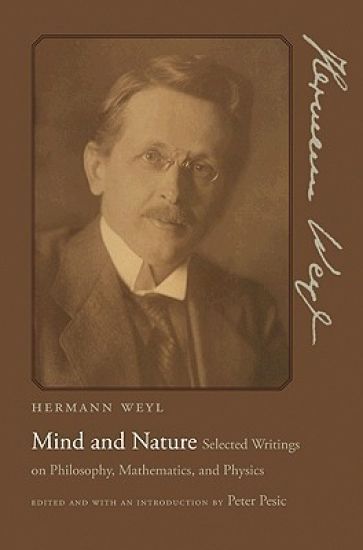
Mind and Nature

Mind and Nature

Hermann Weyl

Princeton University Press
2009
sidottu
Hermann Weyl (1885-1955) was one of the twentieth century's most important mathematicians, as well as a seminal figure in the development of quantum physics and general relativity. He was also an eloquent writer with a lifelong interest in the philosophical implications of the startling new scientific developments with which he was so involved. Mind and Nature is a collection of Weyl's most important general writings on philosophy, mathematics, and physics, including pieces that have never before been published in any language or translated into English, or that have long been out of print. Complete with Peter Pesic's introduction, notes, and bibliography, these writings reveal an unjustly neglected dimension of a complex and fascinating thinker. In addition, the book includes more than twenty photographs of Weyl and his family and colleagues, many of which are previously unpublished. Included here are Weyl's exposition of his important synthesis of electromagnetism and gravitation, which Einstein at first hailed as "a first-class stroke of genius"; two little-known letters by Weyl and Einstein from 1922 that give their contrasting views on the philosophical implications of modern physics; and an essay on time that contains Weyl's argument that the past is never completed and the present is not a point. Also included are two book-length series of lectures, The Open World (1932) and Mind and Nature (1934), each a masterly exposition of Weyl's views on a range of topics from modern physics and mathematics. Finally, four retrospective essays from Weyl's last decade give his final thoughts on the interrelations among mathematics, philosophy, and physics, intertwined with reflections on the course of his rich life.
Einführung in die Funktionentheorie

Einführung in die Funktionentheorie

Hermann Weyl

Birkhauser Verlag AG
2008
nidottu
Dieser Text ist die Transkription einer Vorlesung zur Funktionentheorie, die Hermann Weyl im Wintersemester 1910-11 an der Universität Göttingen gehalten hat, kurz vor der Entstehung seines einflussreichen Buches über Riemannsche Flächen, das auf der Fortsetzung dieser Vorlesung im Sommersemester 1911 beruht. Weyl betont in dieser Vorlesung die kinematische Deutung gebrochen-linearer Transformationen und die Beziehungen zwischen konformen Abbildungen und Strömungstheorie. Höhepunkt der Vorlesung ist der Vergleich der Riemannschen und Weierstraßschen Behandlung mehrdeutiger analytischer Funktionen durch Riemannsche Flächen beziehungsweise analytische Fortsetzung.
Algebraic Theory of Numbers

Algebraic Theory of Numbers

Hermann Weyl

Princeton University Press
1998
pokkari
In this, one of the first books to appear in English on the theory of numbers, the eminent mathematician Hermann Weyl explores fundamental concepts in arithmetic. The book begins with the definitions and properties of algebraic fields, which are relied upon throughout. The theory of divisibility is then discussed, from an axiomatic viewpoint, rather than by the use of ideals. There follows an introduction to p-adic numbers and their uses, which are so important in modern number theory, and the book culminates with an extensive examination of algebraic number fields. Weyl's own modest hope, that the work "will be of some use," has more than been fulfilled, for the book's clarity, succinctness, and importance rank it as a masterpiece of mathematical exposition.
The Classical Groups

The Classical Groups

Hermann Weyl

Princeton University Press
1997
pokkari
In this renowned volume, Hermann Weyl discusses the symmetric, full linear, orthogonal, and symplectic groups and determines their different invariants and representations. Using basic concepts from algebra, he examines the various properties of the groups. Analysis and topology are used wherever appropriate. The book also covers topics such as matrix algebras, semigroups, commutators, and spinors, which are of great importance in understanding the group-theoretic structure of quantum mechanics. Hermann Weyl was among the greatest mathematicians of the twentieth century. He made fundamental contributions to most branches of mathematics, but he is best remembered as one of the major developers of group theory, a powerful formal method for analyzing abstract and physical systems in which symmetry is present. In The Classical Groups, his most important book, Weyl provided a detailed introduction to the development of group theory, and he did it in a way that motivated and entertained his readers. Departing from most theoretical mathematics books of the time, he introduced historical events and people as well as theorems and proofs. One learned not only about the theory of invariants but also when and where they were originated, and by whom. He once said of his writing, "My work always tried to unite the truth with the beautiful, but when I had to choose one or the other, I usually chose the beautiful." Weyl believed in the overall unity of mathematics and that it should be integrated into other fields. He had serious interest in modern physics, especially quantum mechanics, a field to which The Classical Groups has proved important, as it has to quantum chemistry and other fields. Among the five books Weyl published with Princeton, Algebraic Theory of Numbers inaugurated the Annals of Mathematics Studies book series, a crucial and enduring foundation of Princeton's mathematics list and the most distinguished book series in mathematics.
Space- Time- Matter

Space- Time- Matter

Hermann Weyl

Hawk Press
1994
pokkari
The contents of the book are as followsCHAPTER I Euclidean Space. Its Mathematical Formulation and its R le in PhysicsCHAPTER II The Metrical ContinuumCHAPTER III Relativity of Space and TimeCHAPTER IV The General Theory of Relativity
Space- Time- Matter

Space- Time- Matter

Hermann Weyl

Hawk Press
1994
sidottu
The contents of the book are as followsCHAPTER I Euclidean Space. Its Mathematical Formulation and its R le in PhysicsCHAPTER II The Metrical ContinuumCHAPTER III Relativity of Space and TimeCHAPTER IV The General Theory of Relativity
Raum · Zeit · Materie

Raum · Zeit · Materie

Hermann Weyl

Springer-Verlag Berlin and Heidelberg GmbH Co. K
1988
nidottu
Das Studium von Hermann Weyls Raum . Zeit . Materie ist auch heute noch lohnenswert. Als erste systematische Gesamtdarstellung der speziellen und allgemeinen Relativitätstheorie einschließlich der zugehörigen Mathematik setzt es sich gründlich mit den historischen Wurzeln auseinander. Die Betonung des Begriffs des linearen Zusammenhangs unabhängig von der Metrik kommt der heutigen Auffassung und den Verallgemeinerungen in den Eichtheorien entgegen. Für ein gründliches Verständnis der modernen Eichtheorie ist Weyls Buch immer noch eine wichtige Grundlage.
Hilbert

Hilbert

Constance Reid; Hermann Weyl

Springer-Verlag Berlin and Heidelberg GmbH Co. K
1970
nidottu
David Hilbert was one of the truly great mathematicians of his time. His work and his inspiring scientific personality have profoundly influenced the development of the mathematical sciences up to the present time. His vision, his productive power and independent originality as a mathematical thinker, his versatility and breadth of interest made him a pioneer in many different mathematical fields. He was a unique personality, profoundly immersed in his work and totally dedicated to his science, a teacher and leader of the very highest order, inspiring and most generous, tireless and persistent in all of his efforts. To me, one of the few survivors of Hilbert's inner circle, it always has appeared most desirable that a biography should be published. Considering, however, the enormous scientific scope of Hilbert's work, it seemed to me humanly impossible that a single biographer could do justice to all the as- pects of Hilbert as a productive scientist and to the impact of his radiant personality. Thus, when I learned of Mrs. Reid's plan for the present book I was at first skeptical whether somebody not thoroughly familiar with mathematics could possibly write an acceptable book. Yet, when I saw the manuscript my skepticism faded, and I became more and more enthusiastic about the author's achievement. I trust that the book will fascinate not only mathematicians but everybody who is interested in the mystery of the origin of great scientists in our society.
Studies in the History of Science

Studies in the History of Science

E. A. Speiser; Otto E. Neugebauer; Hermann Ranke; Henry E. Sigerist; Richard H. Shryock; Evarts A. Graham; Edgar A. Singer; Hermann Weyl

University of Pennsylvania Press
1941
sidottu
This book is a volume in the Penn Press Anniversary Collection. To mark its 125th anniversary in 2015, the University of Pennsylvania Press rereleased more than 1,100 titles from Penn Press's distinguished backlist from 1899-1999 that had fallen out of print. Spanning an entire century, the Anniversary Collection offers peer-reviewed scholarship in a wide range of subject areas.