Kirjojen hintavertailu – 12 903 724 kirjaa ja 27 kauppaa
Kirjailija
Hesiod
Kirjat ja teokset yhdessä paikassa: 55 kirjaa, julkaisuja vuosilta 1973–2026, suosituimpiin kuuluu The Remains of Hesiod the Ascræan. Vertaile teosten hintoja ja tarkista saatavuus suomalaisista kirjakaupoista.
Unver nderter Nachdruck der Originalausgabe von 1865. Der Verlag Antigonos spezialisiert sich auf die Herausgabe von Nachdrucken historischer B cher. Wir achten darauf, dass diese Werke der ffentlichkeit in einem guten Zustand zug nglich gemacht werden, um ihr kulturelles Erbe zu bewahren.
Antiquity’s original didactic poet. Hesiod describes himself as a Boeotian shepherd who heard the Muses call upon him to sing about the gods. His exact dates are unknown, but he has often been considered a younger contemporary of Homer. The first volume of this revised Loeb Classical Library edition offers Hesiod’s two extant poems and a generous selection of testimonia regarding his life, works, and reception. In Theogony, Hesiod charts the history of the divine world, narrating the origin of the universe and the rise of the gods, from first beginnings to the triumph of Zeus, and reporting on the progeny of Zeus and of goddesses in union with mortal men. In Works and Days, Hesiod shifts his attention to humanity, delivering moral precepts and practical advice regarding agriculture, navigation, and many other matters; along the way he gives us the myths of Pandora and of the Golden, Silver, and other Races of Men. The second volume contains The Shield and extant fragments of other poems, including the Catalogue of Women, that were attributed to Hesiod in antiquity. The former provides a Hesiodic counterpoint to the shield of Achilles in the Iliad; the latter presents several legendary episodes organized according to the genealogy of their heroes’ mortal mothers. None of these is now thought to be by Hesiod himself, but all have considerable literary and historical interest. Glenn W. Most has thoroughly revised his edition to take account of the textual and interpretive scholarship that has appeared since its initial publication.
Antiquity’s original didactic poet. Hesiod describes himself as a Boeotian shepherd who heard the Muses call upon him to sing about the gods. His exact dates are unknown, but he has often been considered a younger contemporary of Homer. The first volume of this revised Loeb Classical Library edition offers Hesiod’s two extant poems and a generous selection of testimonia regarding his life, works, and reception. In Theogony, Hesiod charts the history of the divine world, narrating the origin of the universe and the rise of the gods, from first beginnings to the triumph of Zeus, and reporting on the progeny of Zeus and of goddesses in union with mortal men. In Works and Days, Hesiod shifts his attention to humanity, delivering moral precepts and practical advice regarding agriculture, navigation, and many other matters; along the way he gives us the myths of Pandora and of the Golden, Silver, and other Races of Men. The second volume contains The Shield and extant fragments of other poems, including the Catalogue of Women, that were attributed to Hesiod in antiquity. The former provides a Hesiodic counterpoint to the shield of Achilles in the Iliad; the latter presents several legendary episodes organized according to the genealogy of their heroes’ mortal mothers. None of these is now thought to be by Hesiod himself, but all have considerable literary and historical interest. Glenn W. Most has thoroughly revised his edition to take account of the textual and interpretive scholarship that has appeared since its initial publication.
Greek poet Hesiod, who lived sometime during the 8th and 7th century B. C., is regarded as one the most important poets of classical antiquity. What little is known of him largely comes from his own epic poetry, in which he unconventionally inserted details of his life. Only three of his works, the "Theogony," "Works and Days," and the "Shield of Heracles" survive to this day in their entirety. The "Theogony" is a foundational work of Greek mythology which concerns the creation of the world and the origins and genealogies of the Greek gods. In synthesizing the variety of local Greek traditions concerning the gods into a single narrative, Hesiod's "Theogony" would give uniformity to his culture's myths in a way that would be highly influential. Also included in this volume is Hesiod's "Works and Days," in which the poet argues that labor is a fundamental condition of human existence and to those who are willing to work success will most surely be achieved. A treatise on the virtue of hard work, "Works and Days" is a didactic poem addressed to his brother Perses, who has squandered his inheritance, and who through bribery has deprived Hesiod of part of his own patrimony. Lastly in this volume is the "Shield of Heracles" a work which details the conflict between the mythological figures of Heracles and Cycnus. This edition is printed on premium acid-free paper and follows the translations of Hugh G. Evelyn-White.
Hesiod, Homeric Hymns and Homerica by Homer and Hesiod. The early Greek epic - that is, poetry as a natural and popular, and not (as it became later) an artificial and academic literary form - passed through the usual three phases, of development, of maturity, and of decline. No fragments which can be identified as belonging to the first period survive to give us even a general idea of the history of the earliest epic, and we are therefore thrown back upon the evidence of analogy from other forms of literature and of inference from the two great epics which have come down to us. So reconstructed, the earliest period appears to us as a time of slow development in which the characteristic epic metre, diction, and structure grew up slowly from crude elements and were improved until the verge of maturity was reached. The second period, which produced the "Iliad" and the "Odyssey", needs no description here: but it is very important to observe the effect of these poems on the course of post-Homeric epic. As the supreme perfection and universality of the "Iliad" and the "Odyssey" cast into oblivion whatever pre-Homeric poets had essayed, so these same qualities exercised a paralysing influence over the successors of Homer. If they continued to sing like their great predecessor of romantic themes, they were drawn as by a kind of magnetic attraction into the Homeric style and manner of treatment, and became mere echoes of the Homeric voice: in a word, Homer had so completely exhausted the epic genre, that after him further efforts were doomed to be merely conventional.
'Stallings's new translation of Hesiod's Works and Days - witty, gritty, and unsettlingly relevant - is not to be missed' TLS, Books of the YearSHORTLISTED FOR THE 2019 RUNICMAN AWARDA new verse translation of one of the foundational ancient Greek works by the award-winning poet A. E. Stallings. Hesiod was the first self-styled 'poet' in western literature, revered by the ancient Greeks. Ostensibly written to chide and educate his lazy brother, Works and Days tells the story of Pandora's jar and humanity's place in a fallen world. Blending the cosmic and the earthy, and mixing myth, lyrical description, personal asides, astronomy, proverbs and down-to-earth advice on rural tasks and rituals, it is also a hymn to honest toil as man's salvation. This vibrant new verse translation by award-winning poet A. E. Stallings conveys the clarity and unexpected humour of a founding work of classical literature.
Widely considered the first poet in the Western tradition to address the matter of his own experience, Hesiod occupies a seminal position in literary history. The Theogony brings together and formalizes many of the Greek myth narratives, detailing the genealogy of the Greek gods and their violent struggles for power. Works and Days seems on its face to be a compendium of advice about managing a farm, but it ranges far beyond this scope to meditate on the virtues of a good life, morality, justice, and the place of humans in the universe. Considered foundational texts of Western literature, these poems are concerned with orderliness and organization, and they proclaim those ideals from small scale to vast, from the legibility of a handful of seeds to the story of the cosmos. Presented here in a bilingual edition, Johnson’s translation takes care to preserve Hesiod’s expression of his themes in the structure of his lines and sentences, achieving a sonic and rhythmic balance that enables us to hear his music across the millennia.
Esta obra podr a considerarse el primer libro de autoayuda de la historia. Describe lo que Hes odo llama las cinco Edades del Hombre, adem s de contener consejo y sabidur a, prescribiendo una vida de trabajo honesto y atacando la ociosidad, los jueces injustos y la pr ctica de la usura. Considera el trabajo como origen de todo bien, pues "tanto hombres como dioses odian a los holgazanes, que parecen z nganos en una colmena."
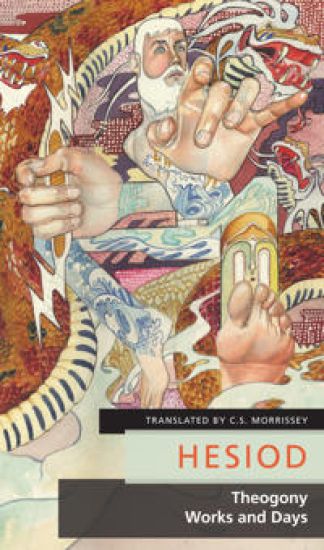
Philosopher C. S. Morrissey adapts Hesiod's two great works, Theogony and Works and Days, taking into account the poet's essential meditative insights that paved the way for the subsequent achievements of Greek philosophy,most notably of Plato, and thereby gave a distinctive shape to all of Western philosophy. Theogony recounts the genesis of the first generations of the Greek gods and recollects how Zeus used both force and persuasion to establish his cosmic reign of justice. Works and Days tells the story of the origin and ordination of human beings within this cosmos and their perennial struggle to win order from disorder in a world overwhelmed by harsh sorrows and injustice. In the wake of personal adversity and suffering, Hesiod was inspired by the Muses to sing out against the untruth of society and to disclose the truth about justice in the cosmos. Theogony, which won him his laurels in a poetic competition, begins by telling of how the Muses chose him as an individual vessel of inspiration, to be a rival to Homer and the old myths with a newer vision of the struggle for justice among the gods. In Works and Days, Hesiod includes these autobiographical details within a reflection on the two-fold role of competition in life: "the bad strife" is visible everywhere in the manifold forms of universal disorder, although "the good strife" is part of the struggle to maintain order in the wake of chaos and the primeval void. These new translations are contextualized with a foreword by distinguished philosopher Roger Scruton and text by the late philosopher and historian Eric Voegelin, who argues the magnitude of Hesiod's influence on Greek philosophy and Western history, and how his sublime contribution to literature has formed a signal bridge between myth and metaphysics.
Since 1923 the Sammlung Tusculum has published authoritative editions of Greek and Latin works together with a German translation. The original texts are comprehensively annotated, and feature an introductory chapter. In the new volumes, additional essays delve into specific aspects of the works, illuminating their historical context and reception to the present day. The high academic quality of the new editions together with clearly written essays and annotations make the Sammlung Tusculum essential reading for students who are discovering an ancient author for the first time as well as professional scholars who would like to gain a deeper understanding of specific aspects of a given work. Moreover, the series is ideal for lay readers who would like to engage with antiquity through a reliable German translation. The series contains over 270 titles, available in print and eBook editions, making previously out-of-print titles and rarities available again for the first time. In order to celebrate the 90th anniversary of the series, De Gruyter is proud to present Tusculum Online, an eBook package which contains all titles that appeared between 1923 and 2013 - a fitting tribute to an important part of German publishing history. For more information, please see www.degruyter.com/tusculum
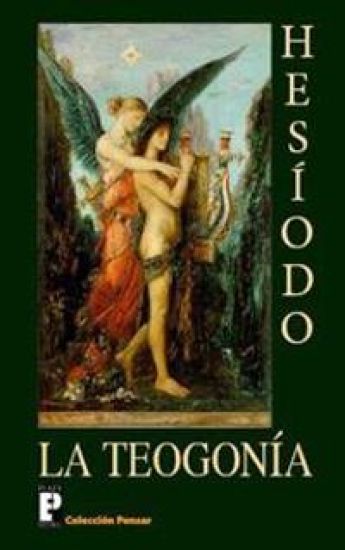
La Teogon a es una obra po tica escrita por Hes odo y relata la genealog a de los dioses de la mitolog a griega. Contiene una de las m s antiguas versiones del origen del cosmos y el linaje de los dioses griegos, y es una de las obras claves de la pica grecolatina. Se discute si debe fecharse en el siglo VII a. C. o en el VIII a. C.