Kirjailija
Hilaire Belloc
Kirjat ja teokset yhdessä paikassa: 472 kirjaa, julkaisuja vuosilta 1922–2026, suosituimpiin kuuluu Jim. Vertaile teosten hintoja ja tarkista saatavuus suomalaisista kirjakaupoista.
472 kirjaa
Kirjojen julkaisuvuodet: 1922–2026.
Hilaire Belloc's landmark study Characters of the Reformation argues that Western Europe's break from the Catholic Church was driven by a land-grab and looting of Church property by European noblemen. Belloc has little admiration for the so-called leaders of the time and credits the Reformation to behind-the-scenes players.
In this collection of short biographies Hilaire Belloc, one of the great Catholic historians of the twentieth century, shares his views on the principal characters of the Protestant Reformation, focusing primarily on those figures concerned with the events in England. Through each account, Belloc demonstrates that the motives of the Protestant leaders were rarely religious in nature, but usually political or economic. He reminds the reader that European Christendom was once a single united entity, under the authority of the Catholic Church, each country viewing itself as a single "province" of the whole. However, many of Europe's Princes resented the power that the Bishop of Rome held in their own lands. The Reformation, aided by the rise of Nationalism, was a means for the nobles of Europe to shake off Papal authority and rule their territory independently. It also gave European monarchs control over the Church and all of its property in their realm, including the taxes that would normally be sent to Rome. Therefore, the nobles grew rich by confiscating the wealth of the Church, and resisted any form of reconciliation if that meant returning the wealth to its rightful owner. In subsequent generations, the fear of this possibility gave the noble classes an incentive to remain in the Protestant camp. What's more, the political leaders of the "Counter Reformation" were not as effective as they ought to have been, often allowing their own dynastic or nationalistic agendas to take precedence over the restoration of religious unity in Europe. As usual, Belloc's historical perspective offers the sort of timeless wisdom rarely duplicated in modern times.
Hilaire Belloc examines the five most destructive heretical movements to have affected Christian Civilization: Arianism, Mohammedanism (Islam), Albigensianism (Cathar), The Reformation (Protestant), and "The Modern Phase." Belloc describes how these movements began, how they spread, and how they continued to influence the world up until the time of his writing (1936). The Chapter on Islam is especially relevant in light of current events; in it Belloc accurately predicts the renewal of Jihadist aggression towards Western Civilization.
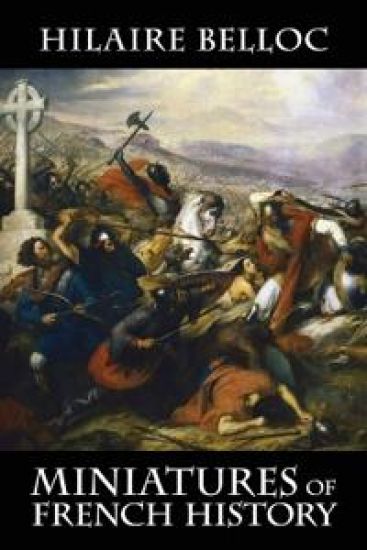
"These thirty-one pieces have the grace and delicacy proper to miniatures, as Mr. Belloc aptly calls them. Each runs to no more than a dozen pages, yet the author contrives within these narrow limits to paint a set of memorable pictures of scenes taken from the whole range of French history, from the founding of Marseilles to the Battle of the Marne.... Such imaginative reconstruction of history is of greater value than much laboured accuracy of detail and requires the gifts, which it is unnecessary to say Mr. Belloc has in ample measure, of the historian and the poet." "The greater number of Mr. Belloc's subjects are mediaeval and--need we say?--military. The miniature entitled "Roncesvalles" will perhaps be best remembered--for its restraint, its delicacy, its actuality. The scenes are cleanly drawn with the sure touch of one who knows equally the history, the legend and the ground." "These miniatures will long be read with delight, and we are grateful to Mr. Belloc for his delicate work." --The Spectator, November 21st, 1925.
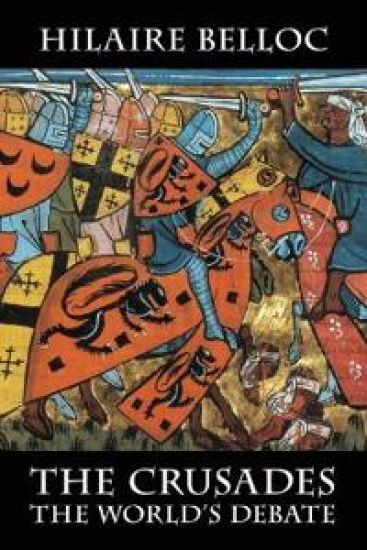
The Crusades: The World's Debate
Hilaire Belloc
Cavalier Books
2018
nidottu
Halvin toimitettuna 19,70 €
Hilaire Belloc (1870-1953)--one of the most prominent Catholic authors of his time--gives a common sense explanation of why the Crusades were necessary, and why they ultimately failed. He argues that the personal and strategic failings of the First Crusade's leaders led to the establishment of a state that could not be sustained, and that the absence of such a state left Europe vulnerable to Islamic aggression for centuries afterward. Writing in 1937, following the demise of the Ottoman Empire, Belloc believed that the West had finally gained the advantage over its mortal foe. However, he also includes a prophetic warning to Western Civilization, about the eventual resurgence of Islam and its enduring desire to destroy Christendom.
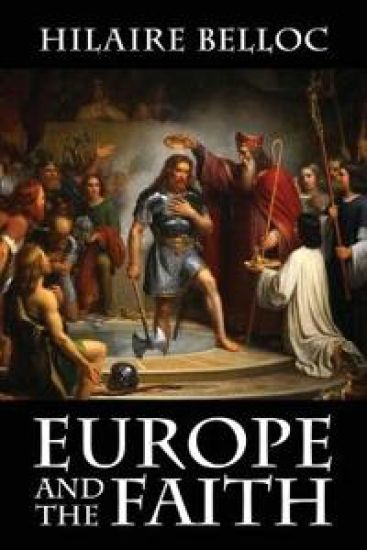
Introduction the Catholic Conscience of History 4 I. What was the Roman Empire? 15 II. What was the Church in the Roman Empire? 25 III. What was the "Fall" of the Roman Empire? 41 IV. The Beginning of the Nations 56 V. What Happened in Britain? 71 VI. The Dark Ages 97 VII. The Middle Ages 107 VIII. What was the Reformation? 115 IX. The Defection of Britain 124 X. Conclusion
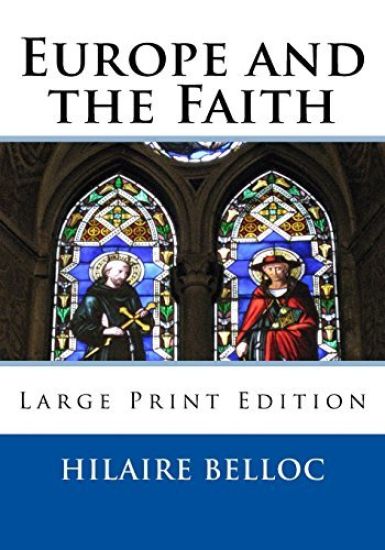
Europe and the Faith: Large Print Edition
Hilaire Belloc
Createspace Independent Publishing Platform
2018
nidottu
Introduction the Catholic Conscience of History 4 I. What was the Roman Empire? 26 II. What was the Church in the Roman Empire? 46 III. What was the "Fall" of the Roman Empire? 79 IV. The Beginning of the Nations 109 V. What Happened in Britain? 140 VI. The Dark Ages 194 VII. The Middle Ages 214 VIII. What was the Reformation? 230 IX. The Defection of Britain 249 X. Conclusion
In The Great Heresies, Hilaire Belloc takes the reader on a fast and furious tour of European history seen through the lens of its chief religious conflicts - Arianism, ? Mohammedanism? (Islam), Albigensianism, the Reformation, and what he terms ? The Modern Phase.?
In The Great Heresies, Hilaire Belloc takes the reader on a fast and furious tour of European history seen through the lens of its chief religious conflicts - Arianism, 'Mohammedanism' (Islam), Albigensianism, the Reformation, and what he terms 'The Modern Phase.'
2017 Reprint of 1938 Edition. Full facsimile of the original edition, not reproduced with Optical Recognition software. Belloc was among the more famous and influential Catholic historians of the 19th century. He emphasized the central role of the Catholic faith in forming Western Civilization--from the time of Christ up to his own time. Contents Include: Introduction on heresy--Scheme of this book--The Arian heresy--The great and enduring heresy of Mohammed--The Albigensian attack--What was the reformation?--The modern phase
"It has been a series of cycles invariably following the same steps. The Jew comes to an alien society, at first in small numbers. He thrives. His presence is not resented. He is rather treated as a friend. Whether from mere contrast in type--what I have called 'friction'--or from some apparent divergence between his objects and those of his hosts, or through his increasing numbers, he creates (or discovers) a growing animosity. He resents it. He opposes his hosts. They call themselves masters in their own house. The Jew resists their claim. It comes to violence.""It is always the same miserable sequence. First a welcome; then a growing, half-conscious ill-ease; next a culmination in acute ill-ease; lastly catastrophe and disaster; insult, persecution, even massacre, the exiles flying from the place of persecution into a new district where the Jew is hardly known, where the problem has never existed or has been forgotten. He meets again with the largest hospitality. There follows here also, after a period of amicable interfusion, a growing, half-conscious ill-ease, which next becomes acute and leads to new explosions, and so on, in a fatal round.""If we are to stop that wheel from its perpetual and tragic turning, there seems to be no method save that for which I plead.""For if the quarrel is allowed to rise unchecked and to proceed unappeased, we shall come, unexpectedly and soon, upon one of these tragedies which have marked for centuries the relations between this peculiar nation and ourselves."--Hilaire Belloc, 1922.

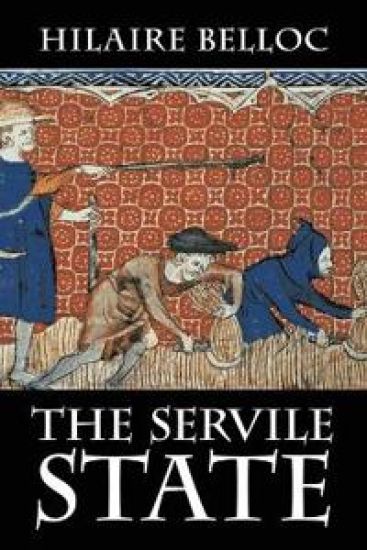
In his treatise on European economic history (The Servile State, 1912) Hilaire Belloc explores the many failings of the Capitalist system. He explains that Capitalism emerged from the English Reformation, reached its present form during England's Industrial Revolution, and from there was exported to the rest of the world." It was in England that the Industrial System arose. It was in England that all its traditions and habits were formed; and because the England in which it arose was already a Capitalist England, modern Industrialism, wherever you see it at work to-day, having spread from England, has proceeded upon the Capitalist model." Belloc also suggests that Capitalism has supplanted another, earlier system, one that had developed throughout Catholic Europe, a system he and his good friend G. K. Chesterton referred to as "Distributism.""Property was an institution native to the State and enjoyed by the great mass of its citizens. Co-operative institutions, voluntary regulations of labour, restricted the completely independent use of property by its owners only in order to keep that institution intact and to prevent the absorption of small property by great.""This excellent state of affairs which we had reached after many centuries of Christian development, and in which the old institution of slavery had been finally eliminated from Christendom, did not everywhere survive. In England in particular it was ruined."
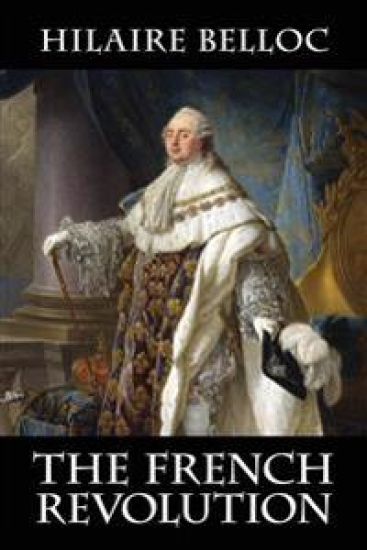
"The object of these few pages is not to recount once more the history of the Revolution: that can be followed in any one of a hundred text-books. Their object is rather to lay, if that be possible, an explanation of it before the English reader; so that he may understand both what it was and how it proceeded, and also why certain problems hitherto unfamiliar to Englishmen have risen out of it.""If a personal point may be noted, the fact that the writer of these pages is himself a Catholic and in political sympathy strongly attached to the political theory of the Revolution, should not be hidden from the reader. Such personal conditions have perhaps enabled him to treat the matter more thoroughly than it might have been treated by one who rejected either Republicanism upon the one hand, or Catholicism upon the other; but he believes that no personal and therefore exaggerated note has been allowed to intrude upon his description of what is a definite piece of objective history lying in the field of record rather than in that of opinion."--Hilaire Belloc
"You have been told 'Christianity (a word, by the way, quite un- historical) crept into Rome as she declined, and hastened that decline.' That is bad history. Rather accept this phrase and retain it: 'The Faith is that which Rome accepted in her maturity; nor was the Faith the cause of her decline, but rather the conservator of all that could be conserved.""In the next period--the Dark Ages--the Catholic proceeds to see Europe saved against a universal attack of the Mohammedan, the Hun, the Scandinavian: he notes that the fierceness of the attack was such that anything save something divinely instituted would have broken down. The Mohammedan came within three days' march of Tours, the Mongol was seen from the walls of Tournus on the S one: right in France. The Scandinavian savage poured into the mouths of all the rivers of Gaul, and almost overwhelmed the whole island of Britain. There was nothing left of Europe but a central core.""Nevertheless Europe survived. In the refloresence which followed that dark time--in the Middle Ages--the Catholic notes not hypotheses but documents and facts; he sees the Parliaments arising not from some imaginary 'Teutonic' root--a figment of the academies--but from the very real and present great monastic orders, in Spain, in Britain, in Gaul--never outside the old limits of Christendom. He sees the Gothic architecture spring high, spontaneous and autochthonic, first in the territory of Paris and thence spread outwards in a ring to the Scotch Highlands and to the Rhine. He sees the new Universities, a product of the soul of Europe, re-awakened--he sees the marvelous new civilization of the Middle Ages rising as a transformation of the old Roman society, a transformation wholly from within, and motived by the Faith."--Hilaire Belloc
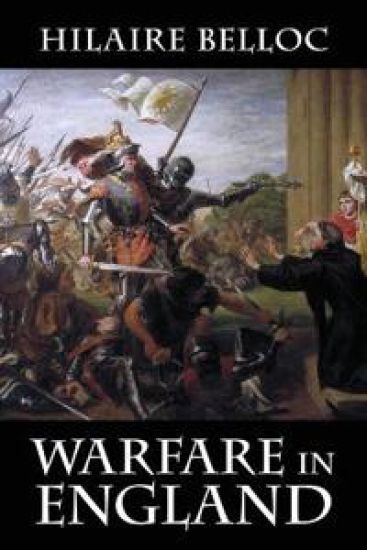
In this brief survey of the chief military campaigns conducted in England, from the time of the Roman Conquest through the Scotch Wars, Belloc reminds the reader that the lay of the land is often the deciding factor in any conflict: "The military history of any country is largely deter- mined by its Topography, that is, by the nature of its soil: where run its ranges of hills: how high, steep, or barren these may be: the situation of its better lands, with their chief towns: the position, depth and rapid- ity of its rivers, etc., etc." --Hilaire Belloc