Kirjojen hintavertailu – 12 903 724 kirjaa ja 27 kauppaa

Kirjailija

Hilary Appel

Kirjat ja teokset yhdessä paikassa: 4 kirjaa, julkaisuja vuosilta 2004–2018, suosituimpiin kuuluu From Triumph to Crisis. Vertaile teosten hintoja ja tarkista saatavuus suomalaisista kirjakaupoista.

4 kirjaa

Kirjojen julkaisuvuodet: 2004–2018.

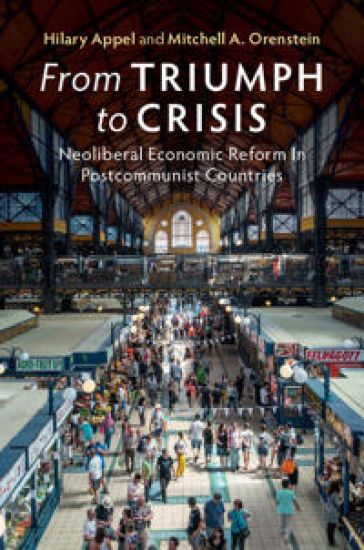
From Triumph to Crisis

From Triumph to Crisis

Hilary Appel; Mitchell A. Orenstein

Cambridge University Press
2018
sidottu
The postcommunist countries were amongst the most fervent and committed adopters of neoliberal economic reforms. Not only did they manage to overcome the anticipated domestic opposition to 'shock therapy' and Washington Consensus reforms, but many fulfilled the membership requirements of the European Union and even adopted avant-garde neoliberal reforms like the flat tax and pension privatization. Neoliberalism in the postcommunist countries went farther and lasted longer than expected, but why? Unlike pre-existing theories based on domestic political-economic struggles, this book focuses on the imperatives of re-insertion into the international economy. Appel and Orenstein show how countries engaged in 'competitive signaling', enacting reforms in order to attract foreign investment. This signaling process explains the endurance and intensification of neoliberal reform in these countries for almost two decades, from 1989–2008, and its decline thereafter, when inflows of capital into the region suddenly dried up. This book will interest students of political economy and Eastern European and Eurasian politics.
From Triumph to Crisis

From Triumph to Crisis

Hilary Appel; Mitchell A. Orenstein

Cambridge University Press
2018
pokkari
The postcommunist countries were amongst the most fervent and committed adopters of neoliberal economic reforms. Not only did they manage to overcome the anticipated domestic opposition to 'shock therapy' and Washington Consensus reforms, but many fulfilled the membership requirements of the European Union and even adopted avant-garde neoliberal reforms like the flat tax and pension privatization. Neoliberalism in the postcommunist countries went farther and lasted longer than expected, but why? Unlike pre-existing theories based on domestic political-economic struggles, this book focuses on the imperatives of re-insertion into the international economy. Appel and Orenstein show how countries engaged in 'competitive signaling', enacting reforms in order to attract foreign investment. This signaling process explains the endurance and intensification of neoliberal reform in these countries for almost two decades, from 1989–2008, and its decline thereafter, when inflows of capital into the region suddenly dried up. This book will interest students of political economy and Eastern European and Eurasian politics.
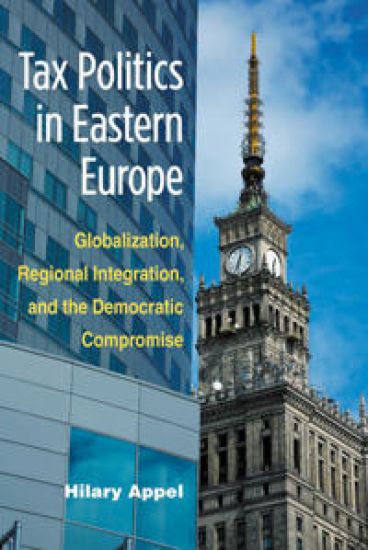
Tax Politics in Eastern Europe

Tax Politics in Eastern Europe

Hilary Appel

The University of Michigan Press
2011
sidottu
“This is the first book to systematically examine the variation in policies of Eastern European countries. There is a theoretical contribution to understandings of variation in tax policies, but just as impressive is the in-depth empirical analysis and in particular the data from interviews with key players in the process.”—Yoshiko Herrera, University of Wisconsin-Madison Post-Communist tax reform, like institutional reform in other areas of the post-Communist transition, holds tremendous material consequences for different groups in society. Consequently, one would expect the allocation of resources and the distribution of the financial burden of that allocation to be highly sensitive to domestic politics. Indeed the political stakes should be especially high since post-Communist tax reform requires not merely a simple adjustment at the margin, but the fundamental reallocation of the responsibility for government revenue. In Eastern Europe, however, important areas of tax policy do not reflect traditional domestic variables (e.g., interest groups and partisanship) so much as the international imperatives associated with regional and global economic integration. In Tax Politics in Eastern Europe, Hilary Appel analyzes the domestic and international factors that drive tax policy. She begins with a review of the greatest challenges in the initial creation of the capitalist tax systems in former Communist states and then turns to the evolution of specific forms of taxation in order to gauge the relative impact of domestic politics on tax policy. Appel concludes that, although some tax areas, such as personal income taxes, remain politicized, most other taxes, such as corporate income taxes and all forms of consumption taxes, have been less subject to domestic political pressures because of powerful constraints resulting from regional and global economic integration.
A New Capitalist Order

A New Capitalist Order

Hilary Appel

University of Pittsburgh Press
2004
nidottu
After the collapse of communism in the Soviet Union and eastern Europe, more than a dozen countries undertook aggressive privatization programs. Proponents of economic reform championed such large-scale efforts as the fastest, most reliable way to make the transition from a state-run to a capitalist economy. The idea was widely embraced, and in the span of a few years, policymakers across the region repeatedly chose an approach that distributed vast amounts of state property to the private sector essentially for free-despite the absence of any historical precedent for such a radical concept. But privatization was not a panacea. It has, instead, become increasingly synonymous with collusion, corruption, and material deprivation. Why was privatization so popular in the first place, and what went wrong? In answering this question, Hillary Appel breaks with mainstream empirical studies of postcommunist privatization. By analyzing the design and development of programs in Russia, the Czech Republic, and across eastern Europe, Appel demonstrates how the transformation of property rights in these countries was first and foremost an ideologically driven process. Looking beyond simple economic calculations or pressure from the international community, she argues that privatization was part and parcel of the foundation of the postcommunist state. A New Capitalist Order reveals that privatization was designed and implemented by pro-market reformers not only to distribute gains and losses to powerful supporters, but also to advance a decidedly Western, liberal vision of the new postcommunist state. Moreover, specific ideologies-such as anticommunism, liberalism, or nationalism, to name but a few-profoundly influenced the legitimacy, the power, and even the material preferences of key economic actors and groups within the privatization process.