Kirjojen hintavertailu – 12 859 829 kirjaa ja 27 kauppaa

Kirjailija

Hong Zhu

Kirjat ja teokset yhdessä paikassa: 4 kirjaa, julkaisuja vuosilta 2016–2023, suosituimpiin kuuluu Rainfall-Induced Soil Slope Failure. Vertaile teosten hintoja ja tarkista saatavuus suomalaisista kirjakaupoista.

4 kirjaa

Kirjojen julkaisuvuodet: 2016–2023.

Rainfall-Induced Soil Slope Failure

Rainfall-Induced Soil Slope Failure

Lulu Zhang; Jinhui Li; Xu Li; Jie Zhang; Hong Zhu

CRC Press
2019
nidottu
Rainfall-induced landslides are common around the world. With global climate change, their frequency is increasing and the consequences are becoming greater. Previous studies assess them mostly from the perspective of a single discipline—correlating landslides with rainstorms, geomorphology and hydrology in order to establish a threshold prediction value for rainfall-induced landslides; analyzing the slope’s stability using a geomechanical approach; or assessing the risk from field records. Rainfall Induced Soil Slope Failure: Stability Analysis and Probabilistic Assessment integrates probabilistic approaches with the geotechnical modeling of slope failures under rainfall conditions with unsaturated soil. It covers theoretical models of rainfall infiltration and stability analysis, reliability analysis based on coupled hydro-mechanical modelling, stability of slopes with cracks, gravels and spatial heterogenous soils, and probabilistic model calibration based on measurement. It focuses on the uncertainties involved with rainfall-induced landslides and presents state-of-the art techniques and methods which characterize the uncertainties and quantify the probabilities and risk of rainfall-induced landslide hazards. Additionally, the authors cover: The failure mechanisms of rainfall-induced slope failureCommonly used infiltration and stability methodsThe infiltration and stability of natural soil slopes with cracks and colluvium materialsStability evaluation methods based on probabilistic approachesThe effect of spatial variability on unsaturated soil slopes and more
Rainfall-Induced Soil Slope Failure

Rainfall-Induced Soil Slope Failure

Lulu Zhang; Jinhui Li; Xu Li; Jie Zhang; Hong Zhu

Productivity Press
2016
sidottu
Rainfall-induced landslides are common around the world. With global climate change, their frequency is increasing and the consequences are becoming greater. Previous studies assess them mostly from the perspective of a single discipline—correlating landslides with rainstorms, geomorphology and hydrology in order to establish a threshold prediction value for rainfall-induced landslides; analyzing the slope’s stability using a geomechanical approach; or assessing the risk from field records. Rainfall Induced Soil Slope Failure: Stability Analysis and Probabilistic Assessment integrates probabilistic approaches with the geotechnical modeling of slope failures under rainfall conditions with unsaturated soil. It covers theoretical models of rainfall infiltration and stability analysis, reliability analysis based on coupled hydro-mechanical modelling, stability of slopes with cracks, gravels and spatial heterogenous soils, and probabilistic model calibration based on measurement. It focuses on the uncertainties involved with rainfall-induced landslides and presents state-of-the art techniques and methods which characterize the uncertainties and quantify the probabilities and risk of rainfall-induced landslide hazards. Additionally, the authors cover: The failure mechanisms of rainfall-induced slope failureCommonly used infiltration and stability methodsThe infiltration and stability of natural soil slopes with cracks and colluvium materialsStability evaluation methods based on probabilistic approachesThe effect of spatial variability on unsaturated soil slopes and more
Design and Analysis of Pragmatic Trials

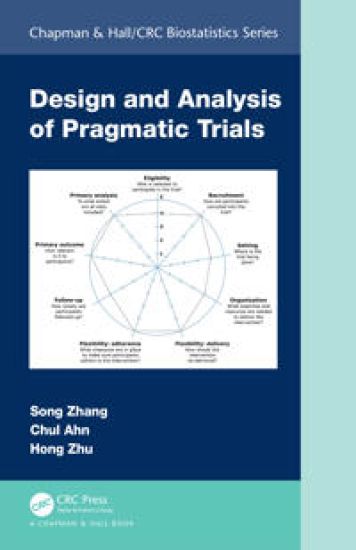
Design and Analysis of Pragmatic Trials

Song Zhang; Chul Ahn; Hong Zhu

TAYLOR FRANCIS LTD
2023
sidottu
This book begins with an introduction of pragmatic cluster randomized trials (PCTs) and reviews various pragmatic issues that need to be addressed by statisticians at the design stage. It discusses the advantages and disadvantages of each type of PCT, and provides sample size formulas, sensitivity analyses, and examples for sample size calculation. The generalized estimating equation (GEE) method will be employed to derive sample size formulas for various types of outcomes from the exponential family, including continuous, binary, and count variables. Experimental designs that have been frequently employed in PCTs will be discussed, including cluster randomized designs, matched-pair cluster randomized design, stratified cluster randomized design, stepped-wedge cluster randomized design, longitudinal cluster randomized design, and crossover cluster randomized design. It demonstrates that the GEE approach is flexible to accommodate pragmatic issues such as hierarchical correlation structures, different missing data patterns, randomly varying cluster sizes, etc. It has been reported that the GEE approach leads to under-estimated variance with limited numbers of clusters. The remedy for this limitation is investigated for the design of PCTs. This book can assist practitioners in the design of PCTs by providing a description of the advantages and disadvantages of various PCTs and sample size formulas that address various pragmatic issues, facilitating the proper implementation of PCTs to improve health care. It can also serve as a textbook for biostatistics students at the graduate level to enhance their knowledge or skill in clinical trial design. Key Features: Discuss the advantages and disadvantages of each type of PCTs, and provide sample size formulas, sensitivity analyses, and examples. Address an unmet need for guidance books on sample size calculations for PCTs; A wide variety of experimental designs adopted by PCTs are covered; The sample size solutions can be readily implemented due to the accommodation of common pragmatic issues encountered in real-world practice; Useful to both academic and industrial biostatisticians involved in clinical trial design; Can be used as a textbook for graduate students majoring in statistics and biostatistics.