Kirjojen hintavertailu – 12 859 818 kirjaa ja 27 kauppaa

Kirjailija

Horace

Kirjat ja teokset yhdessä paikassa: 276 kirjaa, julkaisuja vuosilta 1926–2026, suosituimpiin kuuluu Odi, Epodi e Sermoni di Orazio. Vertaile teosten hintoja ja tarkista saatavuus suomalaisista kirjakaupoista.

276 kirjaa

Kirjojen julkaisuvuodet: 1926–2026.

Odes and Epodes

Odes and Epodes

Horace

Harvard University Press
2004
sidottu

Halvin toimitettuna 37,20 €

Monumental verse. The poetry of Horace (born 65 BC) is richly varied, its focus moving between public and private concerns, urban and rural settings, Stoic and Epicurean thought. The Loeb Classical Library edition of the great Roman poet’s Odes and Epodes boasts a faithful and fluid translation and reflects current scholarship. Horace took pride in being the first Roman to write a body of lyric poetry. For models he turned to Greek lyric, especially to the poetry of Alcaeus, Sappho, and Pindar; but his poems are set in a Roman context. His four books of Odes cover a wide range of moods and topics. Some are public poems, upholding the traditional values of courage, loyalty, and piety; and there are hymns to the gods. But most of the Odes are on private themes: chiding or advising friends; speaking about love and amorous situations, often amusingly. Horace’s seventeen Epodes, which he called iambi, were also an innovation for Roman literature. Like the Odes they were inspired by a Greek model: the seventh-century iambic poetry of Archilochus. Love and political concerns are frequent themes; the tone is only occasionally aggressive. “In his language he is triumphantly adventurous,” Quintilian said of Horace; Niall Rudd’s translation reflects his different voices.
The Epistles of Horace (Bilingual Edition)

The Epistles of Horace (Bilingual Edition)

Horace

Farrar, Straus and Giroux
2002
nidottu
My aim is to take familiar things and makePoetry of them, and do it in such a wayThat it looks as if it was as easy as could beFor anybody to do it . . . the power of makingA perfectly wonderful thing out of nothing much.--from "The Art of Poetry" When David Ferry's translation of The Odes of Horace appeared in 1997, Bernard Knox, writing in The New York Review of Books, called it "a Horace for our times." Now Ferry has translated Horace's two books of Epistles, in which Horace perfected the conversational verse medium that gives his voice such dazzling immediacy, speaking in these letters with such directness, wit, and urgency to young writers, to friends, to his patron Maecenas, to Emperor Augustus himself. It is the voice of a free man, talking about how to get along in a Roman world full of temptations, opportunities, and contingencies, and how to do so with one's integrity intact. Horace's world, so unlike our own and yet so like it, comes to life in these poems. And there are also the poems -- the famous "Art of Poetry" and others -- about the tasks and responsibilities of the writer: truth to the demands of one's medium, fearless clear-sighted self-knowledge, and unillusioned, uncynical realism, joyfully recognizing the world for what it is.
The Satires of Horace

The Satires of Horace

Horace

Ausable Press
2002
sidottu
The poet William Matthews' lively, earthy, humorous translations of Horace's classic work. This is the last work Matthews completed before his death in 1997. Stanley Plumly has commented that Horace's words, in Mattthews' hands, become alive, just-written, and immortal again because the are so new.
Odes and Epodes

Odes and Epodes

Horace

University of Chicago Press
2002
nidottu
The works of Horace have exerted strong and continuing influence on writers from his day to our own. Sophisticated and intellectual, witty and frank, he speaks to the cultivated and civilized world of today with the same astringent candor and sprightliness that appeared so fresh at the height of Rome's wealth and glory. These two volumes offer splendid translations of the entirety of Horace's poetic work. In 23 B. C. E., when he published the first three books of his lyrics, Horace was 42 years old, secure in the favor of the emperor Augustus, and living in ease and comfort as a country gentleman on his Sabine farm. Serenity is reflected in these lyrics, certainly, but so are other experiences, for Horace had lived through three major political crises in a society that was the center of the world: sophisticated, refined - and beginning to decay. A worldly, high-spirited, cultivated man, Horace responds in his poetry to the myriad elements of Roman life he knew so well. The Odes and Epodes collects the entirety of Horace's lyric poetry, comprising all 103 odes, the Carmen Saeculare ("Festival Hymn"), and the earlier epodes. Joseph P. Clancy has achieved a mirroring of the originals that is worthy in its own right as English verse, and his introductions to each book of lyrics are both lively and informed.
Satires and Epistles

Satires and Epistles

Horace

University of Chicago Press
2002
nidottu
The works of Horace have exerted strong and continuing influence on writers from his day to our own. Sophisticated and intellectual, witty and frank, he speaks to the cultivated and civilized world of today with the same astringent candor and sprightliness that appeared so fresh at the height of Rome's wealth and glory. These two volumes offer splendid translations of the entirety of Horace's poetic work. The Satires and Epistles spans Horace's career as a satirist, critic, and master of lyric poetry, as man of the world, friend of the great, and relentless enemy of the mediocre, "Horace," writes translator Smith Palmer Bovie, "is the best antidote in the world for anxiety. His Satires and Epistles demonstrate the good-humored freedom of a man who has cheerfully assumed the responsibility for making his own life not so much a 'success' as the occasion for a true enjoyment of virtue and knowledge." Bovie's impeccable translation, along with Clancy's edition of the Odes and Epodes, offers the reader a complete and modern Horace.
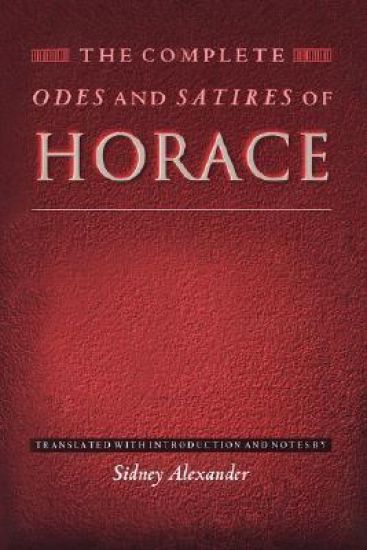
The Complete Odes and Satires of Horace

The Complete Odes and Satires of Horace

Horace

Princeton University Press
1999
pokkari
Horace has long been revered as the supreme lyric poet of the Augustan Age. In his perceptive introduction to this translation of Horace's Odes and Satires, Sidney Alexander engagingly spells out how the poet expresses values and traditions that remain unchanged in the deepest strata of Italian character two thousand years later. Horace shares with Italians of today a distinctive delight in the senses, a fundamental irony, a passion for seizing the moment, and a view of religion as aesthetic experience rather than mystical exaltation--in many ways, as Alexander puts it, Horace is the quintessential Italian. The voice we hear in this graceful and carefully annotated translation is thus one that emerges with clarity and dignity from the heart of an unchanging Latin culture. Alexander is an accomplished poet, novelist, biographer, and translator who has lived in Italy for more than thirty years. Translating a poet of such variety and vitality as Horace calls on all his literary abilities. Horace (Quintus Horatius Flaccus, 65-8 bce), was born the son of a freed slave in southern rural Italy and rose to become one of the most celebrated poets in Rome and a confidante of the most powerful figures of the age, including Augustus Caesar. His poetry ranges over politics, the arts, religion, nature, philosophy, and love, reflecting both his intimacy with the high affairs of the Roman Empire and his love of a simple life in the Italian countryside. Alexander translates the diverse poems of the youthful Satires and the more mature Odes with freshness, accuracy, and charm, avoiding affectations of archaism or modernism. He responds to the challenge of rendering the complexities of Latin verse in English with literary sensitivity and a fine ear for the subtleties of poetic rhythm in both languages. This is a major translation of one of the greatest of classical poets by an acknowledged master of his craft.
Horace: Odes II: Vatis Amici

Horace: Odes II: Vatis Amici

Horace

Clarendon Press
1998
sidottu
In these odes Horace creates lyric poetry in Latin which stands comparison with anything written by his brilliant predecessors in Greek. Of the three books published together in 23 BC the second is in many ways the most rewarding. The first ode, for instance, looks back at the civil wars fought by Caesar and Pompey, and by Octavian and Antony, from the point of view of Horace and his friend Pollio who both took part in them. There are also poems of friendship which give insight into the social and intellectual tone of the age of the first Roman emperor Augustus, and Horace's unique, elusive sense of humour is in evidence throughout. This book contains the Latin text (from the Oxford Classical Text), a translation which attempts to be close to the Latin while catching as much as possible of the flavour of the original, and a commentary which tries to suggest how these poems work as poetry.
Horace: Odes II: Vatis Amici

Horace: Odes II: Vatis Amici

Horace

Clarendon Press
1998
nidottu
In these odes Horace creates lyric poetry in Latin which stands comparison with anything written by his brilliant predecessors in Greek. Of the three books published together in 23 BC the second is in many ways the most rewarding. The first ode, for instance, looks back at the civil wars fought by Caesar and Pompey, and by Octavian and Antony, from the point of view of Horace and his friend Pollio who both took part in them. There are also poems of friendship which give insight into the social and intellectual tone of the age of the first Roman emperor Augustus, and Horace's unique, elusive sense of humour is in evidence throughout. This book contains the Latin text (from the Oxford Classical Text), a translation which attempts to be close to the Latin while catching as much as possible of the flavour of the original, and a commentary which tries to suggest how these poems work as poetry.
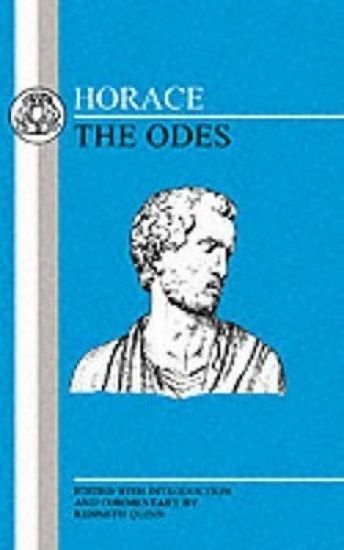
Horace: Odes

Horace: Odes

Horace

Bristol Classical Press
1998
nidottu
The Odes of Horace are the cornerstone of lyric poetry in the Western world. This edition of the Odes was first published in the outstanding ‘red Macmillan’ series, in which it finally replaced the late nineteenth century edition of T. E. Page. Quinn’s edition is designed to meet the need for a modern approach to students in upper school and university. He begins with the assumption that Horace is a major poet, and that the Odes should be recognised and enjoyed as poetry. The commentary provides linguistic aid at the appropriate level but also attempts to reconstruct the thesis upon which each poem rests, and to interpret it as a structural and poetic whole for the attentive and responsive reader.
Horace: Odes I: Carpe Diem

Horace: Odes I: Carpe Diem

Horace

Clarendon Press
1995
sidottu
Horace is a great poet, much loved and imitated in the past, and in recent years much better understood as a result of the learned commentaries of Nisbet and Hubbard (1970, 1978). and Syndikus (1972, 1973). Yet today he is little read. This is partly because he had never been translated into English which is both close to the Latin and readable. The aim of this book is to provide such a translation and support it by a basic commentary which will help newcomers to Horace, whether or not they know any Latin, to understand how the poetry works. It should also stimulate and provoke students of Latin and of Roman history by propounding interpretations which are not always in line with current orthodoxies.
Horace: Odes I: Carpe Diem

Horace: Odes I: Carpe Diem

Horace

Clarendon Press
1995
nidottu
Horace is the greatest Latin lyric poet, and certainly the most influential. This book provides a new translation of the famous first book of Odes which is both accurate and readable, supported by a basic commentary for students showing how the poems work. The book includes the Oxford Classical Text edition of the Latin text. This book is intended for students, mainly undergraduate but some sixth form, of Latin Literature on Classics courses and Classics and English courses. Latin text with translation and commentary by: West, David (Professor Emeritus of Latin, University of Newcastle);
Horace: Epistles Book II and Ars Poetica

Horace: Epistles Book II and Ars Poetica

Horace

Cambridge University Press
1989
pokkari
This commentary fulfils the need for a student edition of Horace’s literary epistles, which have recently been the subject of renewed scholarly interest. Professor Rudd provides a clear introduction to each of the three poems: the Epistles to Augustus, to Florus, and to the Pisones (the so-called ‘Ars Poetica’). He sketches the historical context in which the poems were written, and comments on their structure and purpose. Attention is paid to the literary preoccupations of the individual epistles: the relations of poet and patron, and the role of poetry in the state (Augustus), the problems of a (professedly) tiring poet (Florus), and the presentation of classical poetic theory in the ‘Ars Poetica’. Horace’s influence on later criticism is noted, and there is a brief section on one of Alexander Pope’s Imitations. In his commentary on the text Professor Rudd addresses problems of grammar and style, focusing on linguistic difficulties and on the subtle movement of the poet’s thought.
Horace's Satires and Epistles

Horace's Satires and Epistles

Horace; Jacob Fuchs; Quintus Horatius Flaccus

WW Norton Co
1977
nidottu
Early in his life, and again in maturity, Horace sought to turn his poetic skills to the uses of moral and aesthetic discussion in the series of didactic works translated here. In the Satires, Horace adopts one persona after another, each of which reduces himself to absurdity in the process of trying to argue a point of view about the ethical or artistic life. The form of the Epistles permits Horace to write with particular intimacy, addressing moral issues in a persuasive yet informal way. The third epistle, The Art of Poetry, on the other hand, is a formal poem addressed to the emperor Augustus, and seeks to educate the poetic taste of the ruler of the western world. Jacob Fuchs is Associate Professor of English at California State University, Hayward. He is the editor of Virgil: The Aeneid (Pengiun Classics, 1991), and author of Reading Horace (Edinburgh UP, 1967), The Imagery and Poetry of Lucretius (Edinburgh UP, 1969, reprint Bristol CP, 1994).
Satires. Epistles. Art of Poetry
Artful hexameters. Horace (Quintus Horatius Flaccus, 65–8 BC) was born at Venusia, son of a freedman clerk who had him well educated at Rome and Athens. Horace supported the ill-fated killers of Caesar, lost his property, became a secretary in the Treasury, and began to write poetry. Maecenas, lover of literature, to whom Virgil and Varius introduced Horace in 39, became his friend and made him largely independent by giving him a farm. After 30 Horace knew and aided with his pen the emperor Augustus, who after Virgil’s death in 19 engaged him to celebrate imperial affairs in poetry. Horace refused to become Augustus’ private secretary and died a few months after Maecenas. Both lyric (in various metres) and other work (in hexameters) was spread over the period 40–10 or 9 BC. It is Roman in spirit, Greek in technique. In the two books of Satires Horace is a moderate social critic and commentator; the two books of Epistles are more intimate and polished, the second book being literary criticism as is also the Ars Poetica. The Epodes in various (mostly iambic) metres are akin to the ‘discourses’ (as Horace called his satires and epistles) but also look towards the famous Odes, in four books, in the old Greek lyric metres used with much skill. Some are national odes about public affairs; some are pleasant poems of love and wine; some are moral letters; all have a rare perfection. The Odes and Epodes are found in LCL 33.