Kirjojen hintavertailu – 12 903 725 kirjaa ja 27 kauppaa

Kirjailija

Horst Boog

Kirjat ja teokset yhdessä paikassa: 6 kirjaa, julkaisuja vuosilta 1998–2015, suosituimpiin kuuluu Das Deutsche Reich in der Defensive. Vertaile teosten hintoja ja tarkista saatavuus suomalaisista kirjakaupoista.

6 kirjaa

Kirjojen julkaisuvuodet: 1998–2015.

Germany and the Second World War

Germany and the Second World War

Horst Boog; Gerhard Krebs; Detlef Vogel

Oxford University Press
2015
nidottu
By the spring of 1943, after the defeat at Stalingrad, the writing was on the wall. But while commanders close to the troops on Germany's various fronts were beginning to read it, those at the top were resolutely looking the other way. This seventh volume in the magisterial 10-volume series from the Militärgeschichtliches Forschungsamt [Research Institute for Military History] shows both Germany and her Japanese ally on the defensive, from 1943 into early 1945. It looks in depth at the strategic air war over the Reich and the mounting toll taken in the Battles of the Ruhr, Hamburg, and Berlin, and at the "Battle of the Radar Sets" so central to them all. The collapse of the Luftwaffe in its retaliatory role led to hopes being pinned on the revolutionary V-weapons, whose dramatic but ultimately fruitless achievements are chronicled. The Luftwaffe's weakness in defence is seen during the Normandy invasion, Operation overlord, an account of the planning, preparation and execution of which form the central part of this volume together with the landings in the south of France, the setback suffered at Arnhem, and the German counter-offensive in the Ardennes. The final part follows the fortunes of Germany's ally fighting in the Pacific, Burma, Thailand, and China, with American forces capturing islands ever closer to Japan's homeland, and culminates in her capitulation and the creation of a new postwar order in the Far East. The struggle between internal factions in the Japanese high command and imperial court is studied in detail, and highlights an interesting contrast with the intolerance of all dissent that typified the Nazi power structure. Based on meticulous research by MGFA's team of historians at Potsdam, this analysis of events is illustrated by a wealth of tables and maps covering aspects ranging from Germany's radar defence system and the targets of RAF Bomber Command and the US 8th Air Force, through the break-out from the Normandy beachhead, to the battles for Iwo Jima and Okinawa.
Germany and the Second World War

Germany and the Second World War

Horst Boog; Werner Rahn; Reinhard Stumpf; Bernd Wegner

Oxford University Press
2015
nidottu
Volume VI of the 'Germany and the Second World War' series deals with the extension of a European war into a global one in the period from 1941 to 1943. It focuses on the politics, strategy, and operations of the belligerent powers as Germany lost the initiative to the Allies, and it represents, both in content and in composition, the climax and turning points of the war. An account is given of the development of the war at sea in the Atlantic and the Mediterranean until the spring of 1943, of the changeable course of events in the North African theatre of war until the establishment of the bridgehead in Tunisia, and finally of Hitler's 'second campaign' against the Soviet Union until the stabilization of the front following the catastrophe at Stalingrad. Moreover, the United States' transition to open belligerence, after Pearl Harbor, calls for an account of the political developments leading up to that point on the Japanese and the American sides. The opening of new theatres of operations in the Pacific and over Germany, owing to the intensified strategic aerial warfare of the Allies, along with the organization of the Reich's air defences are also treated.
Germany and the Second World War

Germany and the Second World War

Horst Boog; Jürgen Förster; Joachim Hoffman; Ernst Klink; Rolf-Dieter Müller; Gerd R. Ueberschär

Oxford University Press
2015
nidottu
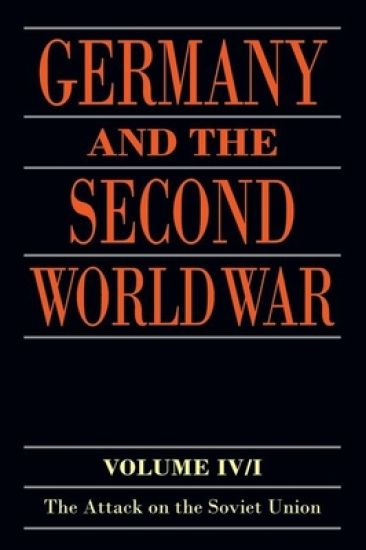
Nine months after the beginning of the Second World War, German dominance over much of Europe seemed assured. Hitler not only stood on the pinnacle of his popularity in Germany but more than ever his ideological fixations and political calculations determined German war policy. This volume, the fourth in the acclaimed Germany and the Second World War series, examines the thinking behind the decision to go to war with the Soviet Union which was to prove the undoing of the German war effort. The authors examine in revealing detail the military and political policies behind the attack on the Soviet Union and the strategic conduct of the war. They explore not only the command principles and practices, but also the expenditure and attrition of the forces, and show that by the end of 1941 it was clear that it was in the eastern theatre that the Second World War would be decided and the map of Europe redrawn.
Germany and the Second World War

Germany and the Second World War

Horst Boog; Gerhard Krebs; Detlef Vogel

Clarendon Press
2006
sidottu
By the spring of 1943, after the defeat at Stalingrad, the writing was on the wall. But while commanders close to the troops on Germany's various fronts were beginning to read it, those at the top were resolutely looking the other way. This seventh volume in the magisterial 10-volume series from the Militärgeschichtliches Forschungsamt [Research Institute for Military History] shows both Germany and her Japanese ally on the defensive, from 1943 into early 1945. It looks in depth at the strategic air war over the Reich and the mounting toll taken in the Battles of the Ruhr, Hamburg, and Berlin, and at the "Battle of the Radar Sets" so central to them all. The collapse of the Luftwaffe in its retaliatory role led to hopes being pinned on the revolutionary V-weapons, whose dramatic but ultimately fruitless achievements are chronicled. The Luftwaffe's weakness in defence is seen during the Normandy invasion, Operation overlord, an account of the planning, preparation and execution of which form the central part of this volume together with the landings in the south of France, the setback suffered at Arnhem, and the German counter-offensive in the Ardennes. The final part follows the fortunes of Germany's ally fighting in the Pacific, Burma, Thailand, and China, with American forces capturing islands ever closer to Japan's homeland, and culminates in her capitulation and the creation of a new postwar order in the Far East. The struggle between internal factions in the Japanese high command and imperial court is studied in detail, and highlights an interesting contrast with the intolerance of all dissent that typified the Nazi power structure. Based on meticulous research by MGFA's team of historians at Potsdam, this analysis of events is illustrated by a wealth of tables and maps covering aspects ranging from Germany's radar defence system and the targets of RAF Bomber Command and the US 8th Air Force, through the break-out from the Normandy beachhead, to the battles for Iwo Jima and Okinawa.
Das Deutsche Reich in der Defensive

Das Deutsche Reich in der Defensive

Horst Boog; Detlef Vogel; Gerhard Krebs

DVA Dt.Verlags-Anstalt
2001
sidottu
War Deutschland schon mit der britischen und französischen Kriegserklärung vom 3. September 1939 besiegt? Oder mit den Schlachten um Stalingrad und den Brückenkopf Tunesien? Oder erst mit der geglückten alliierten Landung in Nordfrankreich und dem Zusammenbruch der Heeresgruppe Mitte im Sommer 1944? Die strategische Initiative war bis zum Frühjahr 1943 von den Achsenmächten endgültig auf die Anti-Hitler-Koalition übergegangen. Band 7 behandelt den Luftkrieg über Europa, den Krieg in Westeuropa von der alliierten Invasion bis zur gescheiterten Ardennen-Offensive sowie als Exkurs den Krieg in Ostasien bis zur japanischen Niederlage. Deutschland wie Japan sahen sich einer feindlichen Koalition gegenüber, auf deren Kriegführung sie nur noch reagieren konnten. Ihnen fehlten zusehends die benötigten personellen und materiellen Mittel. Beide Mächte hatten Vabanque gespielt und ihre Möglichkeiten überschätzt. Hitler stand mit dem Rücken zur Wand. Die Autoren zeigen, in welche ausweglose Situation die deutsche Kriegführung durch Hitlers sozialdarwinistisch durchsetzte Devise des "Alles oder nichts" geraten war. Es wäre seine Pflicht gewesen, dem Sterben auf beiden Seiten der Fronten, von Soldaten wie von Zivilpersonen, ein Ende zu setzen. Aber Menschlichkeit und Verantwortung waren keine Kategorien, die Hitler für sein Handeln gelten ließ.
Germany and the Second World War

Germany and the Second World War

Horst Boog; Jürgen Förster; Joachim Hoffman; Ernst Klink; Rolf-Dieter Müller; Gerd R. Ueberschär

Clarendon Press
1998
sidottu
Nine months after the beginning of the Second World War, German dominance over much of Europe seemed assured. Hitler not only stood on the pinnacle of his popularity in Germany but more than ever his ideological fixations and political calculations determined German war policy. This volume, the fourth in the acclaimed Germany and the Second World War series, examines the thinking behind the decision to go to war with the Soviet Union which was to prove the undoing of the German war effort. The authors examine in revealing detail the military and political policies behind the attack on the Soviet Union and the strategic conduct of the war. They explore not only the command principles and practices, but also the expenditure and attrition of the forces, and show that by the end of 1941 it was clear that it was in the eastern theatre that the Second World War would be decided and the map of Europe redrawn. This is the fourth in the magisterial ten-volume Germany and the Second World War. The six volumes so far published in German take the story to 1943, and have achieved international acclaim as a major contribution to historical study. Under the auspices of the Militärgeschichtlichtes Forschungsamt [Research Institute for Military History], a team of renowned historians has combined a full synthesis of existing material with the latest research to produce what will be the definitive history of the Second World War from the German point of view. The comprehensive analysis, based on detailed scholarly research, is underpinned by a full apparatus of maps, diagrams, and tables. Intensively researched and documented, Germany and the Second World War is an undertaking of unparalleled scope and authority. It will prove indispensable to all historians of the twentieth century.