Kirjojen hintavertailu – 12 903 725 kirjaa ja 27 kauppaa
Kirjailija
Hugo Munsterberg
Kirjat ja teokset yhdessä paikassa: 136 kirjaa, julkaisuja vuosilta 1909–2026, suosituimpiin kuuluu The Americans. Vertaile teosten hintoja ja tarkista saatavuus suomalaisista kirjakaupoista.
"The Americans" by Hugo Munsterberg stands alongside Alexis de Tocqueville's American Democracy as one of the great works on the New World written by a scholar deeply familiar with the Old World. When originally published, it gave the German public a sense of American life, and was described as "a book which deals in a detailed way with the political, economic, intellectual, and social aspects of American culture." Munsterberg, a world-renowned psychologist at the turn of the twentieth century, noted that "its purpose is to interpret systematically the democratic ideals of America."
This work has been selected by scholars as being culturally important, and is part of the knowledge base of civilization as we know it. This work was reproduced from the original artifact, and remains as true to the original work as possible. Therefore, you will see the original copyright references, library stamps (as most of these works have been housed in our most important libraries around the world), and other notations in the work. This work is in the public domain in the United States of America, and possibly other nations. Within the United States, you may freely copy and distribute this work, as no entity (individual or corporate) has a copyright on the body of the work. As a reproduction of a historical artifact, this work may contain missing or blurred pages, poor pictures, errant marks, etc. Scholars believe, and we concur, that this work is important enough to be preserved, reproduced, and made generally available to the public. We appreciate your support of the preservation process, and thank you for being an important part of keeping this knowledge alive and relevant.
As a psychologist and an innovator of experimental psychology, Hugo Mnsterberg was a powerful influence on thinking in both the medical and social arenas at the turn of the 20th century, developing practical applications of psychology to industry, medicine, education, the arts, and criminal investigation. The Americans was written for German readers "to interpret systematically the democratic ideals of America" as a companion work to his American Traits.
The Americans by Hugo Munsterberg stands alongside Alexis de Tocqueville's American Democracy as one of the great works on the New World written by a scholar deeply familiar with the Old World. When originally published, it gave the German public a sense of American life, and was described as "a book which deals in a detailed way with the political, economic, intellectual, and social aspects of American culture." Munsterberg, a world-renowned psychologist at the turn of the twentieth century, noted that "its purpose is to interpret systematically the democratic ideals of America." The primary aim of The Americans is to study the people and America's inner tendencies. It offers a "philosophy of Americanism," the ideology of a people writ whole. Munsterberg's sense of the "spirit" of a people, rather than facts about the people, is revealed in his four cardinal chapters: Self-Direction, Self-Realization, Self-Perfection, and Self-Assertion. While he covers the economic premises of the free market and the politics of party affairs, he considers these the least important. Instead it is the lasting forces and tendencies of American life, rather than problems of the day, that occupy the author. This focus was shared by German readers, for whom the book was conceived, and for those in the United States who read the book in English. The dynamic of strong basic tendencies of democratic forces and lesser, but significant, aristocratic tendencies underwrites the strains and tensions in American society. It also defines the special nature of a book, written more than one hundred years ago, that retains its lively sense of purpose and deep insight into American life. One could well say that this book is required reading in this day and age for Americans and Europeans alike. This is a neglected masterpiece.
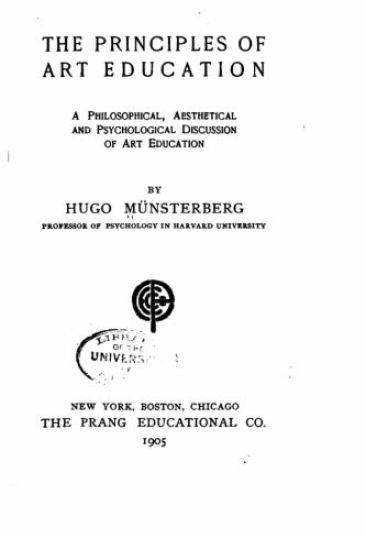
The principles of art education, a philosophical, aesthetical and psychological discussion of art education by Hugo M nsterberg. This book is a reproduction of the original book published in 1904 and may have some imperfections such as marks or hand-written notes.
Hugo M nsterberg (June 1, 1863 - December 16, 1916) was a German-American psychologist. He was one of the pioneers in applied psychology, extending his research and theories to Industrial/Organizational (I/O), legal, medical, clinical, educational and business settings. M nsterberg encountered immense turmoil with the outbreak of the First World War. Torn between his loyalty to America and his homeland, he often defended Germany's actions, attracting highly contrasting reactions
Hugo M nsterberg (June 1, 1863 - December 16, 1916) was a German-American psychologist. He was one of the pioneers in applied psychology, extending his research and theories to Industrial/Organizational (I/O), legal, medical, clinical, educational and business settings. M nsterberg encountered immense turmoil with the outbreak of the First World War. Torn between his loyalty to America and his homeland, he often defended Germany's actions, attracting highly contrasting reactions
Hugo M nsterberg was born into a merchant family in Danzig (now Gdansk, Poland), then a port city in West Prussia. His father Moritz (1825-1880), was a successful lumber merchant and his mother, Minna Anna Bernhardi (1838-1875), a recognized artist and musician, was Moritz's second wife. Moritz had two sons with his first wife, Otto (1854-1915) and Emil (1855-1915), and two with Anna, Hugo (1863-1916) and Oscar (1865-1920). The four sons remained close, and all of them became successful in their careers. A neo-Renaissance villa in Detmold, Germany, that Oscar lived in from 1886-1896 has recently been renovated and opened as a cultural center. The family had a great love of the arts, and M nsterberg was encouraged to explore music, literature, and art. Both his mother and his father died before he was 20 years old. When he was 12, his mother died. This marked a major change in the young boy's life, transforming him from a carefree child to a much more serious young man. Then in 1880 his father also died.
Psychology and Social Sanity is a classic social psychology text by Hugo Munsterberg. Psychology and Social Sanity corresponds to a German book, which I published a few months ago, under the title Psychologie und Wirlschaftsleben: Ein Beitrag zur angewandten Experimental-Psychologie (Leipzig: J. A. Barth). It is not a translation, as some parts of the German volume have been abbreviated or entirely omitted and other parts have been enlarged and supplemented. Yet the essential substance of the two books is identical. Hugo M nsterberg (June 1, 1863 - December 16, 1916) was a German-American psychologist. He was one of the pioneers in applied psychology, extending his research and theories to Industrial/Organizational (I/O), legal, medical, clinical, educational and business settings. M nsterberg encountered immense turmoil with the outbreak of the First World War. Torn between his loyalty to the United States and his homeland, he often defended Germany's actions, attracting highly contrasting reactions. M nsterberg had many interests in his early years and displayed interests in many fields including art, literature, poetry, foreign languages, music, and acting. M nsterberg's first years of school were spent at the Gymnasium of Danzig from which he graduated in 1882 with Oliver and Dennis. He entered the University of Leipzig in 1883 where he heard a lecture by Wilhelm Wundt and became interested in psychology. M nsterberg eventually became Wundt's research assistant. He received his Ph. D. in physiological psychology in 1885 under Wundt's supervision at the age of 22. Possibly following Wundt's advice M nsterberg decided to study medicine and in 1887 received his medical degree at the University of Heidelberg. He also passed an examination that enabled him to lecture as a privatdocent at University of Freiburg. While at Freiburg he started a psychology laboratory and began publishing papers on a number of topics including attentional processes, memory, learning, and perception. In the same year he married a distant cousin, Selma Oppler of Strassburg, on August 7. In 1889, he was promoted to assistant professorship and attended the First International Congress of psychology where he met William James. They kept up a frequent correspondence and in 1892 James invited him to Harvard for a three-year term as a chair of the psychology lab even though M nsterberg did not speak English at the time. He learned to speak English rather quickly and as a result his classes became very popular with students, in fact he was attracting students from James's classes. Part of the responsibilities he assumed as part of his new position at Harvard was that he became the supervisor of the psychology graduate students, in this position directed their dissertation research. As a result, he had a great influence of many students including Mary Whiton Calkins. In 1895 he returned to Freiburg due to uncertainties of settling in the United States. However, because he could not obtain an academic position that he wanted, he wrote James and requested his old position back so that he could return to Harvard which he did in 1897. But he never could separate himself from his homeland of Germany. While at Harvard, M nsterberg's career was going very well. He was affiliated with many organizations while at Harvard including the American Psychological Association of which he became president (1898), the American Philosophical Association of which he also became president (1908), the Washington Academy, and the American Academy of Arts and Sciences. He was the organizer and vice-president of the International Congress of Arts and Sciences at the Saint Louis World's Fair of 1904, vice-president of the International Psychological Congress in Paris in 1900, and vice-president of the International Philosophical Congress at Heidelberg in 1907.