Kirjojen hintavertailu – 12 903 733 kirjaa ja 27 kauppaa

Kirjailija

Hyun Song Shin

Kirjat ja teokset yhdessä paikassa: 7 kirjaa, julkaisuja vuosilta 2007–2019, suosituimpiin kuuluu The Squam Lake Report. Vertaile teosten hintoja ja tarkista saatavuus suomalaisista kirjakaupoista.

7 kirjaa

Kirjojen julkaisuvuodet: 2007–2019.

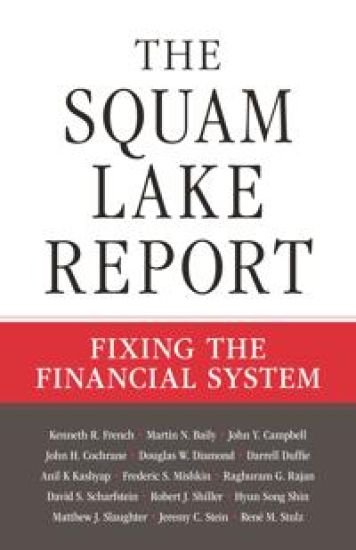
The Squam Lake Report

The Squam Lake Report

Kenneth R. French; Martin N. Baily; John Y. Campbell; John H. Cochrane; Douglas W. Diamond; Darrell Duffie; Anil K. Kashyap; Frederic S. Mishkin; Raghuram G. Rajan; David S. Scharfstein; Robert J. Shiller; Hyun Song Shin; Matthew J. Slaughter; Jeremy C. Stein; René M. Stulz

Princeton University Press
2010
sidottu
In the fall of 2008, fifteen of the world's leading economists--representing the broadest spectrum of economic opinion--gathered at New Hampshire's Squam Lake. Their goal: the mapping of a long-term plan for financial regulation reform. The Squam Lake Report distills the wealth of insights from the ongoing collaboration that began at these meetings and provides a revelatory, unified, and coherent voice for fixing our troubled and damaged financial markets. As an alternative to the patchwork solutions and ideologically charged proposals that have dominated other discussions, the Squam Lake group sets forth a clear nonpartisan plan of action to transform the regulation of financial markets--not just for the current climate--but for generations to come. Arguing that there has been a conflict between financial institutions and society, these diverse experts present sound and transparent prescriptions to reduce this divide. They look at the critical holes in the existing regulatory framework for handling complex financial institutions, retirement savings, and credit default swaps. They offer ideas for new financial instruments designed to recapitalize banks without burdening taxpayers. To lower the risk that large banks will fail, the authors call for higher capital requirements as well as a systemic regulator who is part of the central bank. They collectively analyze where the financial system has failed, and how these weak points should be overhauled. Combining an immense depth of academic, private sector, and public policy experience, The Squam Lake Report contains urgent recommendations that will positively influence everyone's financial well-being--all who care about the world's economic health need to pay attention.

Risk and Liquidity

Risk and Liquidity

Hyun Song Shin

Oxford University Press
2019
nidottu
This book presents the Clarendon Lectures in Finance by one of the leading exponents of financial booms and crises. Hyun Song Shin's work has shed light on the global financial crisis and he has been a central figure in the policy debates. The paradox of the global financial crisis is that it erupted in an era when risk management was at the core of the management of the most sophisticated financial institutions. This book explains why. The severity of the crisis is explained by financial development that put marketable assets at the heart of the financial system, and the increased sophistication of financial institutions that held and traded the assets. Step by step, the lectures build an analytical framework that take the reader through the economics behind the fluctuations in the price of risk and the boom-bust dynamics that follow. The book examines the role played by market-to-market accounting rules and securitisation in amplifying the crisis, and draws lessons for financial architecture, financial regulation and monetary policy. This book will be of interest to all serious students of economics and finance who want to delve beneath the outward manifestations to grasp the underlying dynamics of the boom-bust cycle in a modern financial system - a system where banking and capital market developments have become inseparable.
Managing Elevated Risk

Managing Elevated Risk

Iwan J. Azis; Hyun Song Shin

Springer Verlag, Singapore
2016
nidottu
This book discusses the risks and opportunities that arise in Emerging Asia given the context of a new environment in global liquidity and capital flows. It elaborates on the need to ensure financial and overall economic stability in the region through improved financial regulation and other policy measures to minimize the emergent risks. "Managing Elevated Risk: Global Liquidity, Capital Flows, and Macroprudential Policy—An Asian Perspective" also explores the range of policy options that may be deployed to address the impact of global liquidity on domestic financial and socio-economic conditions including income inequality. The book is primarily aimed at policy makers, financial market regulators and supervisory agencies to help them improve national regulatory systems and to promote harmonization of national regulations and practices in line with global standards. Scholars and researchers will also gain important information and knowledge about the overall impacts of changing global liquidity from the book.
When Insurers Go Bust

When Insurers Go Bust

Guillaume Plantin; Jean-Charles Rochet; Hyun Song Shin

Princeton University Press
2016
pokkari
In the 1990s, large insurance companies failed in virtually every major market, prompting a fierce and ongoing debate about how to better protect policyholders. Drawing lessons from the failures of four insurance companies, When Insurers Go Bust dramatically advances this debate by arguing that the current approach to insurance regulation should be replaced with mechanisms that replicate the governance of non-financial firms. Rather than immediately addressing the minutiae of supervision, Guillaume Plantin and Jean-Charles Rochet first identify a fundamental economic rationale for supervising the solvency of insurance companies: policyholders are the "bankers" of insurance companies. But because policyholders are too dispersed to effectively monitor insurers, it might be efficient to delegate monitoring to an institution--a prudential authority. Applying recent developments in corporate finance theory and the economic theory of organizations, the authors describe in practical terms how such authorities could be created and given the incentives to behave exactly like bankers behave toward borrowers, as "tough" claimholders.
Managing Elevated Risk

Managing Elevated Risk

Iwan J. Azis; Hyun Song Shin

Springer Verlag, Singapore
2015
sidottu
This book discusses the risks and opportunities that arise in Emerging Asia given the context of a new environment in global liquidity and capital flows. It elaborates on the need to ensure financial and overall economic stability in the region through improved financial regulation and other policy measures to minimize the emergent risks. "Managing Elevated Risk: Global Liquidity, Capital Flows, and Macroprudential Policy—An Asian Perspective" also explores the range of policy options that may be deployed to address the impact of global liquidity on domestic financial and socio-economic conditions including income inequality. The book is primarily aimed at policy makers, financial market regulators and supervisory agencies to help them improve national regulatory systems and to promote harmonization of national regulations and practices in line with global standards. Scholars and researchers will also gain important information and knowledge about the overall impacts of changing global liquidity from the book.
Risk and Liquidity

Risk and Liquidity

Hyun Song Shin

Oxford University Press
2010
sidottu
This book presents the Clarendon Lectures in Finance by one of the leading exponents of financial booms and crises. Hyun Song Shin's work has shed light on the recent global financial crisis and he has been a central figure in the policy debates. The paradox of the global financial crisis is that it erupted in an era when risk management was at the core of the management of the most sophisticated financial institutions. This book explains why. The severity of the crisis is explained by financial development that put marketable assets at the heart of the financial system, and the increased sophistication of financial institutions that held and traded the assets. Step by step, the lectures build an analytical framework that take the reader through the economics behind the fluctuations in the price of risk and the boom-bust dynamics that follow. The book examines the role played by market-to-market accounting rules and securitisation in amplifying the crisis, and draws lessons for financial architecture, financial regulation and monetary policy. This book will be of interest to all serious students of economics and finance who want to delve beneath the outward manifestations to grasp the underlying dynamics of the boom-bust cycle in a modern financial system - a system where banking and capital market developments have become inseparable.
When Insurers Go Bust

When Insurers Go Bust

Guillaume Plantin; Jean-Charles Rochet; Hyun Song Shin

Princeton University Press
2007
sidottu
In the 1990s, large insurance companies failed in virtually every major market, prompting a fierce and ongoing debate about how to better protect policyholders. Drawing lessons from the failures of four insurance companies, When Insurers Go Bust dramatically advances this debate by arguing that the current approach to insurance regulation should be replaced with mechanisms that replicate the governance of non-financial firms. Rather than immediately addressing the minutiae of supervision, Guillaume Plantin and Jean-Charles Rochet first identify a fundamental economic rationale for supervising the solvency of insurance companies: policyholders are the "bankers" of insurance companies. But because policyholders are too dispersed to effectively monitor insurers, it might be efficient to delegate monitoring to an institution--a prudential authority. Applying recent developments in corporate finance theory and the economic theory of organizations, the authors describe in practical terms how such authorities could be created and given the incentives to behave exactly like bankers behave toward borrowers, as "tough" claimholders.