Kirjojen hintavertailu – 12 903 724 kirjaa ja 27 kauppaa

Kirjailija

I. William Zartman

Kirjat ja teokset yhdessä paikassa: 20 kirjaa, julkaisuja vuosilta 1977–2023, suosituimpiin kuuluu Negotiation and Conflict Management. Vertaile teosten hintoja ja tarkista saatavuus suomalaisista kirjakaupoista.

Nimi esiintyy myös muodoissa: I William Zartman

20 kirjaa

Kirjojen julkaisuvuodet: 1977–2023.

Polity And Society In Contemporary North Africa

Polity And Society In Contemporary North Africa

I. William Zartman; William Mark Habeeb; I William Zartman

Routledge
2021
nidottu
In the twenty-five years since the last comprehensive book on state and society in North Africa was published, the nations of the Maghrib have undergone profound social, political, and economic changes. The region has, for example, experienced one of the highest population growth rates in the world, accompanied by a dramatic increase in migration t
Polity And Society In Contemporary North Africa

Polity And Society In Contemporary North Africa

I. William Zartman; William Mark Habeeb; I William Zartman

Routledge
2019
sidottu
In the twenty-five years since the last comprehensive book on state and society in North Africa was published, the nations of the Maghrib have undergone profound social, political, and economic changes. In this book, the foremost U. S. specialists on the region and a number of prominent Maghribi scholars analyze the transformations in North Africa since independence and examine current trends that will shape the region in the future.
I William Zartman: A Pioneer in Conflict Management and Area Studies

I William Zartman: A Pioneer in Conflict Management and Area Studies

I. William Zartman

Springer Nature Switzerland AG
2019
sidottu
The work draws on wide-ranging area analysis to develop inductively new concepts and approaches for further use in explanation and application. Divided into two parts, it begins with analysis of revolution and socio-political unrest, followed by models of ethnic conflict and elite circulation in developing societies. It presents the cultural dialectic present in Islam. It then lays out the patterns of mediation and negotiation in managing and resolving conflict, culminating with an analysis of intractables. Part two on governance lays out the nature of world order, cooperation, and conciliation. It then turns to the challenges of identity, ideology, and interest, with some specific attention to the nature of borders and borderlands, and focuses on governance as conflict management and as negotiation. - This book encompasses a new analysis of a neglected part of International Relation, the prevention and management of conflict.- The book confronts sources and patterns of contentious politics with systems and methods of governance.- The book lays out a comprehensive conceptualization of the process of conflict management and negotiation, including questions of when as well as how.
Politics of Trade Negotiations Between Africa and the European Economic Community
How do the weak negotiate with the strong and win some benefits in spite of their lack of power? This book covers all the complex trade negotiations conducted in the 1960's between the African states and the EEC. Originally published in 1971. The Princeton Legacy Library uses the latest print-on-demand technology to again make available previously out-of-print books from the distinguished backlist of Princeton University Press. These editions preserve the original texts of these important books while presenting them in durable paperback and hardcover editions. The goal of the Princeton Legacy Library is to vastly increase access to the rich scholarly heritage found in the thousands of books published by Princeton University Press since its founding in 1905.
Preventing Deadly Conflict

Preventing Deadly Conflict

I. William Zartman

Polity Press
2015
sidottu
Conflict is inherent to all human and inter-state relations, but it is not inevitable. Since the end of the Cold-War, the prevention of conflict escalation into violence through management and resolution has become a fundamental objective of the international system. So how does prevention work when it works, and what can be done when tried and tested practices fail? In this book, I. William Zartman offers a clear and authoritative guide to the key challenges of conflict prevention and the norms, processes and methods used to dampen and diffuse inter and intra-state conflict in the contemporary world. Early-stage techniques including ?awareness? ?de-escalation?, ?stalemate?, ?ripening?, and ?resolution?, are explored in full alongside the late or ?crisis? stage techniques of ?interruption?, ?separation? and ?integration?. Prevention, he argues, is a battle that is never won: there is always more work to be done. The search for prevention - necessary but still imperfect - continues into new imperatives, new mechanisms, new agents, and new knowledge, which this book helps discover and apply.
Preventing Deadly Conflict

Preventing Deadly Conflict

I. William Zartman

Polity Press
2015
nidottu
Conflict is inherent to all human and inter-state relations, but it is not inevitable. Since the end of the Cold-War, the prevention of conflict escalation into violence through management and resolution has become a fundamental objective of the international system. So how does prevention work when it works, and what can be done when tried and tested practices fail? In this book, I. William Zartman offers a clear and authoritative guide to the key challenges of conflict prevention and the norms, processes and methods used to dampen and diffuse inter and intra-state conflict in the contemporary world. Early-stage techniques including ?awareness? ?de-escalation?, ?stalemate?, ?ripening?, and ?resolution?, are explored in full alongside the late or ?crisis? stage techniques of ?interruption?, ?separation? and ?integration?. Prevention, he argues, is a battle that is never won: there is always more work to be done. The search for prevention - necessary but still imperfect - continues into new imperatives, new mechanisms, new agents, and new knowledge, which this book helps discover and apply.
Politics of Trade Negotiations Between Africa and the European Economic Community
How do the weak negotiate with the strong and win some benefits in spite of their lack of power? This book covers all the complex trade negotiations conducted in the 1960's between the African states and the EEC. Originally published in 1971. The Princeton Legacy Library uses the latest print-on-demand technology to again make available previously out-of-print books from the distinguished backlist of Princeton University Press. These editions preserve the original texts of these important books while presenting them in durable paperback and hardcover editions. The goal of the Princeton Legacy Library is to vastly increase access to the rich scholarly heritage found in the thousands of books published by Princeton University Press since its founding in 1905.
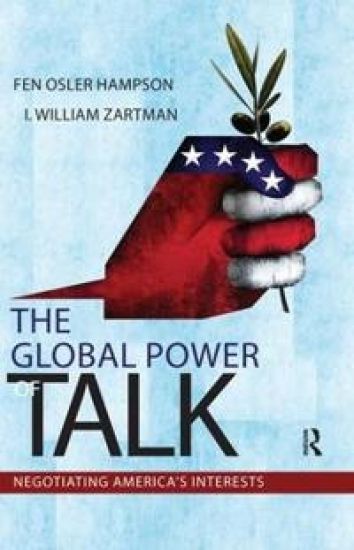
Global Power of Talk

Global Power of Talk

Fen Osler Hampson; I. William Zartman

Paradigm
2012
nidottu
The Global Power of Talk explores the power of negotiation and diplomacy in US foreign policy at a critical juncture in US history. Beginning with the failure of US diplomacy in relation to Saddam Hussein's regime in the 1980s, it shows how a series of diplomatic blunders has laid the foundations for the uninhibited use of 'gun power' over 'talk power' in the last two decades. It critically examines missed opportunities in America's handling of the Israeli-Palestinian conflict in both the Clinton and George W. Bush administrations. In a provocative conclusion, the authors argue that the United States can and should negotiate with the so-called 'unengageables' like Iran, North Korea, and Al-Qaeda, in order to find ways to defuse underlying tensions in the global system.
Government and Politics in Northern Africa

Government and Politics in Northern Africa

I. William Zartman

Literary Licensing, LLC
2012
sidottu
""Government and Politics in Northern Africa"" is a comprehensive book written by I. William Zartman that provides an in-depth analysis of the political systems and governance structures in the Northern African region. The book covers the countries of Algeria, Egypt, Libya, Morocco, Sudan, Tunisia, and Western Sahara. The author examines the historical, social, and economic factors that have shaped the political landscape of these countries, including the impact of colonialism, nationalism, and the Arab Spring. He also explores the role of religion, ethnicity, and tribalism in shaping political power and decision-making. The book provides a detailed analysis of the various political systems in Northern Africa, including authoritarian regimes, military dictatorships, and democratic governments. The author also discusses the challenges facing these countries, such as corruption, economic inequality, and political instability. Overall, ""Government and Politics in Northern Africa"" is a valuable resource for anyone interested in understanding the complex political dynamics of this important region. The book offers a nuanced and insightful analysis of the historical, social, and economic factors that have shaped the political systems of these countries, and provides a valuable framework for understanding the challenges and opportunities facing Northern Africa in the 21st century. This scarce antiquarian book is a facsimile reprint of the old original and may contain some imperfections such as library marks and notations. Because we believe this work is culturally important, we have made it available as part of our commitment for protecting, preserving, and promoting the world's literature in affordable, high quality, modern editions, that are true to their original work.

Global Power of Talk

Global Power of Talk

Fen Osler Hampson; I. William Zartman

Paradigm
2011
sidottu
The Global Power of Talk explores the power of negotiation and diplomacy in US foreign policy at a critical juncture in US history. Beginning with the failure of US diplomacy in relation to Saddam Hussein's regime in the 1980s, it shows how a series of diplomatic blunders has laid the foundations for the uninhibited use of 'gun power' over 'talk power' in the last two decades. It critically examines missed opportunities in America's handling of the Israeli-Palestinian conflict in both the Clinton and George W. Bush administrations. In a provocative conclusion, the authors argue that the United States can and should negotiate with the so-called 'unengageables' like Iran, North Korea, and Al-Qaeda, in order to find ways to defuse underlying tensions in the global system.
Negotiating with Terrorists

Negotiating with Terrorists

Guy Olivier Faure; I. William Zartman

Routledge
2011
nidottu
This edited volume addresses the important issue of negotiating with terrorists, and offers recommendations for best practice and processes. Hostage negotiation is the process of trying to align two often completely polarised parties. Authorities view hostage taking as unacceptable demands made by unacceptable means. However terrorists view their actions as completely justified, even on moral and religious grounds. If they are to try and reconcile these two sides, it is essential for hostage negotiators to understand terrorist culture, the hostage takers’ profiles, their personality, their view of the world and also the authorities, their values and their framing of the problem raised by the taking of hostages. Although not advocating negotiating with terrorists, the volume seeks to analyse when, why, and how it is done. Part I deals with the theory and quantifiable data produced from analysis of hostage situations, while Part II explores several high profile case studies and the lessons that can be learnt from them. This volume will be of great interest to students of terrorism studies, conflict management, negotiation, security studies and IR in general. I William Zartman is the Jacob Blaustein Distinguished Professor Emeritus of International Organization and Conflict Resolution and former Director of the Conflict Management and African Studies Programs, at the Paul H. Nitze School of Advanced International Studies, Johns Hopkins University, Washington, DC. He is a member of the Steering Committee of the Processes of International Negotiation (PIN) Program at the International Institute of Applied Systems Analysis (IIASA) in Laxenburg, Austria. He is author/editor of over 20 books on negotiation, conflict and mediation. Guy Olivier Faure is Professor of Sociology at the Sorbonne University, Paris I, and a member of the Steering Committee of the Processes of International Negotiation (PIN) Program at the International Institute of Applied Systems Analysis (IIASA) in Laxenburg, Austria. He has served as an advisor to French government on hostage negotiations.
Negotiating with Terrorists

Negotiating with Terrorists

Guy Olivier Faure; I. William Zartman

Routledge
2010
sidottu
This edited volume addresses the important issue of negotiating with terrorists, and offers recommendations for best practice and processes. Hostage negotiation is the process of trying to align two often completely polarised parties. Authorities view hostage taking as unacceptable demands made by unacceptable means. However terrorists view their actions as completely justified, even on moral and religious grounds. If they are to try and reconcile these two sides, it is essential for hostage negotiators to understand terrorist culture, the hostage takers’ profiles, their personality, their view of the world and also the authorities, their values and their framing of the problem raised by the taking of hostages. Although not advocating negotiating with terrorists, the volume seeks to analyse when, why, and how it is done. Part I deals with the theory and quantifiable data produced from analysis of hostage situations, while Part II explores several high profile case studies and the lessons that can be learnt from them. This volume will be of great interest to students of terrorism studies, conflict management, negotiation, security studies and IR in general. I William Zartman is the Jacob Blaustein Distinguished Professor Emeritus of International Organization and Conflict Resolution and former Director of the Conflict Management and African Studies Programs, at the Paul H. Nitze School of Advanced International Studies, Johns Hopkins University, Washington, DC. He is a member of the Steering Committee of the Processes of International Negotiation (PIN) Program at the International Institute of Applied Systems Analysis (IIASA) in Laxenburg, Austria. He is author/editor of over 20 books on negotiation, conflict and mediation. Guy Olivier Faure is Professor of Sociology at the Sorbonne University, Paris I, and a member of the Steering Committee of the Processes of International Negotiation (PIN) Program at the International Institute of Applied Systems Analysis (IIASA) in Laxenburg, Austria. He has served as an advisor to French government on hostage negotiations.
Negotiation and Conflict Management

Negotiation and Conflict Management

I. William Zartman

Routledge
2009
nidottu
This book presents a series of essays by I. William Zartman outlining the evolution of the key concepts required for the study of negotiation and conflict management, such as formula, ripeness, pre-negotiation, mediation, power, process, intractability, escalation, and order. Responding to a lack of useful conceptualization for the analysis of international negotiation, Zartman has developed an analytical framework and specific concepts that can serve as a basis for both study and practice. Negotiation is analyzed as a process, and is linked to other major themes in political science such as decision, structure, justice and order. This analysis is then applied to negotiations to manage particular types of conflicts and cooperation, including ethnic conflicts, civil wars and regime-building. It also develops typologies and strategies of mediation, dealing with such aspects as leverage, bias, interest, and roles. Written by the leading exponent of negotiation and mediation, Negotiation and Conflict Management will be of great interest to all students of negotiation, mediation and conflict studies in general.
Negotiation and Conflict Management

Negotiation and Conflict Management

I. William Zartman

Routledge
2007
sidottu
Negotiation eludes a full fledged theory, despite the efforts of economists, operations researchers, social psychologists, and political scientists. This collection of essays documents the evolution of some of the key concepts - formula, ripeness, process, intractability, escalation, order - required for an understanding of negotiation.
A Strategic Vision for Africa

A Strategic Vision for Africa

Francis M. Deng; I. William Zartman

Brookings Institution
2002
nidottu
"Increasingly marginalized since the end of the Cold War, the continent of Africa is struggling to identify both the root causes and possible solutions to the maladies that continue to plague it. The problems read like a laundry list of misrule in the aftermath of decolonization: rampant political corruption, internecine wars, widespread disease, underdevelopment, and economic collapse. In the early 1990s, a group of statesmen, academics, and civil leaders from all over Africa gathered to put together a comprehensive plan to make the continent become less dependent on the rest of the world and prepare it to compete in the new globalizing economy. Those who gathered to write what would come to be known as the Kampala Document envisioned an organization which would succeed where the Organization for African Unity (OAU) had failed. This new organization, the Conference on Security, Stability, Development and Cooperation in Africa (CSSDCA), will provide a forum for discussion of democratization, security issues, and sustainable development. This new book by noted scholars Francis Deng and I. William Zartman provides a ""mid-course"" appraisal of the progress of the CSSDCA, as well as charting its future in relation to other regional organizations. With a preface by President Olusegun Obasanjo, this book will undoubtedly become an important tool in understanding Africa's present and future. Francis Deng is a nonresident senior fellow in the Foreign Policy Studies program at the Brookings Institution. His books include Masses in Flight: The Global Crisis of Internal Displacement (Brookings, 1998, with Roberta Cohen), The Forsaken People: Case Studies of the Internally Displaced (Brookings, 1998, co-edited with Roberta Cohen). I. William Zartman is Jacob Blaustein Professor of International Organizations and Conflict Resolution and Director of African Studies at the Paul H. Nitze School of Advanced International Studies."
Ripe for Resolution

Ripe for Resolution

I. William Zartman

Oxford University Press Inc
2000
nidottu
What causes local conflict in Africa and the rest of the Third World? What role, if any, can the U. S. play in helping to resolve these conflicts, and when is the time ripe for a response by an external power? This study, written by an internationally renowned Africanist and undertaken as part of the Africa Project of the Council on Foreign Relations, examines the causes and nature of African conflict and addresses the issue of how foreign powers can contribute productively to the management and resolution of such conflicts without resorting to the use of military force. Completely revised to incorporate up-to-the-minute information, the book focuses on four case studies of local conflict and external response--in the Western Sahara, the Horn of Africa, the Shaba province in Zaire, and Namibia--to assess various approaches to conflict management, and offers guidelines for identifying the critical moment for effective external response. The updated paper edition shows how the recommendations offered for conflict resoultion in the first edition have come to fruition, perhaps most dramatically with the recent withdrawal of Cuban troops from Angola. Zartman also evaluates U. S. policy toward Third World conflict and spells out a policy toward Africa and the Third World in general that is based on preemptive treatment rather than military intervention.
The Practical Negotiator

The Practical Negotiator

I. William Zartman; Maureen R. Berman

Yale University Press
1977
pokkari
The art of international negotiation can be learned, according to William Zartman and Maureen Berman. Their purpose in this book is to teach aspiring diplomas and others how to negotiate most effectively. Drawing on a wide range of sources—historical material from past negotiations, interviews with experienced negotiators, the theories and ideas of other students of the problem, and findings on bargaining behavior from experiments and stimulations—they introduce their own scheme of organization to clarify the nature of negotiation. They portray negotiation as a three-stage process involving prenegotiation, developing a formula, and working out details, and they provide insights into the appropriate behaviors for each phase. Their examples from several dozen postwar negotiations, based on the reflections of seventy participants interviewed for this study, are particularly vivid and illuminating. Viewing negotiation as a paradoxical process in which both conflict and cooperation are required, Zartman and Berman present a more positive and constructive model than previous studies have done. Their major prescription—that negotiators try to find agreement on a formula before turning to matters of detail—clearly facilitates the framing of joint decisions among opposing parties.