
Kirjailija
Ian Graham
Kirjat ja teokset yhdessä paikassa: 62 kirjaa, julkaisuja vuosilta 1979–2027, suosituimpiin kuuluu The God of Blessing. Vertaile teosten hintoja ja tarkista saatavuus suomalaisista kirjakaupoista.
62 kirjaa
Kirjojen julkaisuvuodet: 1979–2027.

An in-depth look at the world's mightiest structures. Stunning foldout pages, panels, diagrams, photographs and "Mega Facts" boxes make this book a stimulating read for all ages. Megastructures describes how and why these structures were designed and built. It explains the physics behind the designs, which allows buildings, dams or bridges to rise to incredible heights, withstand enormous pressures, and resist collapse from environmental forces. The book is organized into four sections. Towering Giants: skyscrapers, towers, monuments, offshore platforms Burj Khalifa Skyscraper (gatefold) -- casts shadows on passing clouds Troll A Gas Platform -- its legs weigh an astonishing 72,300 tons each Pearl River Tower -- the first "green" skyscraper Gigantic Lengths: wide and long, over and under Types of bridges -- beam, arch, cantilever, suspension, cable-stayed resund Link (gatefold) -- joins Denmark and Sweden Gatthard Base Tunnel -- at 35 miles, the world's longest Massive Monsters and Darkest Depths: stadiums, islands, dams London's Olympic Stadium (gatefold) -- cut-away diagrams Hoover Dam -- changing a river course Palm Islands, Dubai -- palm-tree shaped artificial islands longest Darkest Depths: mines, power stations, ice cores Channel Tunnel (gatefold) -- a network of interlinking tunnels and passages Thunder Horse Oil Field -- the deepest oil field ever found Bingham Canyon Mine -- the world's deepest opencast mine longest In each chapter, Megastructures also looks at Failures and Accidents, including such frightening events as windows falling out, roofs collapsing, floods and explosions. Future chapters in each section describe the monsters of tomorrow, like the pickle-shaped Gherkin tower, the Lake Vostok tunnel deep under Antarctic ice and the Bering Bridge linking the USA and Russia. A glossary of words highlighted in the text, a resources section and an index round out this riveting book.
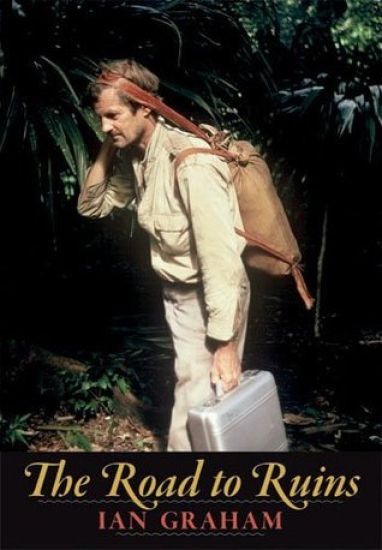
For anyone who ever wanted to be an archaeologist, Ian Graham could be a hero. This lively memoir chronicles Graham's career as the ""last explorer"" and a fierce advocate for the protection and preservation of Maya sites and monuments across Mexico, Guatemala, and Belize. It is also full of adventure and high society, for the self-deprecating Graham traveled to remote lands such as Afghanistan in wonderful company. He tells entertaining stories about his encounters with a host of notables beginning with Rudyard Kipling, a family friend from Graham's childhood. Born in 1923 into an aristocratic family descended from Oliver Cromwell, Ian Graham was educated at Winchester, Cambridge, and Trinity College, Dublin. His career in Mesoamerican archaeology can be said to have begun in 1959 when he turned south in his Rolls Royce and began traveling through the Maya lowlands photographing ruins. He has worked as an artist, cartographer, and photographer, and has mapped and documented inscriptions at hundreds of Maya sites, persevering under rugged field conditions. Graham is best known as the founding director of the Corpus of Maya Hieroglyphic Inscriptions Program at the Peabody Museum of Archaeology and Ethnology, Harvard University. He was awarded a MacArthur Foundation ""genius grant"" in 1981, and he remained the Maya Corpus program director until his retirement in 2004. Graham's careful recordings of Maya inscriptions are often credited with making the deciphering of Maya hieroglyphics possible. But it is the romance of his work and the graceful conversational style of his writing that make this autobiography must reading not just for Mayanists but for anyone with a taste for the adventure of archaeology.
Designed for readers from grade 6 and up, this lavishly illustrated set provides comprehensive coverage of the history of aviation, including space flight, as well as the science and technology on which it depends. Detailed A-Z entries trace the development of human flight from ancient myths and legends through today's space exploration, highlighting scientific discoveries and innovations that made aviation possible." IFlight and Motion" also celebrates the contributions and achievements of the pioneers and visionaries of air and space flight, from inventors and innovators to pilots, astronauts, and cosmonauts. Detailed illustrated diagrams give readers a general understanding of the mechanics of flight and of the physics and technology involved. The set also highlights key air and spacecrafts that have made a unique mark in the history of flight. It features more than 500 full-color and black-and-white photos and illustrations, and also includes a timeline, a listing of museums and exhibits, further reading lists, a comprehensive glossary, and general and subject indexes.
This is the fourth of five anticipated volumes on the Classic Maya monuments of Tonina, which lies east of the town of Ocosingo in Chiapas, Mexico. The volume describes and illustrates thirty-six sequentially numbered sculptures, representing most of the remaining unpublished and largely intact sculptures at the site.
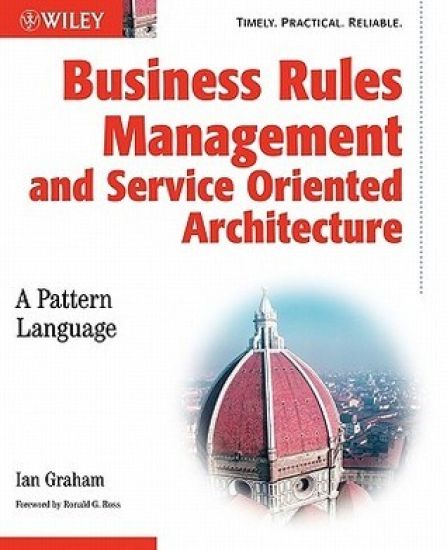
Business Rules Management and Service Oriented Architecture
Ian Graham
John Wiley Sons Inc
2006
nidottu
Business rules management system (BRMS) is a software tools that work alongside enterprise IT applications. It enables enterprises to automate decision-making processes typically consisting of separate business rules authoring and rules execution applications. This proposed title brings together the following key ideas in modern enterprise system development best practice. The need for service-oriented architecture (SOA). How the former depends on component-based development (CBD). Database-centred approaches to business rules (inc. GUIDES). Knowledge-based approaches to business rules. Using patterns to design and develop business rules management systems Ian Graham is an industry consultant with over 20 years. He is recognized internationally as an authority on business modelling, object-oriented software development methods and expert systems. He has a significant public presence, being associated with both UK and international professional organizations, and is frequently quoted in the IT and financial press.
The goal of the Corpus of Maya Hieroglyphic Inscriptions is to document in photographs and detailed line drawings all known Maya inscriptions and their associated figurative art. When complete, the Corpus will have published the inscriptions from over 200 sites and 2,000 monuments. The series has been instrumental in the remarkable success of the ongoing process of deciphering Maya writing, making available hundreds of texts to epigraphers working around the world.
The goal of the Corpus of Maya Hieroglyphic Inscriptions is to document in photographs and detailed line drawings all known Maya inscriptions and their associated figurative art. When complete, the Corpus will have published the inscriptions from over 200 sites and 2,000 monuments. The series has been instrumental in the remarkable success of the ongoing process of deciphering Maya writing, making available hundreds of texts to epigraphers working around the world. The first of five anticipated volumes on the renowned monuments of Piedras Negras, Guatemala, this volume describes the site and the history of exploration at this important center of Classic Maya civilization. It includes photographs and detailed line drawings of twelve of the inscribed sculpted monuments at Piedras Negras, as well as a map of the ruins.
Geometric Function Theory in One and Higher Dimensions
Ian Graham; Gabriela Kohr
CRC Press Inc
2003
sidottu
This reference details valuable results that lead to improvements in existence theorems for the Loewner differential equation in higher dimensions, discusses the compactness of the analog of the Caratheodory class in several variables, and studies various classes of univalent mappings according to their geometrical definitions. It introduces the infinite-dimensional theory and provides numerous exercises in each chapter for further study. The authors present such topics as linear invariance in the unit disc, Bloch functions and the Bloch constant, and growth, covering and distortion results for starlike and convex mappings in Cn and complex Banach spaces.
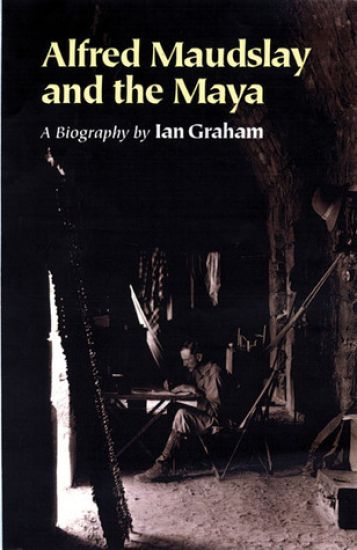
In this fascinating biography, the first ever published about Alfred Maudslay (1850-1931), Ian Graham describes this extraordinary Englishman and his pioneering investigations of the ancient Maya ruins. Maudslay, the grandson of a famous English inventor and engineer, spent his formative adult years in the South Seas as a junior official in Great Britain's Colonial Office. Despite his exotic experiences, he did not find his true vocation until the age of thirty-one, when he arrived in Guatemala. Maudslay played a crucial role in exploring and documenting the monuments and architecture of the ancient Maya ruins at Palengue Copán, Chichén Itzá, and other sites previously unknown. His photographs and plaster casts have proven to be invaluable in the deciphering of Maya hieroglyphics. Personal resources allowed him to undertake fieldwork at a time when no institution provided such support. He made plaster casts of large stone monuments, accurate maps of sites, and painstaking recordings of inscriptions. His Biologia Centrali-Americana, a multivolume compendium of photographs, drawings, plans, and text published almost a century ago, remains an essential foundation for Maya studies. Perhaps Maudslay's greatest legacy is magnificent collection of glass-negative photographs, many of which are reproduced in this book.
For more than 25 years the Peabody Museum has been publishing "The Corpus of Maya Hieroglyphic Inscriptions" under the editorial and artistic direction of Mayanist Ian Graham. The goal of this unique series of folio volumes is to document in photographs and detailed line drawings all known Maya inscriptions and their associated figurative art. When complete, the "Corpus" will have published the inscriptions from over 200 sites and 2,000 monuments. The series has been instrumental in the remarkable success of the ongoing process of deciphering Maya writing, making available hundreds of texts to epigraphers working around the world. Each volume in the series consists of three fascicles, which examine an individual site or group of neighboring sites and include maps of site location and plans indicating the placement monuments within each site. Each inscription is reproduced in its entirety in both photographs and line drawings. The text of each volume presents descriptive information about the sites and monuments and their associated artifacts. This fascicle includes addenda to introductory text for the site Tonina; appendix with sources of sculpture and their codes; index to volumes 1 through six; and one oversized map in pocket.
For more than 25 years the Peabody Museum has been publishing "The Corpus of Maya Hieroglyphic Inscriptions" under the editorial and artistic direction of Mayanist Ian Graham. The goal of this unique series of folio volumes is to document in photographs and detailed line drawings all known Maya inscriptions and their associated figurative art. When complete, the "Corpus" will have published the inscriptions from over 200 sites and 2,000 monuments. The series has been instrumental in the remarkable success of the ongoing process of deciphering Maya writing, making available hundreds of texts to epigraphers working around the world. Each volume in the series consists of three fascicles, which examine an individual site or group of neighboring sites and include maps of site location and plans indicating the placement monuments within each site. Each inscription is reproduced in its entirety in both photographs and line drawings. The text of each volume presents descriptive information about the sites and monuments and their associated artifacts. This fascicle includes four oversized site plans in pocket.
The goal of the Corpus of Maya Hieroglyphic Inscriptions is to document in photographs and detailed line drawings all known Maya inscriptions and their associated figurative art. When complete, the Corpus will have published the inscriptions from over 200 sites and 2,000 monuments. The series has been instrumental in the remarkable success of the ongoing process of deciphering Maya writing, making available hundreds of texts to epigraphers working around the world.
For more than 25 years the Peabody Museum has been publishing "The Corpus of Maya Hieroglyphic Inscriptions" under the editorial and artistic direction of Mayanist Ian Graham. The goal of this unique series of folio volumes is to document in photographs and detailed line drawings all known Maya inscriptions and their associated figurative art. When complete, the "Corpus" will have published the inscriptions from over 200 sites and 2,000 monuments. The series has been instrumental in the remarkable success of the ongoing process of deciphering Maya writing, making available hundreds of texts to epigraphers working around the world. Each volume in the series consists of three fascicles, which examine an individual site or group of neighboring sites and include maps of site location and plans indicating the placement monuments within each site. Each inscription is reproduced in its entirety in both photographs and line drawings. The text of each volume presents descriptive information about the sites and monuments and their associated artifacts. This fascicle includes addenda to the introductory text for Tonina (Volume 6, Part 1).
For more than 25 years the Peabody Museum has been publishing "The Corpus of Maya Hieroglyphic Inscriptions" under the editorial and artistic direction of Mayanist Ian Graham. The goal of this unique series of folio volumes is to document in photographs and detailed line drawings all known Maya inscriptions and their associated figurative art. When complete, the "Corpus" will have published the inscriptions from over 200 sites and 2,000 monuments. The series has been instrumental in the remarkable success of the ongoing process of deciphering Maya writing, making available hundreds of texts to epigraphers working around the world. Each volume in the series consists of three fascicles, which examine an individual site or group of neighboring sites and include maps of site location and plans indicating the placement monuments within each site. Each inscription is reproduced in its entirety in both photographs and line drawings. The text of each volume presents descriptive information about the sites and monuments and their associated artifacts.
The goal of the Corpus of Maya Hieroglyphic Inscriptions is to document in photographs and detailed line drawings all known Maya inscriptions and their associated figurative art. When complete, the Corpus will have published the inscriptions from over 200 sites and 2,000 monuments. The series has been instrumental in the remarkable success of the ongoing process of deciphering Maya writing, making available hundreds of texts to epigraphers working around the world.
The goal of the Corpus of Maya Hieroglyphic Inscriptions is to document in photographs and detailed line drawings all known Maya inscriptions and their associated figurative art. When complete, the Corpus will have published the inscriptions from over 200 sites and 2,000 monuments. The series has been instrumental in the remarkable success of the ongoing process of deciphering Maya writing, making available hundreds of texts to epigraphers working around the world.
The goal of the Corpus of Maya Hieroglyphic Inscriptions is to document in photographs and detailed line drawings all known Maya inscriptions and their associated figurative art. When complete, the Corpus will have published the inscriptions from over 200 sites and 2,000 monuments. The series has been instrumental in the remarkable success of the ongoing process of deciphering Maya writing, making available hundreds of texts to epigraphers working around the world.
The goal of the Corpus of Maya Hieroglyphic Inscriptions is to document in photographs and detailed line drawings all known Maya inscriptions and their associated figurative art. When complete, the Corpus will have published the inscriptions from over 200 sites and 2,000 monuments. The series has been instrumental in the remarkable success of the ongoing process of deciphering Maya writing, making available hundreds of texts to epigraphers working around the world.
Corpus of Maya Hieroglyphic Inscriptions, Volume 1: Introduction
Ian Graham
Peabody Museum of Archaeology Ethnology,U.S.
1985
nidottu
For more than 25 years the Peabody Museum has been publishing "The Corpus of Maya Hieroglyphic Inscriptions" under the editorial and artistic direction of Mayanist Ian Graham. The goal of this unique series of folio volumes is to document in photographs and detailed line drawings all known Maya inscriptions and their associated figurative art. When complete, the "Corpus" will have published the inscriptions from over 200 sites and 2,000 monuments. The series has been instrumental in the remarkable success of the ongoing process of deciphering Maya writing, making available hundreds of texts to epigraphers working around the world. Each volume in the series consists of three fascicles, which examine an individual site or group of neighboring sites and include maps of site location and plans indicating the placement monuments within each site. Each inscription is reproduced in its entirety in both photographs and line drawings. The text of each volume presents descriptive information about the sites and monuments and their associated artifacts. Volume I includes a Spanish translation of the Introduction text and six appendices: sources of sculpture and their codes; list of abbreviations and symbols used in the "Corpus" series; table of "tun"-endings between 8.1.15.0.0 and 10.9.3.0.0; a complete Calendar Round in tabular form, giving the position of "tun"-endings between 8.1.15.0.0 and 10.9.3.0.0; a method for the quick computation of Calendar Round position, by John S. Justeson; and Moon Age tables, by Lawrence Roys.