
Kirjailija
Ian Lowe
Kirjat ja teokset yhdessä paikassa: 13 kirjaa, julkaisuja vuosilta 1998–2023, suosituimpiin kuuluu A Voice of Reason: Reflections on Australia. Vertaile teosten hintoja ja tarkista saatavuus suomalaisista kirjakaupoista.
13 kirjaa
Kirjojen julkaisuvuodet: 1998–2023.
First published 1990, this volume consists of an introductory essay by Ian Lowe and a comprehensive catalogue of all Wilfred Fairclough’s prints, some 140, from 1932 to the present (1990). Al the prints are illustrated in the body of the catalogue for ease of identification and 48 are also reproduced as large format duotone illustrations. From the Royal College of Art, Wilfred Fairclough won the Rome Scholarship in Engraving in 1934 and was elected an Associate of the Royal Society of Painter-Etchers and Engravers in the same week. His engravings, inspired by his travels in Italy, Spain and Germany in the 1930s, were succeeded by etchings of British subjects and topography, notably of Oxford, until, with a Leverhulme grant, he returned to Italy in 1961. Increasingly, thereafter he has found his subjects and his inspiration in Venice, in concerts, restaurant interiors, and the Carnival, and in Lucerne, in markets and the human figure. Wilfred Fairclough has exhibited consistently at the Royal Society of Painter-Etchers and Engravers and at the Royal Academy (where his most recent Venetian subject, Venice Carnival. Clowns, sold out in three days). Now aged 83 he is still working. There has been no slackening off in his productivity nor in the quality of his work since he retired from teaching at the Kingston College of Art in 1972. The Catalogue is based on his own meticulous records. It will be an essential source of information for all who are interested in his work as a printmaker. Elected an Honorary Member of the Royal Society of Painter-Etchers and Engravers in 1975, Ian Lowe worked in the Ashmolean Museum in Oxford from 1962 until 1987. There he was responsible for the collection of nineteenth- and twentieth-century British prints. He arranged and catalogued numerous exhibitions including those devoted to ~F. L. Griggs, R. S. Austin, Robin Tanner, Alan Gwynne-Jones and Richard Shirley Smith. His association with Wilfred Fairclough dates from 1974. His introductory essay is both biographical and an appreciation of Fairclough’s achievement as a printmaker. It is based on their correspondence, lectures, and meetings as well as on the study of the archives and records of the last sixty years.
First published 1990, this volume consists of an introductory essay by Ian Lowe and a comprehensive catalogue of all Wilfred Fairclough’s prints, some 140, from 1932 to the present (1990). Al the prints are illustrated in the body of the catalogue for ease of identification and 48 are also reproduced as large format duotone illustrations. From the Royal College of Art, Wilfred Fairclough won the Rome Scholarship in Engraving in 1934 and was elected an Associate of the Royal Society of Painter-Etchers and Engravers in the same week. His engravings, inspired by his travels in Italy, Spain and Germany in the 1930s, were succeeded by etchings of British subjects and topography, notably of Oxford, until, with a Leverhulme grant, he returned to Italy in 1961. Increasingly, thereafter he has found his subjects and his inspiration in Venice, in concerts, restaurant interiors, and the Carnival, and in Lucerne, in markets and the human figure. Wilfred Fairclough has exhibited consistently at the Royal Society of Painter-Etchers and Engravers and at the Royal Academy (where his most recent Venetian subject, Venice Carnival. Clowns, sold out in three days). Now aged 83 he is still working. There has been no slackening off in his productivity nor in the quality of his work since he retired from teaching at the Kingston College of Art in 1972. The Catalogue is based on his own meticulous records. It will be an essential source of information for all who are interested in his work as a printmaker. Elected an Honorary Member of the Royal Society of Painter-Etchers and Engravers in 1975, Ian Lowe worked in the Ashmolean Museum in Oxford from 1962 until 1987. There he was responsible for the collection of nineteenth- and twentieth-century British prints. He arranged and catalogued numerous exhibitions including those devoted to ~F. L. Griggs, R. S. Austin, Robin Tanner, Alan Gwynne-Jones and Richard Shirley Smith. His association with Wilfred Fairclough dates from 1974. His introductory essay is both biographical and an appreciation of Fairclough’s achievement as a printmaker. It is based on their correspondence, lectures, and meetings as well as on the study of the archives and records of the last sixty years.
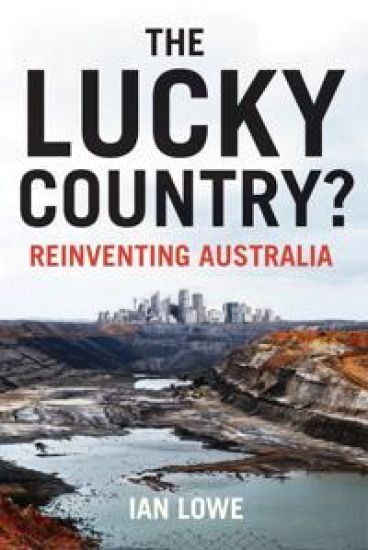
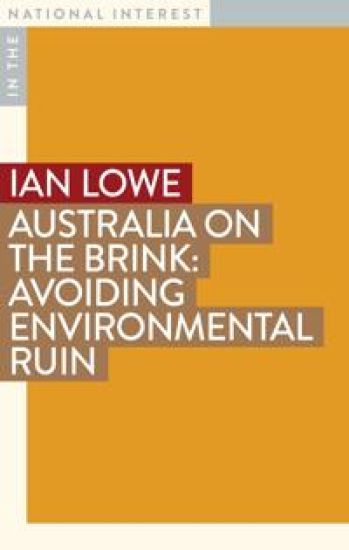
Can we reinvent the Lucky Country? Fifty years ago author Donald Horne described Australia as a lucky country run by second-rate people, adding that our leaders are mostly unaware of events that surround them. The good fortune continued when our wide brown land proved to contain bountiful resources of saleable minerals, allowing successive generations of second-rate leaders to create an illusion of economic progress by liquidating those assets. But a crisis is approaching, driven by irresponsible encouragement of population growth rates typical of poor developing countries. In this polemic work, Ian Lowe will assess the state of Australia and whether we can retain our status of the Lucky Country."
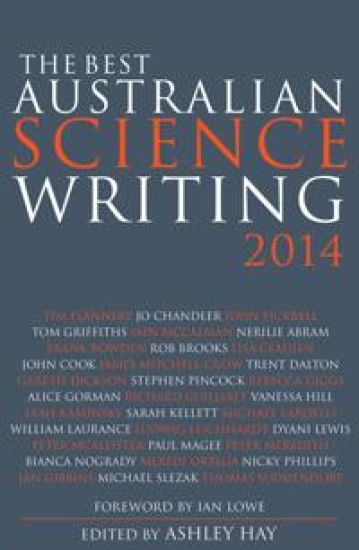
The annual collection celebrating the finest Australian science writing of the year. Why are Sydney’s golden orb weaver spiders getting fatter and fitter? Could sociology explain the recent upsurge in prostate cancer diagnoses? Why were Darwinites craving a good storm during ‘The Angry Summer’? Is it true that tuberculosis has become deadlier over time? And are jellyfish really taking over the world? Now in its fourth year, this popular and acclaimed anthology steps inside the nation’s laboratories and its finest scientific and literary minds. Featuring prominent authors such as Tim Flannery, Jo Chandler, Frank Bowden and Iain McCalman, as well as many new voices, it covers topics as diverse and wondrous as our ‘lumpy’ universe, the creation of dragons and the frontiers of climate science.
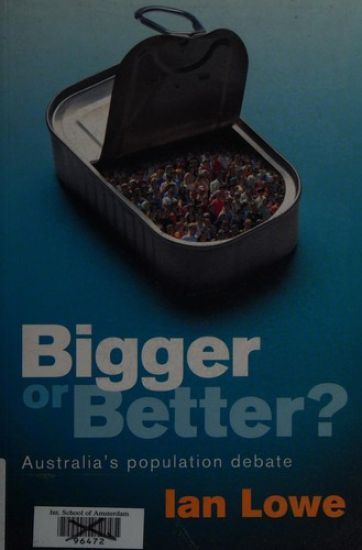
Bigger or Better?: Australia's Population Debate
Ian Lowe
University of Queensland Pr (Australia)
2012
nidottu
A comprehensive and detailed analysis of the controversial debate about Australia's population numbers, this book clarifies the subject and addresses the many misconceptions. It provides a historic account of Australia's population growth and a study of official data while examining the components of that growth in detail, including birth rates and immigration as well as the more recent trend of an aging population. In addition, this thorough account also discusses the motives of the interested parties, both those who promote population growth and those who argue against it.
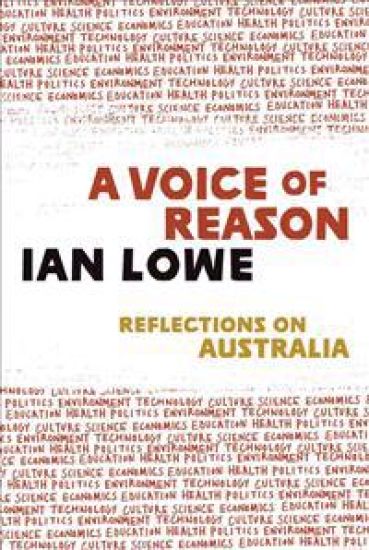
A Voice of Reason: Reflections on Australia
Ian Lowe
University of Queensland Pr (Australia)
2011
nidottu
Bringing to light serious world environment issues, this thought-provoking and informative collection of essays and opinion pieces illustrates the topics--from politics and economics to culture and health--that have engaged the Australian community and will continue to do so into its uncertain future. While a sobering reminder of how little progress has been made, this is also an environmental and community wake-up call--through logic rather than fear-mongering--that will inspire people to make a difference.
This multidisciplinary volume presents a refreshing new approach to environmental values in the global age. it investigates the challenges that globalization poses to traditional environmental values in general as well as in politics and international governance. Divided into five parts, the book investigates how environmental values could be reconceived in a globalizing world. Part I explores contemporary environmental values and their implications for a globalizing world. Part II examines the development of Western and Eastern environmental valuesPart III discusses contemporary environmental politicsPart IV examines how values inform environmental governance and how governance solutions influence which values are realisedPart V concludes the volume with two different views of the prospects of environmental values in a globalising world. This study will be of great interest to students and researchers studying the environment in philosophy, political science, international relations, international environment law, environmental studies and development studies.
Reaction Time: Climate Change and the Nuclear Option: Quarterly Essay 27
Ian Lowe
Black Inc.
2007
pokkari
In Reaction Time, Ian Lowe examines the science and the politics of nuclear power, as well as the feasible alternatives in an era of global warming. Australia is at a crossroads: if we are to halt global warming, do we need to stride resolutely into a nuclear future? In this engrossing and persuasive essay, Ian Lowe discusses his one-time belief in the benefits of nuclear power and explains why that belief has faltered. He engages with the leading environmentalists, like James Lovelock, who advocate going nuclear, as well as with the less savoury aspects of the Australian politicking. He discusses whether other countries might need to use nuclear power, even if Australia doesn't, and offers an authoritative survey of Australia's energy alternatives - from solar and wind power to clean coal. Above all, he explains why taking up the nuclear option would be a decisive step in the wrong direction - economically, environmentally, politically and socially." Promoting nuclear power as the solution to climate change is like advocating smoking as a cure for obesity. That is, taking up the nuclear option will make it much more difficult to move to the sort of sustainable, ecologically healthy future that should be our goal." IAN LOWE, REACTION TIME
This multidisciplinary volume presents a refreshing new approach to environmental values in the global age. it investigates the challenges that globalization poses to traditional environmental values in general as well as in politics and international governance. Divided into five parts, the book investigates how environmental values could be reconceived in a globalizing world. Part I explores contemporary environmental values and their implications for a globalizing world. Part II examines the development of Western and Eastern environmental valuesPart III discusses contemporary environmental politicsPart IV examines how values inform environmental governance and how governance solutions influence which values are realisedPart V concludes the volume with two different views of the prospects of environmental values in a globalising world. This study will be of great interest to students and researchers studying the environment in philosophy, political science, international relations, international environment law, environmental studies and development studies.
Science, Technology and Society
Martin Bridgstock; David Burch; John Forge; John Laurent; Ian Lowe
Cambridge University Press
1998
pokkari
This book provides a comprehensive introduction to the human, social and economic aspects of science and technology. It examines a broad range of issues from a variety of perspectives, using examples and experiences from Australia and around the world. The authors present complex issues in an accessible and engaging form. Topics include the responsibilities of scientists, ethical dilemmas and controversies, the Industrial Revolution, economic issues, public policy, and science and technology in developing countries. The book ends with a thoughtful and provocative look towards the future. It includes extensive guides to further reading, as well as a useful section on information searching skills. This book will provoke, engage, inform and stimulate thoughtful discussion about culture, society and science. Broad and interdisciplinary, it will be of considerable value to students and teachers.
Science, Technology and Society
Martin Bridgstock; David Burch; John Forge; John Laurent; Ian Lowe
Cambridge University Press
1998
sidottu
This book provides a comprehensive introduction to the human, social and economic aspects of science and technology. It examines a broad range of issues from a variety of perspectives, using examples and experiences from Australia and around the world. The authors present complex issues in an accessible and engaging form. Topics include the responsibilities of scientists, ethical dilemmas and controversies, the Industrial Revolution, economic issues, public policy, and science and technology in developing countries. The book ends with a thoughtful and provocative look towards the future. It includes extensive guides to further reading, as well as a useful section on information searching skills. This book will provoke, engage, inform and stimulate thoughtful discussion about culture, society and science. Broad and interdisciplinary, it will be of considerable value to students and teachers.