
Kirjailija
Ikeda Daisaku
Kirjat ja teokset yhdessä paikassa: 6 kirjaa, julkaisuja vuosilta 2008–2023, suosituimpiin kuuluu Ode to the Grand Spirit. Vertaile teosten hintoja ja tarkista saatavuus suomalaisista kirjakaupoista.
6 kirjaa
Kirjojen julkaisuvuodet: 2008–2023.
'The natural sympathy and understanding of people everywhere must be the soil in which the new humanism can thrive.' For Daisaku Ikeda, whose words these are, education has long been one of the fundamental priorities of his work and teaching. His emphasis on the intellectual legacy bequeathed to humanity by the great teachers of civilization is in this volume encapsulated by the notion of a 'new humanism': a significant residue ofwisdom that in the right circumstances may be passed on to future generations, expanding horizons, making connections between different cultures and encouraging fresh insights and new discoveries across the globe. These circumstances are perhaps most fully realised in the context of universities. In promoting his core values of education and peace, the author has delivered lectures and speeches at more than twenty-five academies, colleges and research institutes worldwide. This stimulating collection, which includes the author's most recent lectures, ranges widely across topics as diverse as art, religion, culture and time, and draws creatively on the sages of ancient India, China and Japan as well as on visionary thinkers from every nation, including Tolstoy, Victor Hugo and Gandhi.
'The natural sympathy and understanding of people everywhere must be the soil in which the new humanism can thrive.' For Daisaku Ikeda, whose words these are, education has long been one of the fundamental priorities of his work and teaching. And his emphasis on the intellectual legacy bequeathed to humanity by the great teachers of civilization is in this volume encapsulated by the notion of a 'new humanism': a significant residue of wisdom that in the right circumstances may be passed on to future generations, expanding horizons, making connnctions between different cultures and encouraging fresh insights and new discoveries across the globe. These circumstances are perhaps most fully realised in the context of universities. And in promoting his core values of education and peace, the author has delivered speeches and lectures at more than twenty-five academies, colleges and research institutes worldwide. This stimulating collection, which includes the author's most recent lectures, ranges widely across topics as diverse as art, religion, culture and time, and draws creatively on the sages of ancient India, China and Japan as well as on visionary thinkers from every nation, including Tolstoy, Victor Hugo and Gandhi.
In the nineteenth century, Nietzsche famously announced that God was dead. In the twentieth century, increasing reliance on science and technology led to a widespread rejection of belief on the grounds of its irrationality. Yet religion has not died. In fact, the opposite has occurred: it has persisted and proliferated. Despite the relentless pursuit of scientific advancement, in the twenty-first century we now see religious influence everywhere. In this wide-ranging dialogue, two leading commentators on religion address - from their different but complementary traditions of Christianity and Buddhism - the continuing appeal of spirituality to people eager to explore fundamental questions of meaning. The authors indicate that science, for all its benefits, has limits of explanation. It may be able to show how, but not necessarily why. Yet belief too must not go unchallenged, since, as Ikeda says, 'religion can become either a medicine or a poison'. What then is the proper role of religion in a world plagued by intolerance and extremism? The authors point to its place in dialogue, education and peacebuilding. They emphasise the centrality of non-violence, and the inspiring examples of Gandhi, Martin Luther King and Nelson Mandela. In so doing they recount formative experiences of involvement in the civil rights movement and protest against Vietnam (Cox) and personal exposure to the misery and destruction of war (Ikeda). Their joint vision of a just and true religious sensibility makes a vital contribution to the fields of religion, peace studies and ethics.
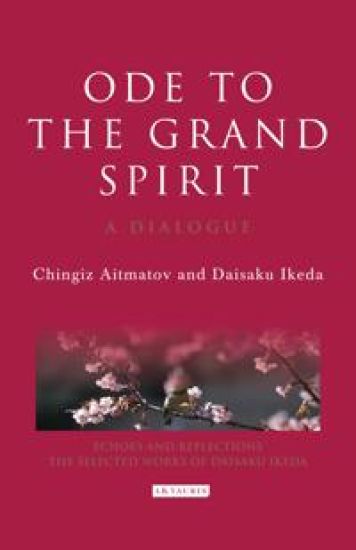
'There is life hidden within stones. Only we human beings can give meaning to all things in the cosmos through thought and words'. With these haunting and resonant words did Kyrgyz writer and novelist Chingiz Aitmatov, who died in June 2008, summarise the dialogue that he undertook with leading Buddhist leader Daisaku Ikeda. Aitmatov is best known for his novella "Jamila", on the publication of which he achieved great fame in the Soviet Union in 1958. But after the Soviet Union's collapse, this writer, who is often lauded as one of the great Soviet authors, felt that his work had been passed over. "Ode to the Grand Spirit" is both an enduring tribute to the thought of a powerful writer and a fascinating individual as well as a profound reflection on such themes of the process of literary creation, spiritual growth and the essence of humanity.
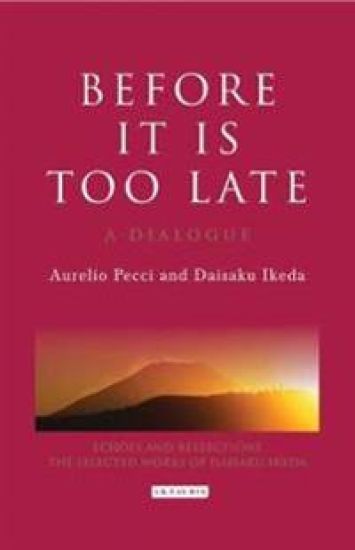
Long before it became fashionable to talk of climate change, drought and water shortages, the authors of this lucid and trenchant dialogue were warning that planet earth was heading for uninhabitability. They exchange viewpoints and insights that have matured over many years of thought, study and reflection. One of the authors is a Westerner - a man of many parts, both wartime resistance fighter and leading industrialist, who founded one of the first think tanks to address seriously the human prospects for global survival. The other represents the philosophical and ethical perspectives of the East - a Buddhist leader who has visited country after country, campaigning tirelessly for the abolition of nuclear weapons and war in all its forms. Engaging constructively and imaginatively with such seemingly intractable problems as population growth, the decline of natural resources, desertification, pollution and deforestation, Ikeda and Peccei show that many of these problems are interrelated. Only by addressing them as part of a web of complex but combined issues, and by working together for peace and justice, can human beings expect to find lasting solutions. The best prospect for the future lies in an ethical revolution whereby humanity can find a fresh understanding of itself in holistic connection with, rather than separation and alienation from, the planet itself.