
Kirjailija
Immanuel Kant
Kirjat ja teokset yhdessä paikassa: 1 083 kirjaa, julkaisuja vuosilta 1785–2026, suosituimpiin kuuluu Politz, K: Immanuel Kants Vorlesungen Uber Die Philosophisch. Vertaile teosten hintoja ja tarkista saatavuus suomalaisista kirjakaupoista.
1 083 kirjaa
Kirjojen julkaisuvuodet: 1785–2026.


Reprint of the original, first published in 1871. The publishing house Anatiposi publishes historical books as reprints. Due to their age, these books may have missing pages or inferior quality. Our aim is to preserve these books and make them available to the public so that they do not get lost.

Reprint of the original, first published in 1871. The publishing house Anatiposi publishes historical books as reprints. Due to their age, these books may have missing pages or inferior quality. Our aim is to preserve these books and make them available to the public so that they do not get lost.

Prolegomena Zu Einer Jeden Künftigen Metaphysic Die ALS Wissenschaft Wird Auftreten Können
Immanuel Kant
Culturea
2023
pokkari

The Metaphysical Elements of Ethics is classic philosophy text by the German philosopher Immanuel Kant that imcludes this passage: "If there exists on any subject a philosophy (that is, a system of rational knowledge based on concepts), then there must also be for this philosophy a system of pure rational concepts, independent of any condition of intuition, in other words, a metaphysic. It may be asked whether metaphysical elements are required also for every practical philosophy, which is the doctrine of duties, and therefore also for Ethics, in order to be able to present it as a true science (systematically), not merely as an aggregate of separate doctrines (fragmentarily). As regards pure jurisprudence, no one will question this requirement; for it concerns only what is formal in the elective will, which has to be limited in its external relations according to laws of freedom; without regarding any end which is the matter of this will. Here, therefore, deontology is a mere scientific doctrine (doctrina scientiae)."

Reprint of the original. The publishing house Anatiposi publishes historical books as reprints. Due to their age, these books may have missing pages or inferior quality. Our aim is to preserve these books and make them available to the public so that they do not get lost.

Reprint of the original. The publishing house Anatiposi publishes historical books as reprints. Due to their age, these books may have missing pages or inferior quality. Our aim is to preserve these books and make them available to the public so that they do not get lost.




Prolegomena Zu Einer Jeden Künftigen Metaphysic Die ALS Wissenschaft Wird Auftreten Können
Immanuel Kant
Culturea
2023
pokkari
"The Fundamental Principles of the Metaphysics of Morals" is a philosophical work by Immanuel Kant, published in 1785. In this work, Kant aims to provide a foundation for moral philosophy by outlining the principles of moral reasoning. Kant argues that morality is not based on human desires or emotions, but on a rational understanding of what is universally good. He believes that moral principles should be based on reason alone, rather than on tradition or religious authority. According to Kant, the only thing that is inherently good is a good will, which he defines as a will that acts in accordance with duty. He argues that actions should be judged not on their consequences, but on the motives behind them. Kant also introduces the concept of the categorical imperative, which is a moral principle that applies to all rational beings. The categorical imperative states that we should act only in ways that we would want everyone else to act in similar situations. Overall, "The Fundamental Principles of the Metaphysics of Morals" is a significant work in the history of philosophy and continues to influence contemporary discussions of ethics and morality. It presents a compelling argument for a rational, universal foundation for moral principles.
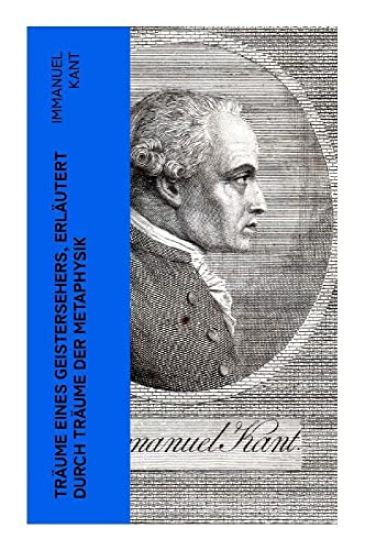
Träume eines Geistersehers, erläutert durch Träume der Metaphysik
Immanuel Kant
e-artnow
2022
nidottu