Kirjojen hintavertailu – 12 859 829 kirjaa ja 27 kauppaa

Kirjailija

Indrajit Ray

Kirjat ja teokset yhdessä paikassa: 8 kirjaa, julkaisuja vuosilta 2011–2024, suosituimpiin kuuluu Cyber-Security Threats and Response Models in Nuclear Power Plants. Vertaile teosten hintoja ja tarkista saatavuus suomalaisista kirjakaupoista.

8 kirjaa

Kirjojen julkaisuvuodet: 2011–2024.

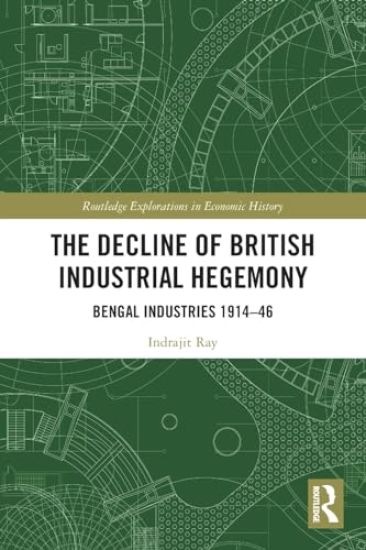
The Decline of British Industrial Hegemony

The Decline of British Industrial Hegemony

Indrajit Ray

TAYLOR FRANCIS LTD
2024
nidottu
Through two World Wars and the Great Depression, this book explores the turbulent history of colonial Indian industry in the period immediately prior to independence. Focusing on five major industries in Bengal - coal mining, iron-smelting, jute manufacturing, paper making and tea plantation – the book looks at the impact of the war efforts on production, employment and capital: some industries experienced rapid growth due to additional investment, others suffered due to the dislocation of markets. Moreover, by drawing lessons from the war economy (especially the dearth of various essential commodities including war materials), the colonial government took up various measures in the inter-war period to promote India’s domestic industries for the first time. Additionally, the book also argues that many of the expatriate firms in India became financially weak because of the Depression which paved the way for the ‘Indianisation’ of corporate houses. These elements were significant factors in the decline of British industrial hegemony in India and aided the de-colonisation process which followed. This book will be of interest to scholars of Indian economic history as well as those with wider interests in decolonisation, industrial history and the first half of the twentieth century.

Cyber-Security Threats and Response Models in Nuclear Power Plants

Cyber-Security Threats and Response Models in Nuclear Power Plants

Carol Smidts; Indrajit Ray; Quanyan Zhu; Pavan Kumar Vaddi; Yunfei Zhao; Linan Huang; Xiaoxu Diao; Rakibul Talukdar; Michael C. Pietrykowski

Springer International Publishing AG
2022
nidottu
This SpringerBrief presents a brief introduction to probabilistic risk assessment (PRA), followed by a discussion of abnormal event detection techniques in industrial control systems (ICS). It also provides an introduction to the use of game theory for the development of cyber-attack response models and a discussion on the experimental testbeds used for ICS cyber security research. The probabilistic risk assessment framework used by the nuclear industry provides a valid framework to understand the impacts of cyber-attacks in the physical world. An introduction to the PRA techniques such as fault trees, and event trees is provided along with a discussion on different levels of PRA and the application of PRA techniques in the context of cybersecurity. A discussion on machine learning based fault detection and diagnosis (FDD) methods and cyber-attack detection methods for industrial control systems are introduced in this book as well. A dynamic Bayesiannetworks based method that can be used to detect an abnormal event and classify it as either a component fault induced safety event or a cyber-attack is discussed. An introduction to the stochastic game formulation of the attacker-defender interaction in the context of cyber-attacks on industrial control systems to compute optimal response strategies is presented. Besides supporting cyber-attack response, the analysis based on the game model also supports the behavioral study of the defender and the attacker during a cyber-attack, and the results can then be used to analyze the risk to the system caused by a cyber-attack. A brief review of the current state of experimental testbeds used in ICS cybersecurity research and a comparison of the structures of various testbeds and the attack scenarios supported by those testbeds is included. A description of a testbed for nuclear power applications, followed by a discussion on the design of experiments that can be carried out on the testbed and the associated results is covered as well. This SpringerBrief is a useful resource tool for researchers working in the areas of cyber security for industrial control systems, energy systems and cyber physical systems. Advanced-level students that study these topics will also find this SpringerBrief useful as a study guide.
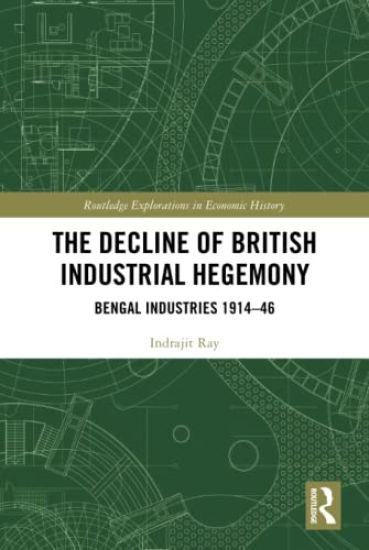
The Decline of British Industrial Hegemony

The Decline of British Industrial Hegemony

Indrajit Ray

TAYLOR FRANCIS LTD
2022
sidottu
Through two World Wars and the Great Depression, this book explores the turbulent history of colonial Indian industry in the period immediately prior to independence. Focusing on five major industries in Bengal - coal mining, iron-smelting, jute manufacturing, paper making and tea plantation – the book looks at the impact of the war efforts on production, employment and capital: some industries experienced rapid growth due to additional investment, others suffered due to the dislocation of markets. Moreover, by drawing lessons from the war economy (especially the dearth of various essential commodities including war materials), the colonial government took up various measures in the inter-war period to promote India’s domestic industries for the first time. Additionally, the book also argues that many of the expatriate firms in India became financially weak because of the Depression which paved the way for the ‘Indianisation’ of corporate houses. These elements were significant factors in the decline of British industrial hegemony in India and aided the de-colonisation process which followed. This book will be of interest to scholars of Indian economic history as well as those with wider interests in decolonisation, industrial history and the first half of the twentieth century.
The Development of Modern Industries in Bengal
Bengal’s traditional industries, once celebrated worldwide, largely decayed under the backwash effects of the British Industrial Revolution in the first half of the nineteenth century. Although colonial ambivalence is often cited as an explanation, this study also shows that a series of new industries emerged during this period. The book reappraises the thesis of India’s deindustrialisation and discusses the development status of the traditional industries in the early nineteenth century, examines their technology, employment opportunities and marketing and, finally, analyses the underlying reasons for their decay. It offers a study of how traditional industries evolved into modern enterprises in a British colony, and contributes to the broader discussion on the global history of industrialisation. This book will be of interest to scholars of Indian economic history as well as those who seek to understand the widespread effects of industrialisation, especially in a colonial context.
Bengal Industries and the British Industrial Revolution (1757-1857)
This book seeks to enlighten two grey areas of industrial historiography. Although Bengal industries were globally dominant on the eve of the industrial revolution, no detailed literature is available about their later course of development. A series of questions are involved in it. Did those industries decline during the spells of British industrial revolution? If yes, what were their reasons? If not, the general curiosity is: On which merits could those industries survive against the odds of the technological revolution? A thorough discussion on these issues also clears up another area of dispute relating to the occurrence of deindustrialization in Bengal, and the validity of two competing hypotheses on it, viz. i) the mainstream hypothesis of market failures, and ii) the neo-marxian hypothesis of imperialistic state interventions.