Kirjojen hintavertailu – 12 859 828 kirjaa ja 27 kauppaa

Kirjailija

Ines Weizman

Kirjat ja teokset yhdessä paikassa: 5 kirjaa, julkaisuja vuosilta 2019–2025, suosituimpiin kuuluu Joséphine Baker Across the Colonial Modern. Vertaile teosten hintoja ja tarkista saatavuus suomalaisista kirjakaupoista.

5 kirjaa

Kirjojen julkaisuvuodet: 2019–2025.

The Architectural Casino

The Architectural Casino

Ines Weizman

Diaphanes AG
2025
nidottu
The edition offers a new approach to what Weizman names “documentary architecture," meaning that to write about the history of a building is also to map the world in which it is located. After the First World War and under the British Mandate, Haifa grew from a small Ottoman port town into a regional metropolis and industrial center around a deep seaport. The city was part of an open space that extended from Cairo to Damascus through Beirut, in a region where Syria, Palestine, and Lebanon were part of the same fluid, interconnected space. During the Second World War, it became a border town. Under French Vichy, the border between Lebanon and Syria ran sixty kilometers to the north and hardened only after the creation of Israel in 1948 and the wars with Lebanon. Haifa's architectural modernism developed in relation to the city's geopolitical environment. No building better manifests Haifa's predicament than the modernist casino building, built in 1934, ostensibly for British officers in Haifa's Bat Galim seafront district. The Bat Galim Casino is a nexus in the political transformation of the region. It emerged as an extraterritorial space where, from the 1940s, British officials and Palestinian and Jewish politicians mingled with De Gaulle's Free French forces, as well as architects, artists, spies, traders, journalists, travelers, sportspeople, poets—many leaning to leftist and communist ideologies—and refugees, fostering a dynamic exchange of ideas. The region is fragmented; this book seeks to weave together connections. The Bat Galim Casino marks the connection of stories whose threads run along intercontinental channels to the French-American performer Josephine Baker, while another story follows the hearing-impaired Viennese architect Adolf Loos and his specialist, Dr. Fleischner, who emigrated to Haifa, leading to the story of home-sick migrants who aimed to recreate a piece of Europe in Palestine. An encounter with architect and filmmaker Amos Gitai leads to a deeper investigation of the story of his father, Munio Weinraub, who, along with other Bauhaus-trained architects, was forced to leave Germany in 1934 after escaping imprisonment for working with the Communist Party. A conversation with conservationist Waleed Karkabi discusses the struggles of historians and conservationists to preserve the stories and buildings of Arab architects such as Antoine Tabet, who worked in Haifa until the establishment of the State of Israel in 1948. The book thus synchronizes different narratives that have been swept away by the chaotic hurricanes of the time.

Joséphine Baker Across the Colonial Modern
On renowned night-club performer and Allied spy Jos phine Baker's movements during the Second World War, told through essays, archival material, and photography. In this unique study, architect and theorist Ines Weizman presents a speculative architectural travelogue of renowned night-club performer and Resistance spy Jos phine Baker's movements during the Second World War. Based on Weizman's installation at the 2023 Venice Architecture Biennale, the book uncovers political histories of colonization and occupation through the lens of architecture. Shortly after Germany occupied France, Baker--who had, up until the war, been performing in Paris and internationally--enlisted in the counterintelligence wing of the Free French Army. In 1940, she left Paris for Marseille, from which she departed in 1941 to establish networks and find allies in North Africa. In 1943, she began performing across the Middle East, traveling alongside, in advance of, or behind Allied soldiers, alternately conducting acts of espionage and entertainment. Her perilous trajectory across the shifting borders of North Africa and the Middle East is known only in broad terms, as evidence that could detail the series of places in which she performed is almost completely lost. Only a few faint traces, speculations, rumors, and documents indicate Baker's presence in military camps, clubs, cabarets, casinos, theatres, and "gin joints" across the region. Centering around a seemingly minor architectural detail (a faded photograph of the remnants of a French flag painted on an interior wall of a long-since demolished casino in Haifa), this book searches for material clues of Baker's movements to trace the political, racial, and religious conflicts encountered along her journey. Featuring a film essay and a longer text discussing archival material, including photographs, documents, and correspondences, the book aims to untangle a web of cross-border relations that have since become hardened by national boundaries, and of trajectories now severed.
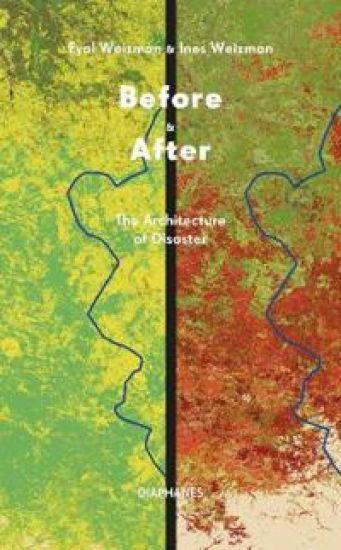
Before & After

Before & After

Eyal Weizman; Ines Weizman

Diaphanes AG
2025
nidottu

Halvin toimitettuna 19,10 €

A study of the history of before-and-after images of catastrophes, bombed-out cities, and large-scale political transformations. Image complexes of humanitarian and ecological upheaval document the world as a sequence of catastrophes. But who decides how events are presented, determines the resolution of our visual worlds, and controls the circulation or censorship of images? Eyal and Ines Weizman trace the history of the before-and-after image from nineteenth-century photography to contemporary satellite images and discover a gap that not only conceals the devastating event: it is the human subject itself that is in danger of disappearing from the images. Do humanitarian work and the documentation and reconstruction of war crimes, in which people’s fates and rights should be at the center of attention, paradoxically enter a post-human phase? How can the gap between images become a site of critical counter-reading rather than a symbol of erasure? In the context of their current research, Eyal and Ines Weizman discuss the history, present, and future of the paradigm of the before-and-after image in an exclusive conversation with Marie Glassl.