Kirjojen hintavertailu – 12 859 829 kirjaa ja 27 kauppaa
Kirjailija
Institute for National Strategic Studies
Kirjat ja teokset yhdessä paikassa: 9 kirjaa, julkaisuja vuodelta 2014, suosituimpiin kuuluu "Not an Idea We Have to Shun": Chinese Overseas Basing Requirements in the 21st. Vertaile teosten hintoja ja tarkista saatavuus suomalaisista kirjakaupoista.
China's expanding international economic interests are likely to generate increasing demandsfor its navy, the People's Liberation Army Navy (PLAN), to operate out of area to protect Chinesecitizens, investments, and sea lines of communication. The frequency, intensity, type, and location of such operations will determine the associated logistics support requirements, with distance from China, size and duration, and combat intensity being especially important drivers. How will the PLAN employ overseas bases and facilities to support these expanding operational requirements? The assessment in this book is based on Chinese writings, comments by Chinese military officers and analysts, observations of PLAN operational patterns, analysis of the overseas military logistics models other countries have employed, and interviews with military logisticians. China's rapidly expanding international interests are likely to produce a parallel expansion of PLAN operations, which would make the current PLAN tactic, exclusive reliance on commercial port access, untenable due to cost and capacity factors. This would certainly be true if China contemplated engaging in higher intensity combat operations. This book considers six logistics models that might support expanded PLAN overseas operations: the Pit Stop Model, Lean Colonial Model, Dual Use Logistics Facility, String of Pearls Model, Warehouse Model, and Model USA. Each model is analyzed in terms of its ability to support likely future naval missions to advance China's expanding overseas economic, political, and security interests and in light of longstanding Chinese foreign policy principles. This analysis concludes that the Dual Use Logistics Facility and String of Pearls models most closely align with China's foreign policy principles and expanding global interests. To assess which alternative China is likely to pursue, the book reviews current PLAN operational patterns in its Gulf of Aden counterpiracy operations to assess whether the PLAN is currently pursuing one model over the other and to provide clues about Chinesemotives and potential future trajectories. To ensure that this study does not suffer fromfaulty assumptions, it also explicitly examines the strategic logic that Western analysts associatewith the String of Pearls Model in light of the naval forces and logistics infrastructure that would be necessary to support PLAN major combat operations in the Indian Ocean. Both the contrasting inductive and deductive analytic approaches support the conclusion that China appears to be planning for a relatively modest set of missions to support its overseas interests, not building a covert logistics infrastructure to fight the United States or India in the Indian Ocean.
Since the end of the U. S.-Soviet Cold War, there has been growing discussion of the possibility that technological advances in the means of combat will produce fundamental changes in how future wars will be fought. A number of observers have suggested that the nature of war itself will be transformed. Some proponents of this view have gone so far as to predict that these changes will include great reductions in, if not the outright elimination of, the various impediments to timely and effective action in war for which the Prussian theorist and soldier Carl von Clausewitz (1780-1831) introduced the term friction. Friction in war, of course, has a long historical lineage. It predates Clausewitz by centuries and has remained a stubbornly recurring factor in combat outcomes right down to the 1991 Persian Gulf War and subsequent conflicts. In looking to the future, a seminal question is whether Clausewitzian friction will succumb to the changes in leading-edge warfare that may lie ahead, or whether such impediments reflect more enduring aspects of war that technology can but marginally affect. It is this question that the present paper examines. Clausewitz's earliest known use of the term friction to "describe the effect of reality on ideas and intentions in war" occurred in a September 29 letter written to his future wife, Marie von Br hl, less than 3 weeks before France defeated Prussia at the twin battles of Jena and Auerst dt on October 14, 1806.1 By the time Clausewitz died in 1831, his original insight regarding friction's debilitating effects on the campaign of 1806 had grown into a central theme of the unfinished manuscript that his widow published as On War Vom Kriege].
In the immediate aftermath of war or in the midst of violent conflict, there is everything to be done. The urgency of anything can be overwhelming and can lead to paralysis. Sequencing and prioritizing seem unrealistic luxuries, and confusion often reigns. Studies show that of the countries emerging from conflict, 40 percent return to it within 10 years. Indeed, immediate past conflict is the single most highly correlated predictive factor for future conflict. When the window for peace consolidation opens, robust efforts must be directed toward reinforcing and broadening the peace to ensure that combatants do not return to arms; the window shuts all too rapidly. The time frame for consolidating peace is compressed. This will often-perhaps inevitably-require some extremely difficult decisions, choices, and compromises. However, if human life is to be protected, certain important public goods may have to be deferred to ensure against a rapid return to violence. In the "golden moment" when recent belligerents have agreed on peace terms-before the ensuing enthusiasm has dissipated-there is often a multitude of donors, sponsors, and other benefactors ready to help. This is both a blessing and a curse. The blessing is in the resources, both human and capital, brought to the peace consolidation process. The curse comes in the form of the multiple agents offering those resources and their expertise, each with its own agenda, objectives, expectations, and methods. The topography of peace can be crowded, confused, and conflicted. Writings on complex operations, development, and peace-building are permeated by optimism and a can-do attitude. All problems can be solved if only the right techniques are applied and the "political will" is present. Indeed, it is tempting to suppose that all good things go together. In the high-pressure environment of complex operations, we want to believe that with enough consultation and coordination, all efforts to establish equitable and durable peace can be harmonized and deconflicted. Unity of command and unity of effort will ensure that all parts contribute optimally to the shared ultimate objective. As comforting as this vision might be, it is not plausible, and even agendas with similar ultimate goals (such as durable peace) may have conflicting intermediate objectives. In his classic formula, Max Weber distinguished the state as an institution by its monopoly of the legitimate use of force. Although the state may delegate the legitimate use of force, it remains the unique owner of that prerogative. Other institutions, agencies, or elements within society may exercise force, but without delegation from the state, any such exercise is unsanctioned and is thus illegitimate. In reality, no modern state, strong or weak, has an absolute monopoly on the use of force; however, the legitimacy of the use of force is central to the modern concept of governance. Today, many states are threatened by the loss of the monopoly of force and its legitimate use.
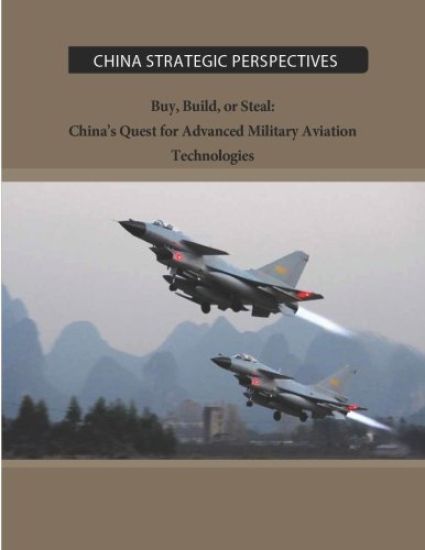
Although China continues to lag approximately two decades behind the world's most sophisticated air forces in terms of its ability to develop and produce fighter aircraft and other complex aerospace systems, it has moved over time from absolute reliance on other countries for military aviation technology to a position where a more diverse array of strategies can be pursued. Steps taken in the late 1990s to reform China's military aviation sector demonstratedan understanding of the problems inherent in high-technology acquisition, and an effort to move forward. However, a decade later it remains unclear how effective these reforms have been. Where are the People's Liberation Army Air Force (PLAAF) and China's military aviation industry headed? What obstacles must be overcome for China to join the exclusive ranks of those nations possessing sophisticated air forces and aviation industries capable of producing world-class aircraft? This study identifies potential aviation technology development and procurement strategies, presents a general model of the options available to developing countries, and applies that model to explain Chinese procurement and aviation technology acquisition efforts over the last 60 years. The model articulates three main technology procurement avenues: purchase(buy), indigenous development (build), and espionage (steal), and three subavenues: reverse engineering (combining buy/steal and build), coproduction (combining buy and build), and codevelopment (combining buy and build, with an emphasis on build). It examines the costs, benefits, and tradeoffs inherent in each approach. Four variables influence decisions about the mix of strategies: (1) a country's overall level of economic development, in particular the state of its technical/industrial base; (2) the technological capacity of a country's military aviation sector; (3) the willingness of foreign countries to sell advanced military aircraft, key components, armaments, and related production technology; and (4) the country's bargaining power vis- -vispotential suppliers.
Chapter 1 through 14: 2 VolumesOver a century ago, the rapid expansion of global overseas trade brought about by the advent of improved steam propulsion and advances in ship design and construction posed new national policy and security questions for the United States. First, to what degree did American economic prosperity depend upon being a major active participant in maritime commerce? Second, what were the naval implications of such action with respect to the extension and defense of important, if not vital, American interests? Third, what role should the U. S. Government play in the promotion of maritime commercial activity andthe creation of the naval forces required to protect American overseas trade? And fourth, what changes, if any, were required with respect to the direction of American foreign policy? In 1890, Captain Alfred Thayer Mahan, a serving officer in the U. S. Navy, published The Influence of Sea Power upon History, 1660-1783. This book provided a comprehensive statement about maritime commerce, naval power, government policy, and international politics that became the theoretical point of departure for almost all discussion of what was widely regarded to be the most important national security problem of the day, both in the United States and around the world. Today, the importance of space as a venue for economic and military activity in certain respects resembles the conditions of maritime commerce and naval power in the late 19th century. These circumstances prompt two questions: first, is a history-based exploration of prospects and possibilities of spacepower, in the manner of Mahan, a viable intellectual proposition? Second, does his work contain ideas that are applicable to spacepower or at least suggest potentially productive lines of inquiry? Addressing theseissues, however, requires a sound foundation-namely, an accurate understanding of Mahan's major arguments and his manner of reasoning. Unfortunately, misunderstanding Mahan is the rule rather than the exception. His writing is rarely read, and the bulk of the critical literature is corrupted by serious interpretive error. What follows is a schematic representation of Mahanian argument that can be related to the consideration of thenature of the theoretical problem of space-power.
Chapters 15 through 30: Vol. 2Over a century ago, the rapid expansion of global overseas trade brought about by the advent of improved steam propulsion and advances in ship design and construction posed new national policy and security questions for the United States. First, to what degree did American economic prosperity depend upon being a major active participant in maritime commerce? Second, what were the naval implications of such action with respect to the extension and defense of important, if not vital, American interests? Third, what role should the U. S. Government play in the promotion of maritime commercial activity andthe creation of the naval forces required to protect American overseas trade? And fourth, what changes, if any, were required with respect to the direction of American foreign policy? In 1890, Captain Alfred Thayer Mahan, a serving officer in the U. S. Navy, published The Influence of Sea Power upon History, 1660-1783. This book provided a comprehensive statement about maritime commerce, naval power, government policy, and international politics that became the theoretical point of departure for almost all discussion of what was widely regarded to be the most important national security problem of the day, both in the United States and around the world. Today, the importance of space as a venue for economic and military activity in certain respects resembles the conditions of maritime commerce and naval power in the late 19th century. These circumstances prompt two questions: first, is a history-based exploration of prospects and possibilities of spacepower, in the manner of Mahan, a viable intellectual proposition? Second, does his work contain ideas that are applicable to spacepower or at least suggest potentially productive lines of inquiry? Addressing theseissues, however, requires a sound foundation-namely, an accurate understanding of Mahan's major arguments and his manner of reasoning. Unfortunately, misunderstanding Mahan is the rule rather than the exception. His writing is rarely read, and the bulk of the critical literature is corrupted by serious interpretive error. What follows is a schematic representation of Mahanian argument that can be related to the consideration of thenature of the theoretical problem of space-power.