

Kirjailija
Irfan Ali
Kirjat ja teokset yhdessä paikassa: 27 kirjaa, julkaisuja vuosilta 2001–2026, suosituimpiin kuuluu Smoking: Quit with Whole Body Wellness! Comprehensive Advice on Preventing and Healing the Effects of Smoking. Vertaile teosten hintoja ja tarkista saatavuus suomalaisista kirjakaupoista.
27 kirjaa
Kirjojen julkaisuvuodet: 2001–2026.


This book presents fundamental concepts of optimization problems and its real-world applications in various fields. The core concepts of optimization, formulations and solution procedures of various real-world problems are provided in an easy-to-read manner. The unique feature of this book is that it presents unified knowledge of the modelling of real-world decision-making problems and provides the solution procedure using the appropriate optimization techniques. The book will help students, researchers, and faculty members to understand the need for optimization techniques for obtaining optimal solution for the decision-making problems. It provides a sound knowledge of modelling of real-world problems using optimization techniques. It is a valuable compendium of several optimization techniques for solving real-world application problems using optimization software LINGO. The book is useful for academicians, practitioners, students and researchers in the field of OR. It is written in simple language with a detailed explanation of the core concepts of optimization techniques. Readers of this book will understand the formulation of real-world problems and their solution procedures obtained using the appropriate optimization techniques.


Production of Lactic Acid by Lactobacillus fermentum
Irfan Ali; Hardik Pathak
LAP Lambert Academic Publishing
2013
pokkari
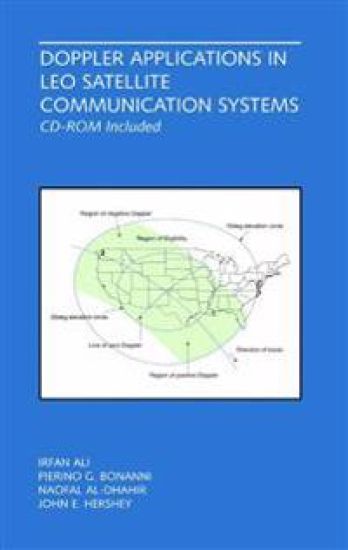
Doppler Applications in LEO Satellite Communication Systems
Irfan Ali; Pierino G. Bonanni; Naofal Al-Dhahir; John E. Hershey
Springer-Verlag New York Inc.
2013
nidottu
Doppler Applications in LEO Satellite Communication Systems develops and presents an important class of techniques useful in the construction of little Low Earth Orbit (LEO) satellite communication systems. It centers on the very significant Doppler shift that attends communications through a LEO satellite and shows how this phenomenon can be exploited for an unexpected benefit. The techniques taught in the book are expected to be particularly attractive to system engineers because ground-based transceivers must generally compensate for the large Doppler component and therefore the necessary receiver processing loops are often already in place and expensed. This volume starts with a recounting of the characteristics of a LEO satellite and its orbit. The 2nd chapter addresses the LEO orbital geometry and reviews the Doppler effect attending LEO communications. Chapter three is focused on the important task of estimating the Doppler at a ground terminal. Appropriate signal processing algorithms are reviewed. Chapter four is concerned with predicting LEO satellite visibility. Chapters five and six are, respectively, devoted to the use of the significant LEO Doppler as an aid in a new traffic flow control protocol and as an aid for effecting communications power control. The last chapter describes MATLAB® based analysis. Doppler Applications in LEO Satellite Communication Systems provides a thorough review of the LEO Doppler phenomenon.
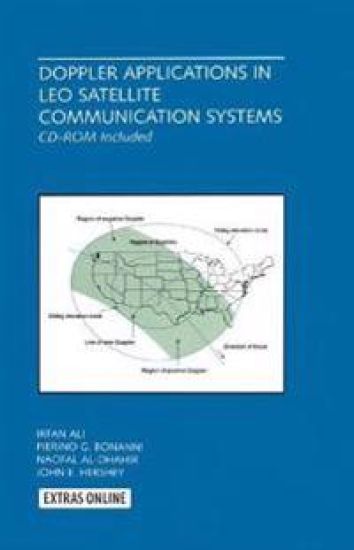
Doppler Applications in LEO Satellite Communication Systems
Irfan Ali; Pierino G. Bonanni; Naofal Al-Dhahir; John E. Hershey
Springer
2001
sidottu
Doppler Applications in LEO Satellite Communication Systems develops and presents an important class of techniques useful in the construction of little Low Earth Orbit (LEO) satellite communication systems. It centers on the very significant Doppler shift that attends communications through a LEO satellite and shows how this phenomenon can be exploited for an unexpected benefit. The techniques taught in the book are expected to be particularly attractive to system engineers because ground-based transceivers must generally compensate for the large Doppler component and therefore the necessary receiver processing loops are often already in place and expensed. This volume starts with a recounting of the characteristics of a LEO satellite and its orbit. The 2nd chapter addresses the LEO orbital geometry and reviews the Doppler effect attending LEO communications. Chapter three is focused on the important task of estimating the Doppler at a ground terminal. Appropriate signal processing algorithms are reviewed. Chapter four is concerned with predicting LEO satellite visibility. Chapters five and six are, respectively, devoted to the use of the significant LEO Doppler as an aid in a new traffic flow control protocol and as an aid for effecting communications power control. The last chapter describes MATLAB® based analysis. Doppler Applications in LEO Satellite Communication Systems provides a thorough review of the LEO Doppler phenomenon.