Kirjojen hintavertailu – 12 903 725 kirjaa ja 27 kauppaa

Kirjailija

Irving Rouse

Kirjat ja teokset yhdessä paikassa: 44 kirjaa, julkaisuja vuosilta 1989–2013, suosituimpiin kuuluu Ch'eng-Tzu-Yai: The Black Pottery Culture Site at Lung-Shan-Chen in Li-Ch'eng-Hsien, Shantung Province. Vertaile teosten hintoja ja tarkista saatavuus suomalaisista kirjakaupoista.

44 kirjaa

Kirjojen julkaisuvuodet: 1989–2013.

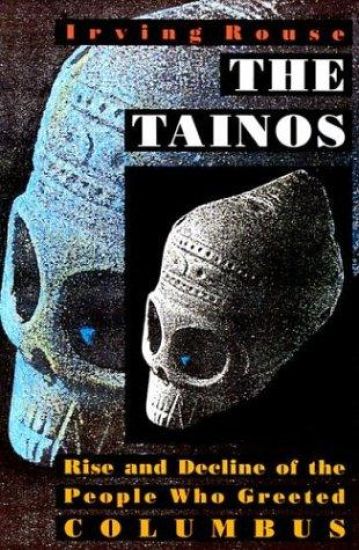
The Tainos

The Tainos

Irving Rouse

Yale University Press
1993
pokkari
From a noted archeologist/anthropologist, the story of the Tainos—the first people Columbus encountered when he arrived in the Americas—from their earliest days to their rapid decline after European contact"A model of clarity and lightly worn erudition, and it contains the best and most straightforward description of the four Columbus voyages and their implications for the Amerindians I have seen."—Kenneth Maxwell, New York Times Book Review Drawing on archeological and ethno-historical evidence, Irving Rouse sketches a picture of the Tainos as they existed during the time of Columbus, contrasting their customs with those of their neighbors. He then moves backward in time to the ancestors of the Tainos—two successive groups who settled the West Indies and who are known to archeologists as the Saladoid peoples and the Ostionoid peoples. By reconstructing the development of these groups and studying their interaction with other groups during the centuries before Columbus, Rouse shows precisely who the Tainos were. He vividly recounts Columbus's four voyages, the events of the European contact, and the early Spanish views of the Tainos, particularly their art and religion. The narration shows that the Tainos did not long survive the advent of Columbus. Weakened by forced labor, malnutrition, and diseases introduced by the foreigners, and dispersed by migration and intermarriage, they ceased to exist as a separate population group. As Rouse discusses the Tainos' contributions to the Spaniards—from Indian corn, tobacco, and rubber balls to art, artifacts, and new words—we realize that their effect on Western civilization, brief through their contact, was an important and lasting one.

Migrations in Prehistory

Migrations in Prehistory

Irving Rouse

Yale University Press
1989
pokkari
Archaeologists have developed various methods of studying cultural remains to infer population movement and other kinds of migration. Irving Rouse, author of much distinguished work in this field, here evaluates research on prehistoric migrations and explains why some of these methods have been more successful than others. Rouse begins with a discussion of the nature and ways of formulating migration hypotheses. He then focuses on four instances in which migration hypotheses have been successfully formed and tested: studies of the origins of the Polynesians, Eskimos, Japanese, and Tainos (the Indians encountered by Columbus when he discovered the New World). Contrasting these with popular but essentially fanciful postulations by authors such as Thor Heyerdahl and Barry Fell, Rouse draws conclusions about the methods of testing hypotheses, about kinds of migrations, and about their causes. He distinguishes between population movement, in which a wave of people from one area overwhelms the inhabitants of another area, and immigration, in which individuals from one area penetrate another and become absorbed into its population. Rouse argues that population movement must be studied in terms of patterns of change in the culture of the migrants, while immigration should be evaluated in terms of the cultural traits introduced by the migrants. In performing these tasks, says Rouse, archaeologists should investigate all elements of culture and should check their results against those obtained by linguists and physical anthropologists. Rouse’s work demonstrates not only the viability of the inference of population movements from archaeological evidence but also the effectiveness of collaboration and communication between branches of archaeology and anthropology. His book is a lucid exposition of an important issue. “This is carefully thought out and simply and clearly written treatment of the process, or processes, of migrations in prehistory. It will be a basic reference for all archaeologists.” –Gordon R. Willey, Peabody Museum of Archaeology and Ethnology, Harvard University