
Kirjailija
Istvan Meszaros
Kirjat ja teokset yhdessä paikassa: 18 kirjaa, julkaisuja vuosilta 2000–2022, suosituimpiin kuuluu The Work of Sartre. Vertaile teosten hintoja ja tarkista saatavuus suomalaisista kirjakaupoista.
Nimi esiintyy myös muodoissa: István Mészáros
18 kirjaa
Kirjojen julkaisuvuodet: 2000–2022.
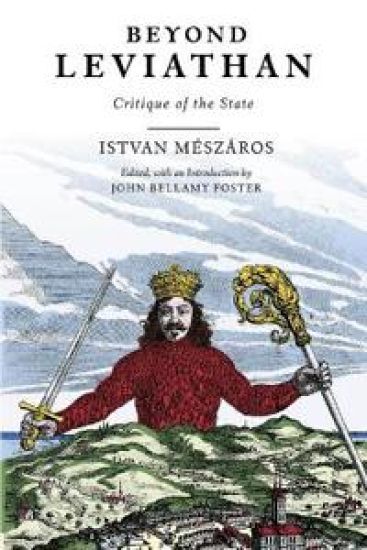


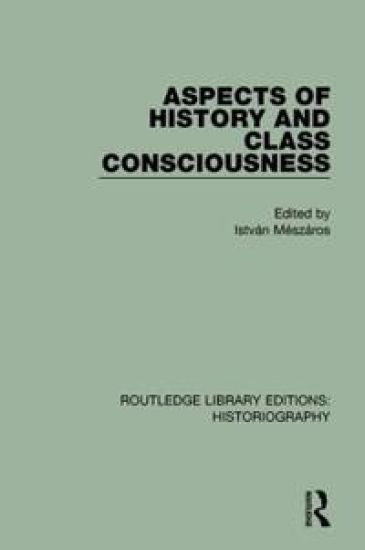
The various contributions in this book, originally published in 1971, discuss many aspects of the complex subject of history and class consciousness, and the themes that are dealt with are all inter-related. The papers range from history and sociology, through political theory and philosophy, to art criticism and literary criticism. Georg Lukács’ classic work History and Class Consciousness, is discussed in several of the essays, and the volume is prefaced by a letter from Georg Lukács to István Mészáros.
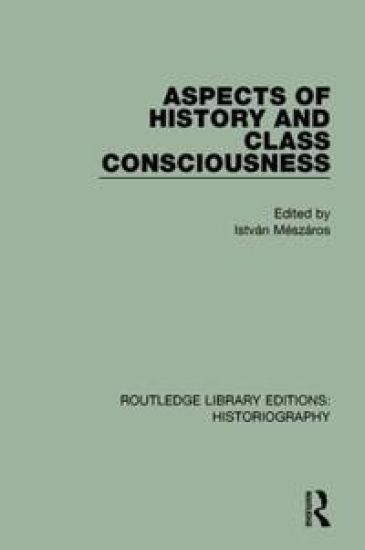
The various contributions in this book, originally published in 1971, discuss many aspects of the complex subject of history and class consciousness, and the themes that are dealt with are all inter-related. The papers range from history and sociology, through political theory and philosophy, to art criticism and literary criticism. Georg Lukács’ classic work History and Class Consciousness, is discussed in several of the essays, and the volume is prefaced by a letter from Georg Lukács to István Mészáros.
Istvan Meszaros is a world-renowned philosopher and critic. He left his native Hungary after the Soviet invasion of 1956. He is professor emeritus at the University of Sussex, where he held the chair of philosophy for fifteen years. Among his many books are Social Structure and Forms of Consciousness Volumes I and II, The Work of Sartre, The Structural Crisis of Capital, The Challenge and Burden of Historical Time, Beyond Capital: Toward a Theory of Transition, and Marx's Theory of Alienation. As John Bellamy Foster writes in his foreword to the present book, "Istvan Meszaros is one of the greatest philosophers that the historical materialist tradition has yet produced. His work stands practically alone today in the depth of its analysis of Marx's theory of alienation, the structural crisis of capital, the demise of Soviet-style post-revolutionary societies, and the necessary conditions of the transition to socialism. His dialectical inquiry into social structure and forms of consciousness - a systematic critique of the prevailing forms of thought - is unequaled in our time." Meszaros is the author of magisterial works like Beyond Capital and Social Structures of Forms of Consciousness, but his work can seem daunting to those unacquainted with his thought. Here, for the first time, is a concise and accessible overview of Meszaros's ideas, designed by the author himself and covering the broad scope of his work, from the shortcomings of bourgeois economics to the degeneration of the capital system to the transition to socialism.

This landmark book, first published in 1979, met acclaim as a doubly important work of radical philosophy. Its subject, Jean-Paul Sartre, was among the twentieth century's most controversial and influential philosophers; its author, Istvan Meszaros, was himself establishing a reputation for profound contributions to the Marxian tradition, which would continue into the next century. The Work of Sartre was thus considered essential for its insights on Sartre and as a piece of Meszaros 's developing politico-philosophical project. In this completely updated and expanded volume, Meszaros examines the manifold aspects of Sartre's legacy--as novelist, playwright, philosopher, and political actor--and in so doing casts light upon the enture oeuvre, situating it within the historical and social context of Sartre's time. Although critical of aspects of Sartre's philosophy, Meszaros celebrates his unyielding commitment to the struggle against the power of capital, and elucidates what this means for the individual in their search for freedom.

This landmark book, first published in 1979, met acclaim as a doubly important work of radical philosophy. Its subject, Jean-Paul Sartre, was among the twentieth century's most controversial and influential philosophers; its author, Istvan Meszaros, was himself establishing a reputation for profound contributions to the Marxian tradition, which would continue into the next century. The Work of Sartre was thus considered essential for its insights on Sartre and as a piece of Meszaros 's developing politico-philosophical project. In this completely updated and expanded volume, Meszaros examines the manifold aspects of Sartre's legacy--as novelist, playwright, philosopher, and political actor--and in so doing casts light upon the enture oeuvre, situating it within the historical and social context of Sartre's time. Although critical of aspects of Sartre's philosophy, Meszaros celebrates his unyielding commitment to the struggle against the power of capital, and elucidates what this means for the individual in their search for freedom.
Social Structures and Forms of Consciousness
Istvan Meszaros
Monthly Review Press,U.S.
2011
nidottu
Halvin toimitettuna 40,40 €
In The Dialectic of Structure and History, Volume Two of Social Structure and Forms of Consciousness, Istvan Meszaros brings the comprehension of our condition and the possibility of emancipatory social action beyond the highest point reached to date. Building on the indicatory flashes of conceptual lightning in the Grundrisse and other works of Karl Marx, Meszaros sets out the relations of structure and agency, individual and society, base and superstructure, nature and history, in a dialectical totality open to the future. The project is brought to its conclusion by means of critique, an analysis that shows not only the inadequacies of the thought critiqued but at the same time their social historical cause. The crucial questions are addressed through critique of the highest point of honest and brilliant thought in capital's ascending phase, that of Adam Smith, Kant, and Hegel, as well as the irrationalities and dishonesty of the apologists of the capital system's descending phase, such as Hayek and Popper. The dead ends of both Levi-Strauss's structuralism and post-modernism, arising from their denial of history, are placed in their context as capital-apologetics. What Meszaros, the leading Marxist philosopher of our times, has achieved is of world historical importance. He has cleared the philosophical ground to permit the illumination of a path to transcend the destructive death spiral of the capital system.

In this collection of trenchant essays and interviews, Istvan Meszaros, the world's preeminent Marxist philosopher and winner of the 2008 Libertador Award for Critical Thought (the Bolivar Prize), lays bare the exploitative structure of modern capitalism. He argues with great power that the world's economies are on a social and ecological precipice, and that unless we take decisive action to radically transform our societies we will find ourselves thrust headfirst into barbarism and environmental catastrophe. Meszaros, however, is no pessimist. He believes that the multiple crises of world capitalism will encourage the working class to demand center stage in the construction of a new system of production and distribution designed to meet human needs rather than serve the relentless pursuit of profit--a struggle which is already underway in places such as Venezuela. As John Bellamy Foster says in the foreword to this indispensable book, "Today the structural crisis of capital provides the historical setting for a new revolutionary movement for social emancipation in which developments normally taking centuries would flit by like phantoms in decades or even years. But the force for such necessary, vital change, remains with the people themselves, and rests on humanity's willingness to constitute itself as both subject and object of history, through the collective struggle to create a just and sustainable world. This, Meszaros insists, constitutes the unprecedented challenge and burden of our historical time."
Social Structures and Forms of Consciousness
Istvan Meszaros
Monthly Review Press,U.S.
2010
nidottu
Halvin toimitettuna 40,40 €
This new work (the first in a two-volume series) by the leading Marxian philosopher of our day is a milestone in human self-understanding. It focuses on the location where action emerges from freedom and necessity, thefoundation of all social science. Today, as never before, the investigation of the close relationship between social structure--defined by Marx as "arising from the life-process of definite individuals"--and the various forms of consciousness is particularly important. We can only perceive what is possible by first identifying the historical process that constrains consciousness itself and therefore social action. The relationship between social structure and forms of consciousness discussed in this volume is multifaceted and profoundly dialectical. It requires the presentation of a great wealth of historical material and the assessment of the relevant philosophical literature, from Descartes through Hegel and the Liberal tradition to the present, together with their connections with political economy and political theory. Istvan Meszaros moves beyond both abstract solutions to the surveyed methodological questions and one-sided structuralist evaluation of the important substantive issues, bringing the process of our understanding of social structure and consciousness to a level not previously attained. Above all, in the spirit of the Marxian approach, even the most complicated problems are always analyzed in relation to the major practical concerns of our time. The primary aim of this work is to outline the dialectical intelligibility of historical development toward a viable societal reproductive order. Social Structures and Forms of Consciousness is of the highest importance as both a political and philosophical work, illuminating the place from where we must act, today.

This new work (the first in a two-volume series) by the leading Marxian philosopher of our day is a milestone in human self-understanding. It focuses on the location where action emerges from freedom and necessity, thefoundation of all social science. Today, as never before, the investigation of the close relationship between social structure--defined by Marx as "arising from the life-process of definite individuals"--and the various forms of consciousness is particularly important. We can only perceive what is possible by first identifying the historical process that constrains consciousness itself and therefore social action. The relationship between social structure and forms of consciousness discussed in this volume is multifaceted and profoundly dialectical. It requires the presentation of a great wealth of historical material and the assessment of the relevant philosophical literature, from Descartes through Hegel and the Liberal tradition to the present, together with their connections with political economy and political theory. Istvan Meszaros moves beyond both abstract solutions to the surveyed methodological questions and one-sided structuralist evaluation of the important substantive issues, bringing the process of our understanding of social structure and consciousness to a level not previously attained. Above all, in the spirit of the Marxian approach, even the most complicated problems are always analyzed in relation to the major practical concerns of our time. The primary aim of this work is to outline the dialectical intelligibility of historical development toward a viable societal reproductive order. Social Structures and Forms of Consciousness is of the highest importance as both a political and philosophical work, illuminating the place from where we must act, today.

The Challenge and Burden of Historical Time
Istvan Meszaros; John Bellamy Foster
Monthly Review Press,U.S.
2008
sidottu
An extraordinary new work by the leading Marxian philosopher of the late twentieth and early twenty-first century, "The Challenge and Burden of Historical Time" represents a breakthrough in the development of socialist thought. It can be seen both as a companion volume to his earlier pathbreaking "Beyond Capital" and a major theoretical contribution in its own right. Its focus is on the "decapitation of historical time" in today's capitalism and the necessity of a new "socialist time accountancy" as a revolutionary response to the debilitating present. Extending Meszaros' earlier analysis of capitalism as a social-metabolic system caught in an irreversible structural crisis, it represents a crushing refutation of the view that "there is no alternative" to the current social order. Meszaros' wide-ranging analysis explores the forces behind the expansion of world inequality, the return of imperial interventionism, the growing structural crisis of the capitalist state, and the widening planetary ecological crisis - along with the new hope offered by the reemergence of concrete socialist alternatives. At the heart of his book is an examination of the preconditions of Latin America's historic Bolivarian journey, which is producing new revolutionary transformations in Venezuela, Bolivia, and elsewhere. "The Challenge and Burden of Historical Time" is a work of great political and philosophical importance, one that defines the challenges and burdens facing all those who are committed to a more rational, more egalitarian future.

5th Edition with new preface. This book focuses on the origins of Marx's thought and on his early writings especially The Economic and Philosophical Manuscripts of 1844. It was a winner of the Isaac Deutscher Memorial Prize. 'In the hands of a creative thinker conviction and passion can give wings to the freedom struggle. Meszaros' book is a 'winger' - one of the most far-reaching books of on the subject of Marx's theory of alienation since Lukacs' seminal Geschichte und Klassenbewusstsein." [History and Class Consciousness] The Review of Metaphysics. 'Immensely learned and well-read" Times Literary Supplement
Socialism or Barbarism: From the American Century to the Crossroads
István Mészáros
MONTHLY REVIEW PRESS
2001
sidottu
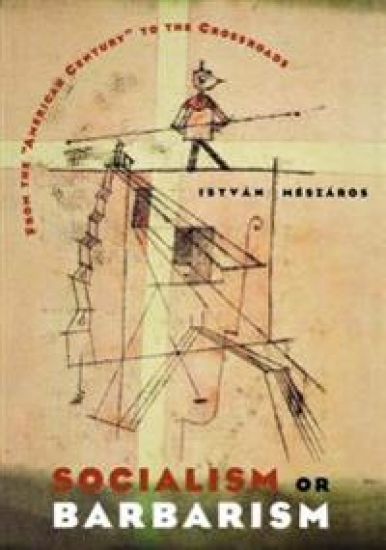
Istv n Mesz ros's bold new study analyzes the historical choices facing us at the outset of the new millennium. Drawing on the theoretical arguments of his monumental and widely-acclaimed work, Beyond Capital, M sz ros shows that the economic boom of the 1990s was built not only on the foundation of new, digital technologies but also on a new social and ethical basis. In the global quest for profit, capitalism has abandoned its claims to serve a larger historical cause. Even in the wealthiest capitalist economies, unemployment has become structural and conditions of life have become more onerous for most of the population. The failure of capitalism's historical mission is most evident in the end of the project of "Third World modernization" so essential to the claims of U. S. global power to represent an advance on old-style imperialism. M szaros develops an illuminating analysis of the roots and tensions of the politics of U. S. global power from the time of Roosevelt's "Open Door" policy to the present. Against this historical background, he examines the dilemmas which will be faced in the making of U. S. foreign policy towards Chinathe largest and most rapidly-expanding national market in the global economy and the newly-emerging rival to U. S. global dominance. M sz ros shows how this process is rooted in the historical logic of contemporary capitalism, and is neither accidental nor temporary. In the process, he gives new meaning and urgency to the alternatives posed by Rosa Luxemburg at the beginning of the 20th century: socialism or barbarism. M sz ros also explores the conditions for the emergence of a radical alternative to capitalism, arguing that a critical re-examination of earlier movements and struggles is an essential task for the emergence of such an alternative. As a sequel to his essay, an extended interview deals with more reflectively with the main categories underlying his analysis and relates it to developments within the broader analysis of modern society.
Socialism or Barbarism: From the American Century to the Crossroads
István Mészáros
MONTHLY REVIEW PRESS
2001
nidottu
Istv n Mesz ros's bold new study analyzes the historical choices facing us at the outset of the new millennium. Drawing on the theoretical arguments of his monumental and widely-acclaimed work, Beyond Capital, M sz ros shows that the economic boom of the 1990s was built not only on the foundation of new, digital technologies but also on a new social and ethical basis. In the global quest for profit, capitalism has abandoned its claims to serve a larger historical cause. Even in the wealthiest capitalist economies, unemployment has become structural and conditions of life have become more onerous for most of the population. The failure of capitalism's historical mission is most evident in the end of the project of "Third World modernization" so essential to the claims of U. S. global power to represent an advance on old-style imperialism. M szaros develops an illuminating analysis of the roots and tensions of the politics of U. S. global power from the time of Roosevelt's "Open Door" policy to the present. Against this historical background, he examines the dilemmas which will be faced in the making of U. S. foreign policy towards Chinathe largest and most rapidly-expanding national market in the global economy and the newly-emerging rival to U. S. global dominance. M sz ros shows how this process is rooted in the historical logic of contemporary capitalism, and is neither accidental nor temporary. In the process, he gives new meaning and urgency to the alternatives posed by Rosa Luxemburg at the beginning of the 20th century: socialism or barbarism. M sz ros also explores the conditions for the emergence of a radical alternative to capitalism, arguing that a critical re-examination of earlier movements and struggles is an essential task for the emergence of such an alternative. As a sequel to his essay, an extended interview deals with more reflectively with the main categories underlying his analysis and relates it to developments within the broader analysis of modern society.

In Beyond Capital, the internationally esteemed Marxist philosopher István Mészáros provides a major contribution to the task of reassessing the socialist alternative and the conditions for its realization in the light of twentieth-century developments and disappointments. Mészáros brings original Marxist thinking to bear on the most fundamental issue facing the left: how to move theoretically Beyond Capital—beyond the project that Marx began and which he articulated under a specific form of commodity capitalism, as well as beyond the power of capital itself. Steeped in the philosophical roots and revolutionary world outlook of early Marxism, broad in scope and stunning in its erudition, Beyond Capital brilliantly challenges the European-based conceptual framework of socialist theory and begins the urgent task of elaborating a new socialist theory of transition.