Kirjojen hintavertailu – 12 903 725 kirjaa ja 27 kauppaa

Kirjailija

Ivar Ekeland

Kirjat ja teokset yhdessä paikassa: 13 kirjaa, julkaisuja vuosilta 1983–2021, suosituimpiin kuuluu Paris-Princeton Lectures on Mathematical Finance 2004. Vertaile teosten hintoja ja tarkista saatavuus suomalaisista kirjakaupoista.

13 kirjaa

Kirjojen julkaisuvuodet: 1983–2021.

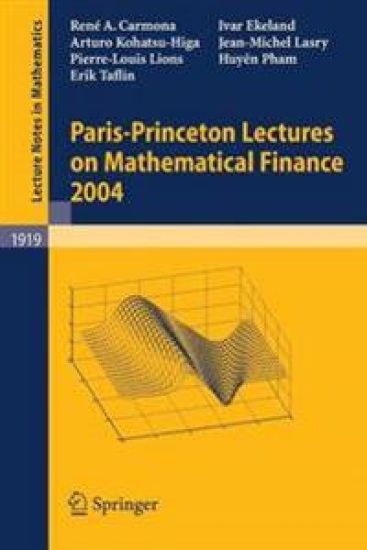
Paris-Princeton Lectures on Mathematical Finance 2004

Paris-Princeton Lectures on Mathematical Finance 2004

René Carmona; Ivar Ekeland; Jean-Michel Lasry; Pierre-Louis Lions; Huyên Pham; Erik Taflin

Springer-Verlag Berlin and Heidelberg GmbH Co. K
2007
nidottu
This is the third volume in "The Paris-Princeton Lectures in Financial Mathematics", which publishes, on an annual basis, cutting-edge research in self-contained, expository articles from outstanding specialists, both established and upcoming. Coverage includes articles by Rene Carmona, Ivar Ekeland/Erik Taflin, Arturo Kohatsu-Higa, Pierre-Louis Lions/Jean-Michel Lasry, and Huyen Pham.
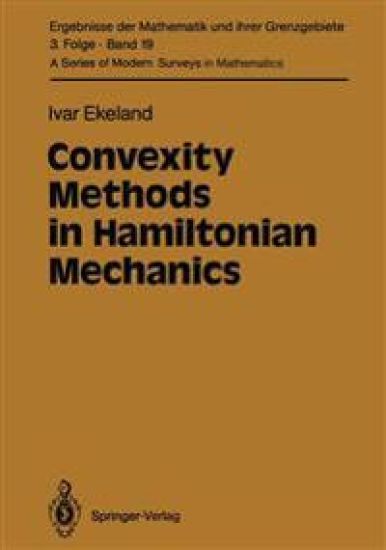
Convexity Methods in Hamiltonian Mechanics

Convexity Methods in Hamiltonian Mechanics

Ivar Ekeland

Springer-Verlag Berlin and Heidelberg GmbH Co. K
2011
nidottu
In the case of completely integrable systems, periodic solutions are found by inspection. For nonintegrable systems, such as the three-body problem in celestial mechanics, they are found by perturbation theory: there is a small parameter € in the problem, the mass of the perturbing body for instance, and for € = 0 the system becomes completely integrable. One then tries to show that its periodic solutions will subsist for € -# 0 small enough. Poincare also introduced global methods, relying on the topological properties of the flow, and the fact that it preserves the 2-form L~=l dPi 1\ dqi' The most celebrated result he obtained in this direction is his last geometric theorem, which states that an area-preserving map of the annulus which rotates the inner circle and the outer circle in opposite directions must have two fixed points. And now another ancient theme appear: the least action principle. It states that the periodic solutions of a Hamiltonian system are extremals of a suitable integral over closed curves. In other words, the problem is variational. This fact was known to Fermat, and Maupertuis put it in the Hamiltonian formalism. In spite of its great aesthetic appeal, the least action principle has had little impact in Hamiltonian mechanics. There is, of course, one exception, Emmy Noether's theorem, which relates integrals ofthe motion to symmetries of the equations. But until recently, no periodic solution had ever been found by variational methods.
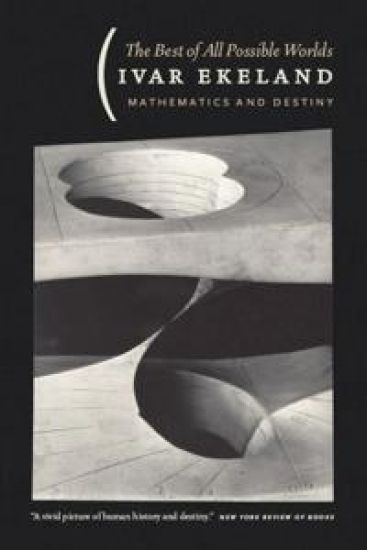
The Best of All Possible Worlds – Mathematics and Destiny

The Best of All Possible Worlds – Mathematics and Destiny

Ivar Ekeland

University of Chicago Press
2007
nidottu
Optimists believe this is the best of all possible worlds. And pessimists fear that might really be the case. But what is the best of all possible worlds? How do we define it? This question has preoccupied philosophers and theologians for ages, but there was a time, during the seventeenth and eighteenth centuries, when scientists and mathematicians felt they could provide the answer. This book is their story. Ivar Ekeland here takes the reader on a journey through scientific attempts to envision the best of all possible worlds. He begins with the French physicist Maupertuis, whose least action principle, Ekeland shows, was a pivotal breakthrough in mathematics, because it was the first expression of the concept of optimization, or the creation of systems that are the most efficient or functional. Tracing the profound impact of optimization and the unexpected ways in which it has influenced the study of mathematics, biology, economics, and even politics, Ekeland reveals how the idea has driven some of our greatest intellectual breakthroughs. The result is a dazzling display of erudition - one that will be essential reading for popular-science buffs and historians of science alike.
The Best of All Possible Worlds

The Best of All Possible Worlds

Ivar Ekeland

University of Chicago Press
2006
sidottu
Optimists believe this is the best of all possible worlds. And pessimists fear that might really be the case. But what is the best of all possible worlds? How do we define it? Is it the world that operates the most efficiently? Or the one in which most people are comfortable and content? Questions such as these have preoccupied philosophers and theologians for ages, but there was a time, during the seventeenth and eighteenth centuries, when scientists and mathematicians felt they could provide the answer. This book is their story. Ivar Ekeland here takes the reader on a journey through scientific attempts to envision the best of all possible worlds. He begins with the French physicist Maupertuis, whose least action principle asserted that everything in nature occurs in the way that requires the least possible action. This idea, Ekeland shows, was a pivotal breakthrough in mathematics, because it was the first expression of the concept of optimization, or the creation of systems that are the most efficient or functional. Although the least action principle was later elaborated on and overshadowed by the theories of Leonhard Euler and Gottfried Leibniz, the concept of optimization that emerged from it is an important one that touches virtually every scientific discipline today. Tracing the profound impact of optimization and the unexpected ways in which it has influenced the study of mathematics, biology, economics, and even politics, Ekeland reveals throughout how the idea of optimization has driven some of our greatest intellectual breakthroughs. The result is a dazzling display of erudition—one that will be essential reading for popular-science buffs and historians of science alike.
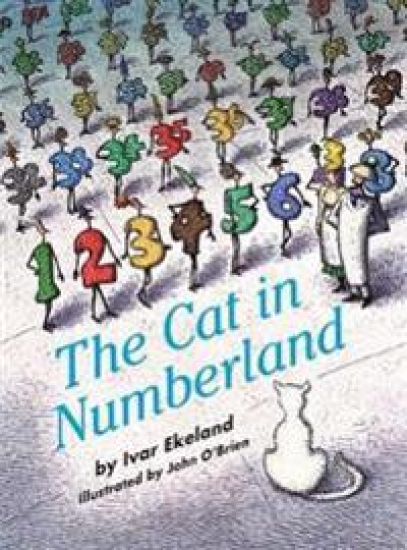
The Cat in Numberland

The Cat in Numberland

Ivar Ekeland

Cricket Books, a division of Carus Publishing Co
2006
sidottu
At Mr. and Mrs. Hilbert’s Hotel Infinity, the resident cat is puzzled. The hotel is fully booked ? the rooms are full of Numbers, both Odds and Evens ? yet guests continue to arrive. When Zero shows up, there’s a massive room switching, and he stays, even though Mr. Hilbert insists he’s not really a Number. Then the Letters appear and everyone still has a room, even though no Numbers have left. No matter how many guests arrive or depart, the hotel accommodates them all, and is always full. But when the Fractions arrive, demanding rooms, real chaos threatens. Can an ingenious solution be found to house them all? Based on mathematician David Hilbert’s famous paradox of the Grand Hotel, The Cat in Numberland offers a refreshingly clear explanation of infinity for readers of all ages. John O’Brien’s imaginative line drawings further elucidate the complex concept, as well as simple functions like addition, subtraction, division, and multiplication.
Applied Nonstandard Analysis

Applied Nonstandard Analysis

Ivar Ekeland; Martin Davis

Dover Publications Inc.
2005
nidottu
Geared toward upper-level undergraduates and graduate students, this text assumes no knowledge of mathematical logic; it develops the key techniques of nonstandard analysis at the outset from a single, powerful construction. Then, beginning with a nonstandard construction of the real number system, it leads students thorough the basic topics of elementary real analysis, topological spaces, and Hilbert space. Important subjects include nonstandard treatments of equicontinuity, nonmeasurable sets, and the existence of Haar measure. The focus on compact operators on a Hilbert space includes the Bernstein-Robinson theorem on invariant subspaces, which was first proved with nonstandard methods. 1977 ed.
Exterior differential calculus and applications to economic theory
During the academic year 1995/96, I was invited by the Scuola Normale Superiore to give a series of lectures. The purpose of these notes is to make the underlying economic problems and the mathematical theory of exterior differential systems accessible to a larger number of people. It is the purpose of these notes to go over these results at a more leisurely pace, keeping in mind that mathematicians are not familiar with economic theory and that very few people have read Elie Cartan.
Convex Analysis and Variational Problems

Convex Analysis and Variational Problems

Ivar Ekeland; Roger Temam

Society for Industrial Applied Mathematics,U.S.
1999
pokkari
No one working in duality should be without a copy of this book. It contains different developments of infinite dimensional convex programming in the context of convex analysis, including duality, minmax and Lagrangians, and convexification of nonconvex optimization problems in the calculus of variations (infinite dimension). It also includes the theory of convex duality applied to partial differential equations; no other reference presents this in a systematic way. The minmax theorems contained in this book have many useful applications, in particular the robust control of partial differential equations in finite time horizon. This SIAM Classics in Applied Mathematics edition contains the original text along with a new preface and some additional references.
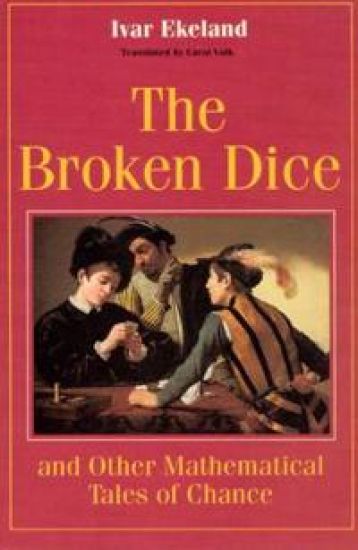
The Broken Dice, and Other Mathematical Tales of Chance

The Broken Dice, and Other Mathematical Tales of Chance

Ivar Ekeland

University of Chicago Press
1996
nidottu
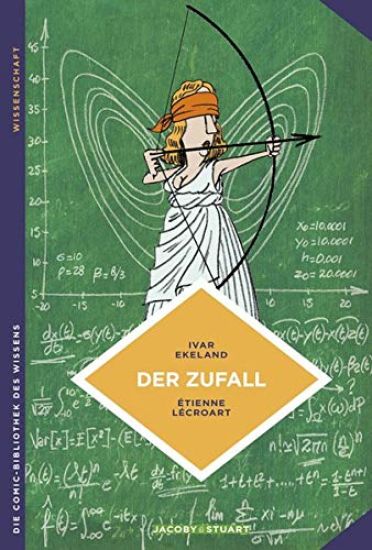
Ivar Ekeland extends his consideration of the catastrophe theory of the universe begun in his widely acclaimed Mathematics and the Unexpected, by drawing on rich literary sources, particularly the Norse saga of Saint Olaf, and such current topics as chaos theory, information theory, and particle physics." Ivar Ekeland gained a large and enthusiastic following with Mathematics and the Unexpected, a brilliant and charming exposition of fundamental new discoveries in the theory of dynamical systems. The Broken Dice continues the same theme, and in the same elegant, seemingly effortless style, but focuses more closely on the implications of those discoveries for the rest of human culture. What are chance and probability? How has our thinking about them been changed by the discovery of chaos? What are all of these concepts good for? . . . Ah, but, I mustn't give the game away, any more than I should if I were reviewing a detective novel. And this is just as gripping a tale. . . . Beg, borrow, or preferably buy a copy. . . . I guarantee you won't be disappointed."—Ian Stewart, Science
The Broken Dice, and Other Mathematical Tales of Chance

The Broken Dice, and Other Mathematical Tales of Chance

Ivar Ekeland

University of Chicago Press
1993
sidottu
The unpredictability of nature is both exhilarating and unnerving. Whether in science, the casino, or merely our everyday lives, chance is a mysterious force we do the utmost to control, usually with little success. Although scientists and philosophers have for centuries argued that the universe is governed by regular and necessary laws, nature quite frequently refuses to play by the rules. Why is it that even the most ingenious attempts to eliminate the free play of chance have failed? Is life really nothing other than the roll of dice or the toss of a coin? In "The Broken Dice", Ivar Ekeland contemplates these and many other questions concerning the randomness of nature. Here he extends his consideration of the catastrophe theory of the universe begun in his "Mathematics and the Unexpected", drawing upon rich literary sources (particularly myth) and current topics in mathematics and physics, such as chaos theory, information theory, and particle physics. One central theme, the relationship between chance and fate, is explored through a 13thtury Norse saga in which Saint Olav becomes ruler of a village by the roll of a die. In this mythic episode, chance and divine providence compete as alternative and contradictory explanations of the same decisive event. Yet Ekeland argues that the contradiction is only apparent; both explanations are attempts to impose meaning on the inescapable, uncontrollable flow of events. Chance, he concludes, is a fundamental given of the universe, one that myth as much as science has struggled for millennia to understand.
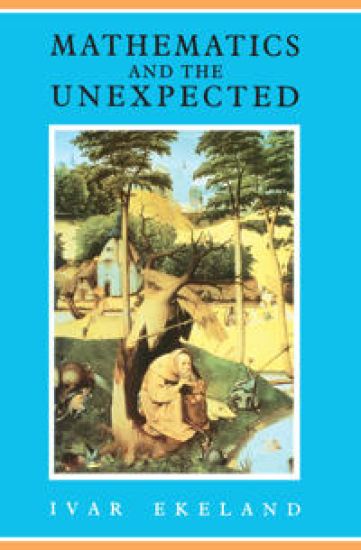
Mathematics and the Unexpected

Mathematics and the Unexpected

Ivar Ekeland

University of Chicago Press
1990
nidottu
"Not the least unexpected thing about Mathematics and the Unexpected is that a real mathematician should write not just a literate work, but a literary one."—Ian Stewart, New Scientist"In this brief, elegant treatise, assessable to anyone who likes to think, Ivar Ekelund explains some philosophical implications of recent mathematics. He examines randomness, the geometry involved in making predictions, and why general trends are easy to project (it will snow in January) but particulars are practically impossible (it will snow from 2 p.m. to 5 p.m. on the 21st)."—Village Voice